
ATD Blog
Transforming to a Sustainable Learning Organization
Fri Feb 10 2017

Content
The end goal of most learning leaders is to be in a position where they can help set strategic direction, link learning and performance, and create a culture of continuous learning—consistently, over time. After all, it’s one thing to achieve performance goals in the short term. It’s quite another to ensure that the commitment and momentum for dynamic learning is deeply embedded into an organization’s DNA, beyond the fanfare of a single program or initiative. Achieving that level of continuity and consistency does not happen overnight.
The end goal of most learning leaders is to be in a position where they can help set strategic direction, link learning and performance, and create a culture of continuous learning—consistently, over time. After all, it’s one thing to achieve performance goals in the short term. It’s quite another to ensure that the commitment and momentum for dynamic learning is deeply embedded into an organization’s DNA, beyond the fanfare of a single program or initiative. Achieving that level of continuity and consistency does not happen overnight.
Content
Those that have succeeded say that it involves perpetual growth, where small, evolutionary stages, rather than revolutionary ones, form the basis for transformation and continuous improvement. Continuous improvement is essential to the learning organization because:
Those that have succeeded say that it involves perpetual growth, where small, evolutionary stages, rather than revolutionary ones, form the basis for transformation and continuous improvement. Continuous improvement is essential to the learning organization because:
Content
Learning strategies, products, and services become stale or obsolete in shorter periods of time.
Learning strategies, products, and services become stale or obsolete in shorter periods of time.
Content
Employees’ skills and knowledge are depreciating faster than ever.
Employees’ skills and knowledge are depreciating faster than ever.
Content
Learning leaders no longer “own” the learning experience; employees are increasingly responsible for their own development and can access information in multiple ways outside a traditional learning environment.
Learning leaders no longer “own” the learning experience; employees are increasingly responsible for their own development and can access information in multiple ways outside a traditional learning environment.
Content
Learning strategies can be disrupted or derailed more easily in the face of increased business disruption.
Learning strategies can be disrupted or derailed more easily in the face of increased business disruption.
Content
Improvement measures, or lack thereof, need to be collected, integrated, and used to inform decisions, make necessary adjustments, and facilitate action planning.
Improvement measures, or lack thereof, need to be collected, integrated, and used to inform decisions, make necessary adjustments, and facilitate action planning.
Content
Learning cannot retain its competitive edge as a driver of business strategy and performance without continuous improvement and innovation.
Learning cannot retain its competitive edge as a driver of business strategy and performance without continuous improvement and innovation.
Content
Subsequently, the people, products, services, and processes associated with a learning organization need to be regularly renewed and transformed to remain relevant amid shifting business conditions.
Subsequently, the people, products, services, and processes associated with a learning organization need to be regularly renewed and transformed to remain relevant amid shifting business conditions.
Transformation and the Sustainability Cycle
Content
CEOs know that strong learning and talent management practices are needed to grow an engaged, high-performing workforce and maintain a competitive edge. Yet despite investments in developing leaders worldwide, a high proportion of executives say they are dissatisfied with the quality and nature of their organization’s development offerings. Perceived gaps between the capabilities needed and delivered by today’s learning leaders have caused many executives to call for a radical transformation of their learning organizations.
CEOs know that strong learning and talent management practices are needed to grow an engaged, high-performing workforce and maintain a competitive edge. Yet despite investments in developing leaders worldwide, a high proportion of executives say they are dissatisfied with the quality and nature of their organization’s development offerings. Perceived gaps between the capabilities needed and delivered by today’s learning leaders have caused many executives to call for a radical transformation of their learning organizations.
Content
For learning leaders, this kind of transformation may involve:
For learning leaders, this kind of transformation may involve:
Content
re-engineering of the learning and development function
re-engineering of the learning and development function
Content
restructuring workplace training and talent development strategies
restructuring workplace training and talent development strategies
Content
changing old habits of conceiving, designing, delivering, and evaluating learning and development or performance improvement projects
changing old habits of conceiving, designing, delivering, and evaluating learning and development or performance improvement projects
Content
reconfiguring roles and responsibilities to be more business- or results-focused
reconfiguring roles and responsibilities to be more business- or results-focused
Content
actively engaging executives, managers, and employees as learning champions
actively engaging executives, managers, and employees as learning champions
Content
integrating technology for more blended and social learning solutions
integrating technology for more blended and social learning solutions
Content
functioning more as an enabler of learning than as a learning gatekeeper
functioning more as an enabler of learning than as a learning gatekeeper
Content
incorporating advanced measures of learning effectiveness, including the use of analytics.
incorporating advanced measures of learning effectiveness, including the use of analytics.
Content
It’s important to note that these kinds of changes represent a transformation process that goes beyond including more efficiencies or tracking more effectiveness measures. True transformation is about building and sustaining a more innovative, adaptive, and resilient learning organization and then expanding it to reach more people in more effective ways. Transformation has more to do with how the learning organization adds sustainable value outside the boundaries of its own function than with how it manages its own internal operations. Yet expanding too quickly, without an adequate foundation and supporting infrastructure, can cause the learning function to implode or flounder. Much like the stories of a building, the stronger the foundation is at the lower levels, the more stable the higher levels will be.
It’s important to note that these kinds of changes represent a transformation process that goes beyond including more efficiencies or tracking more effectiveness measures. True transformation is about building and sustaining a more innovative, adaptive, and resilient learning organization and then expanding it to reach more people in more effective ways. Transformation has more to do with how the learning organization adds sustainable value outside the boundaries of its own function than with how it manages its own internal operations. Yet expanding too quickly, without an adequate foundation and supporting infrastructure, can cause the learning function to implode or flounder. Much like the stories of a building, the stronger the foundation is at the lower levels, the more stable the higher levels will be.
Content
Building a foundation for high levels of stability, relevance, and sustain¬able value generally represents a procession of small, evolutionary stages. These evolutionary stages are often likened to maturity levels, where development processes are transformed from ad hoc, undisciplined states to disciplined processes or practices capable of predictable, sustainable results. These processes build on the infrastructure established at earlier maturity levels and, subsequently, become the foundation for more sustainable, sophisticated processes at the next level.
Building a foundation for high levels of stability, relevance, and sustain¬able value generally represents a procession of small, evolutionary stages. These evolutionary stages are often likened to maturity levels, where development processes are transformed from ad hoc, undisciplined states to disciplined processes or practices capable of predictable, sustainable results. These processes build on the infrastructure established at earlier maturity levels and, subsequently, become the foundation for more sustainable, sophisticated processes at the next level.
Content
As a learning organization moves between stages, its business alignment, business impact, learning and performance capabilities, and overall efficiencies improve. Evolving learning practices and processes to achieve more sustainable, relevant impact requires progressive changes from the learning function as well as from the business. The focus for learning leaders in each evolutionary change period is to find a new set of organizational processes that will become the basis for managing the next period of growth.
As a learning organization moves between stages, its business alignment, business impact, learning and performance capabilities, and overall efficiencies improve. Evolving learning practices and processes to achieve more sustainable, relevant impact requires progressive changes from the learning function as well as from the business. The focus for learning leaders in each evolutionary change period is to find a new set of organizational processes that will become the basis for managing the next period of growth.
Sustainability Requires Cultural Change
Content
Establishing a fully integrated, sustainable learning organization is ultimately about cultural change: the act of moving from an old state of activity-based learning to a new state of results-based, sustainable learning that is unequivocally part of an organization’s DNA. In keeping with the idea of sustainability as a holistic change process, each stage in the cycle reflects specific elements of both organizational change and learning and development process maturity. The focus here is on the capability and maturity of the whole learning organization, rather than specific initiatives (good results are possible even with low levels of maturity).
Establishing a fully integrated, sustainable learning organization is ultimately about cultural change: the act of moving from an old state of activity-based learning to a new state of results-based, sustainable learning that is unequivocally part of an organization’s DNA. In keeping with the idea of sustainability as a holistic change process, each stage in the cycle reflects specific elements of both organizational change and learning and development process maturity. The focus here is on the capability and maturity of the whole learning organization, rather than specific initiatives (good results are possible even with low levels of maturity).
Content
For our purposes, then, sustainability is like a wide-angle lens through which you’re examining the long-term endurance and business value of the whole learning organization (or ecosystem)—its strategies, services, processes, practices, programs, personnel, and results—instead of the outcomes or strategic value achieved by a single project, program, or initiative.
For our purposes, then, sustainability is like a wide-angle lens through which you’re examining the long-term endurance and business value of the whole learning organization (or ecosystem)—its strategies, services, processes, practices, programs, personnel, and results—instead of the outcomes or strategic value achieved by a single project, program, or initiative.
Content
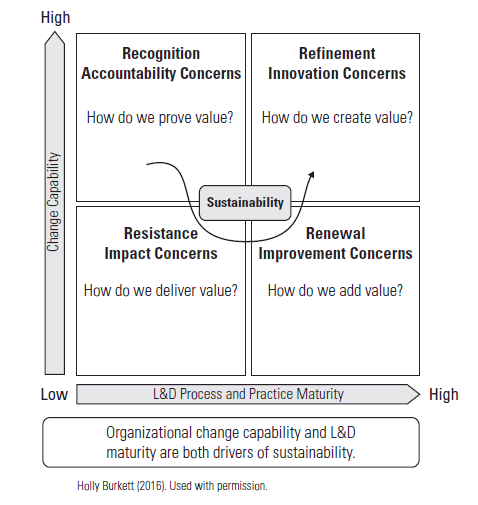
As shown in Figure 1, there are predictable stages of development in this change process. While the degree of complexity and duration of each stage will vary from organization to organization, the Sustainability Cycle has proven true across all types and sizes of learning organizations and across all industries.
As shown in Figure 1, there are predictable stages of development in this change process. While the degree of complexity and duration of each stage will vary from organization to organization, the Sustainability Cycle has proven true across all types and sizes of learning organizations and across all industries.
Content
Figure 1: The Sustainability Cycle for Learning Organizations
Figure 1: The Sustainability Cycle for Learning Organizations
Content
Content
Content
Content
Content
Content
Content
Content
Content
Content
Content
Content
Content
Content
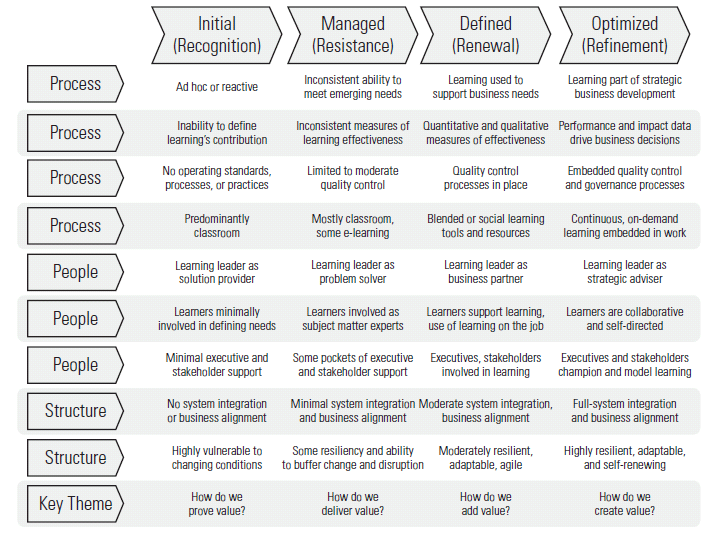
Based on research and interviews with hundreds of learning leaders, Figure 2 illustrates the defining features of each stage in terms of the learning organization’s process, people, and structures.
Based on research and interviews with hundreds of learning leaders, Figure 2 illustrates the defining features of each stage in terms of the learning organization’s process, people, and structures.
Content
Figure 2: Sustainability Stages and Their Features
Figure 2: Sustainability Stages and Their Features
Content
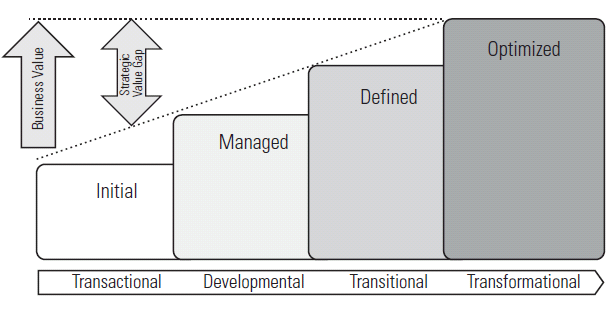
Finally, Figure 3 shows how each stage represents progressively mature levels of L&D capability and business value. In other words, the more capable the L&D organization is at optimizing services, processes, and programs to close strategic gaps, the more value is added, created, and multiplied.
Finally, Figure 3 shows how each stage represents progressively mature levels of L&D capability and business value. In other words, the more capable the L&D organization is at optimizing services, processes, and programs to close strategic gaps, the more value is added, created, and multiplied.
Content
Figure 3: Sustainability Maturity Cycle
Figure 3: Sustainability Maturity Cycle
Content
Editor’s Note: This article is excerpted from Learning for the Long Run: 7 Practices for Sustaining a Resilient Learning Organization (ATD Press, 2016).
Editor’s Note: This article is excerpted from Learning for the Long Run: 7 Practices for Sustaining a Resilient Learning Organization (ATD Press, 2016).