
ATD Blog
Visual Analogy: It's Like, Wow!
Wed Sep 18 2013

Content
Just ask anyone working in advertising: nothing is better for selling an idea than an analogy. Think sports cars and the ubiquitous attractive young woman draped over the hood. As instructors, we know intuitively that, beyond marketing hype, well-constructed graphical metaphors and analogies are great aids for novice learners grappling with new and unfamiliar concepts.
Just ask anyone working in advertising: nothing is better for selling an idea than an analogy. Think sports cars and the ubiquitous attractive young woman draped over the hood. As instructors, we know intuitively that, beyond marketing hype, well-constructed graphical metaphors and analogies are great aids for novice learners grappling with new and unfamiliar concepts.
Content
But while advertising relies on the surface analogy , deeper learning requires the structural analogy, which involves correspondence among multiple levels of two compared ideas. Hernan Casakin in Visual Analogy as a Cognitive Strategy in the Design Process: Expert Versus Novice Performance explains it this way: “Surface analogies relate to easily accessible or superficial concepts of object properties. \[but\] . . . under normal circumstances they could not guarantee the transfer of structural relations between source and target. Structural analogies, on the other hand, involve a system of higher order relations that are based on deep properties of a familiar situation."
But while advertising relies on the surface analogy, deeper learning requires the structural analogy, which involves correspondence among multiple levels of two compared ideas. Hernan Casakin in Visual Analogy as a Cognitive Strategy in the Design Process: Expert Versus Novice Performance explains it this way: “Surface analogies relate to easily accessible or superficial concepts of object properties. \[but\] . . . under normal circumstances they could not guarantee the transfer of structural relations between source and target. Structural analogies, on the other hand, involve a system of higher order relations that are based on deep properties of a familiar situation."
Content
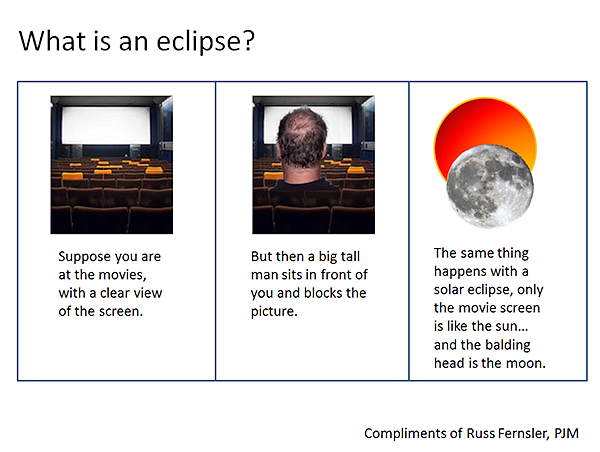
Here is an example of an analogy designed to explain the concept of eclipse to a novice learner who is unaware of celestial mechanics.
Here is an example of an analogy designed to explain the concept of eclipse to a novice learner who is unaware of celestial mechanics.
Content
The graphic quickly tells the story: A man sitting between you and the movie screen obscuring your view is like the moon moving between the earth and the sun blocking your view of the sun. Here, the analogy lets the learners interpret the mechanics of something happening 238,900 miles in space by aligning it with something closer at hand.
The graphic quickly tells the story: A man sitting between you and the movie screen obscuring your view is like the moon moving between the earth and the sun blocking your view of the sun. Here, the analogy lets the learners interpret the mechanics of something happening 238,900 miles in space by aligning it with something closer at hand.
Content
The power of a visual analogy or metaphor relies on its ability to help us structurally bridge our established knowledge—held in long-term memory—with the new concept in the limited capacity of working memory. Meshing it synthesizes the new information with the old, thus helping the learner create and cues for retrieval.
The power of a visual analogy or metaphor relies on its ability to help us structurally bridge our established knowledge—held in long-term memory—with the new concept in the limited capacity of working memory. Meshing it synthesizes the new information with the old, thus helping the learner create and cues for retrieval.
Content
Techniques for generating ideas
Techniques for generating ideas
Content
So, how do we get the creative juices flowing to generate ideas for visual analogies? Every time we explain a concept beginning with the words “it's like” or “it's similar to,” we are moving into territory ripe for recognizing a metaphor or analogy.
So, how do we get the creative juices flowing to generate ideas for visual analogies? Every time we explain a concept beginning with the words “it's like” or “it's similar to,” we are moving into territory ripe for recognizing a metaphor or analogy.
Content
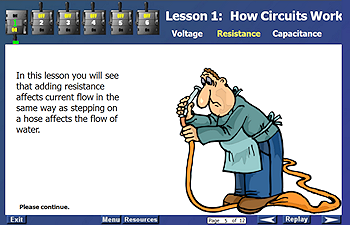
For example, in our book Graphics for Learning , Dr. Ruth Clark and I cite using a graphic to represent the idea “electrical resistance is similar to stepping on a hose to affect the flow of water.” When your subject matter experts explain content, listen for the “is like” and “similar to” cues.
For example, in our book Graphics for Learning, Dr. Ruth Clark and I cite using a graphic to represent the idea “electrical resistance is similar to stepping on a hose to affect the flow of water.” When your subject matter experts explain content, listen for the “is like” and “similar to” cues.
Content
Try this technique: Next time you are designing training for novices on concepts, processes, or procedures, imagine yourself explaining them to a child. Then think about how you would illustrate your words using concepts already familiar to your audience.
Try this technique: Next time you are designing training for novices on concepts, processes, or procedures, imagine yourself explaining them to a child. Then think about how you would illustrate your words using concepts already familiar to your audience.
Content
Another method is to look up the word in a dictionary. Within the dictionary explanation will be cues on visual components that can help illustrate your point.
Another method is to look up the word in a dictionary. Within the dictionary explanation will be cues on visual components that can help illustrate your point.
Content
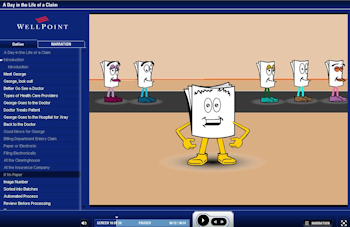
Still no ideas? Try an internet search on a specific topic (in the search engine of your choice) to see what comes up to spark some fresh ideas. For example, try the phrase claims processing . Links to oodles of pictures, explanations, and diagrams will be listed—all elixirs that will get you started. For example, Joe Fisher and Manuel Andrade at WellPoint saw moving the claims through the processing cycle as similar to a “people” mover…and used a cartoon type illustration to help learners visualize the flow from one “station” to another.
Still no ideas? Try an internet search on a specific topic (in the search engine of your choice) to see what comes up to spark some fresh ideas. For example, try the phrase claims processing. Links to oodles of pictures, explanations, and diagrams will be listed—all elixirs that will get you started. For example, Joe Fisher and Manuel Andrade at WellPoint saw moving the claims through the processing cycle as similar to a “people” mover…and used a cartoon type illustration to help learners visualize the flow from one “station” to another.
Content
Caution: metaphor ahead
Caution: metaphor ahead
Content
Beware of the risks inherent in using any analogy—verbal or visual. To avoid faulty logic, an analogy needs to follow certain guidelines.
Beware of the risks inherent in using any analogy—verbal or visual. To avoid faulty logic, an analogy needs to follow certain guidelines.
Content
Be a true analogy, not a false one leading to additional and suspect conclusions that aren’t true to the comparison. S.I. Hayakawa in his seminal work Language in Thought in Action reminds us of the danger of using analogies to intentionally mislead.
Be a true analogy, not a false one leading to additional and suspect conclusions that aren’t true to the comparison. S.I. Hayakawa in his seminal work Language in Thought in Action reminds us of the danger of using analogies to intentionally mislead.
Content
Be stripped of unintended connotations. For instance, a suggested title for this blog was “Visual Analogies: It’s Like Braille for the Blind.” This was obviously offensive, and not right for setting tone.
Be stripped of unintended connotations. For instance, a suggested title for this blog was “Visual Analogies: It’s Like Braille for the Blind.” This was obviously offensive, and not right for setting tone.
Content
Be simple, simple, simple. The more elements in the visual analogy, the more opportunities for confusion or for erroneous associations.
Be simple, simple, simple. The more elements in the visual analogy, the more opportunities for confusion or for erroneous associations.
Content
Be inclusive of all the salient points for the comparison.
Be inclusive of all the salient points for the comparison.
Content
Be reliant on a commonly shared background, whether geographic cultural or social. To illustrate this, consider my verbal analogy of my smart phone being my sonic screwdriver. It didn't work too well on a colleague who never watched Doctor Who.
Be reliant on a commonly shared background, whether geographic cultural or social. To illustrate this, consider my verbal analogy of my smart phone being my sonic screwdriver. It didn't work too well on a colleague who never watched Doctor Who.
Content
Coming up with effective visual analogies that promote learning takes more effort than simply reaching into a grab bag of stock art, but doing so allows designers to flex their instructional moxy, tap into creativity, and prove their worth to the organization.
Coming up with effective visual analogies that promote learning takes more effort than simply reaching into a grab bag of stock art, but doing so allows designers to flex their instructional moxy, tap into creativity, and prove their worth to the organization.