
ATD Blog
3 Ways to Engage and Retain High-Performing Employees
Tue Nov 29 2022

Brought to you by

High-performing employees represent the genuinely exceptional members of your organization. What qualifies someone as a high performer ranges from company to company, but most definitions recognize these employees’ high level of effort and disproportionate impact. They are often pinpointed as the most valuable and hard-to-replace members of a company. One study found that the top 1 percent of workers accounts for a whopping 10 percent of an organization’s output, and the top 5 percent accounts for 25 percent.
There’s no question that engaging and retaining high-performing employees is crucial—which is exactly why Culture Amp’s people science team chose this focus for our new research series exploring the relationship between employee engagement and performance.
Our Methodology
In our research, we standardized the rating scales of 741 companies and more than 200,000 employees. Employees who were defined and rated by their managers and peers as being in that organization’s top performance bucket make up the high performers group. We systematically removed any organizations that appeared to have leniency bias (with more than 20 percent of their company in their top performance bucket) to ensure we are looking at the highest performers.
Depending on the organization, high-performing employees make up between 0 and 20 percent, with the median being 8 percent.
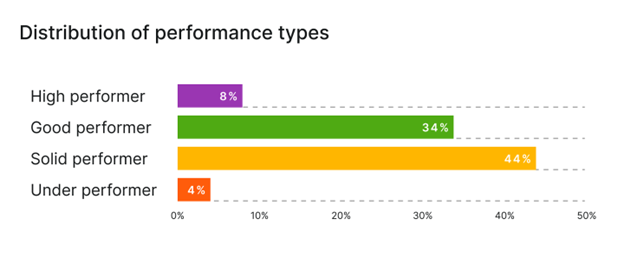
By analyzing the engagement scores of these employees, we were able to identify the top three actions that can help engage and retain high-performing employees.
How To Engage and Retain High-Performing Employees
First, let’s start with a refresher on engagement. Culture Amp defines engagement as the level of enthusiasm, connection, and commitment an employee has toward their organization.
We assess engagement by asking employees how strongly they agree with five statements that fall into three subcategories:
Motivation: “\[Company\] motivates me to go beyond what I would in a similar role elsewhere.”
Advocacy: “I am proud to work for \[Company\],” and “I would recommend \[Company\] as a great place to work.”
Commitment: “I rarely think about looking for a job at another company,” and “I see myself still working at \[Company\] in two years.”
To identify what drives each of these statements, we look at the correlation between other survey questions and these engagement subcategories. The correlation ranges from -1 to +1, and in survey research, a correlation score above 0.5 is generally considered “strongly correlated.”
According to our research, the factors that drive motivation, advocacy, and commitment for high-performing employees are distinct from other performance buckets. We found that high-performing employees are:
1. Uniquely motivated by constructive feedback
2. Most likely to advocate for their company if they agree with and approve of performance management practices
3. More likely to commit to the company long term if they have resources for dealing with stress
Let’s delve into these three areas in more detail with applicable science-backed tips.
1. High Performers Are Uniquely Motivated by Constructive Feedback
While most employees find belonging and career development motivating, constructive feedback was uniquely motivating for high performers.
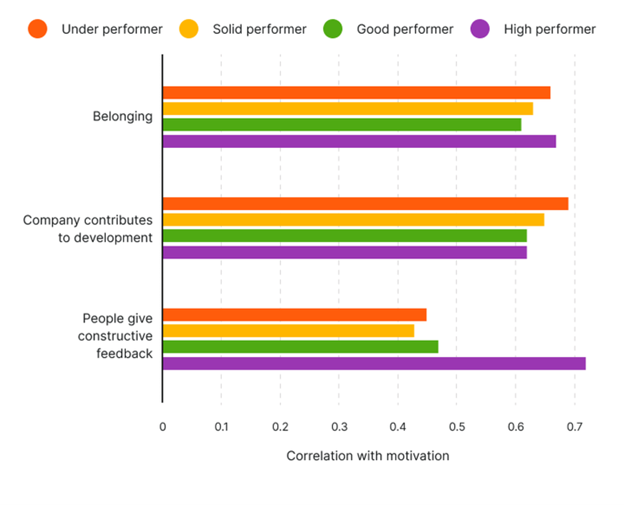
This suggests that high-performing employees actively desire feedback that will enable them to continue improving. They are open and excited to hear how they can improve and to learn exactly where they should focus to progress in the future. This trait has likely helped them reach, cultivate, and maintain a high standard of performance.
To engage and retain these high performers, you’ll want to focus on creating a culture of feedback. However, be careful and intentional; if this culture of feedback is only superficial, you’ll end up creating an environment where praise dominates feedback. This is exceptionally frustrating for high-performing employees who genuinely seek opportunities to grow and improve.
Here are some ways to create a genuine culture of feedback:
Educate and train employees on giving and receiving constructive feedback. Help them learn how to give constructive and motivating feedback and how to receive constructive feedback with a growth mindset. It may be uncomfortable at first, but with practice, constructive feedback will become an intrinsic aspect of the employee experience.
Ensure that a culture of feedback is only for developmental purposes. If constructive feedback becomes a factor in employees’ performance ratings, they will resist giving and receiving this type of feedback.
2. High-Performing Employees Advocate for Companies With Quality Performance Management Processes
Another important aspect of employee engagement is their willingness to advocate for their company.
Our people scientists found that while all employees consider leadership an important factor in their feelings toward their company and whether they would recommend it to friends, the most important element for high performers is the performance management process itself. Specifically, they care that the process focuses on improvement, standards are consistently applied, and bias is minimized.
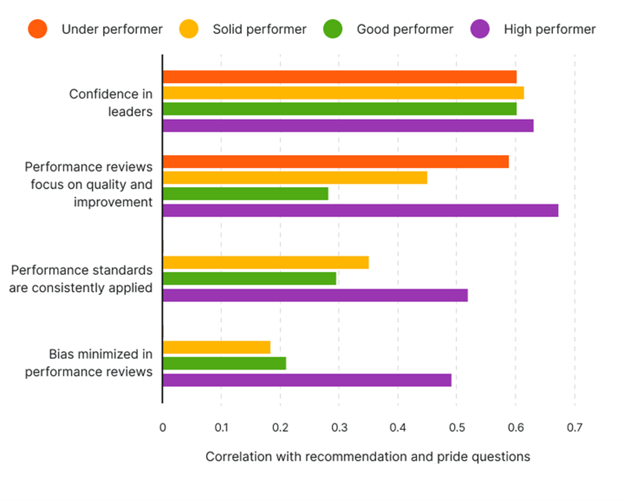
While performance management has a negative reputation, our data suggests that when done right, it can be an effective driver in engaging and retaining high-performing employees who have an outsized impact on their organizations. Many high performers want to be accurately recognized for their efforts and strong results, and the performance management process is the mechanism for receiving that recognition. Accordingly, high performers will only encourage their friends to join their company if they believe their friends will be fairly and appropriately assessed and recognized.
Scrutinize your performance management process with these questions:
Are performance expectations and goals clear?
Are employees given a voice in the performance review process?
Are managers trained on the most common biases and how to combat them?
Does your performance rating scale adequately differentiate levels of performance? (Or are a large group of employees falling into your highest performing bucket, which suggests leniency bias?)
Are ratings calibrated across managers and leaders to ensure the same standards are being consistently applied across teams?
Do you audit outcomes (for example, ratings, raises, and promotions) to learn if employees are being treated equitably?
Taken together, these first two findings demonstrate that high performers demand a high-performance culture focused on continuous constructive feedback and improvement and measurement processes that fairly and consistently differentiate performance.
3. High Performers Need Additional Support to Commit for the Long Haul
While role fit and career opportunities are important for most employees, high-performing employees need sufficient support and resources for coping with stress to truly commit to their organizations.
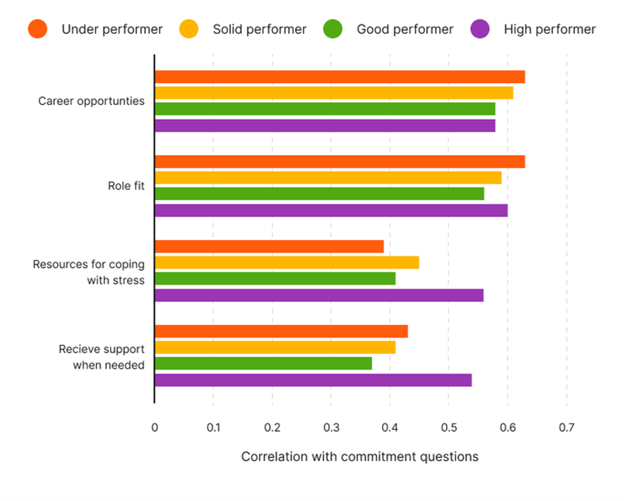
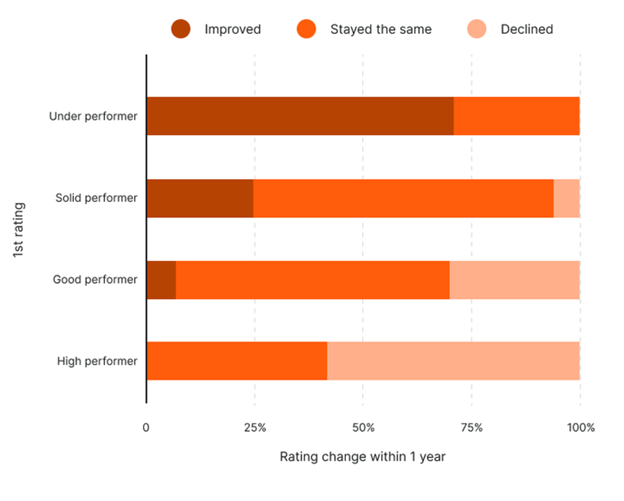
This makes sense. Maintaining a standard of exceptionally high performance is often draining. A lack of support and resources can translate to lower performance ratings in future cycles—a reality reflected in the next graph. High-performing employees are most likely to have their performance ratings decline within one year, whereas solid and good performers are most likely to maintain the same scores.
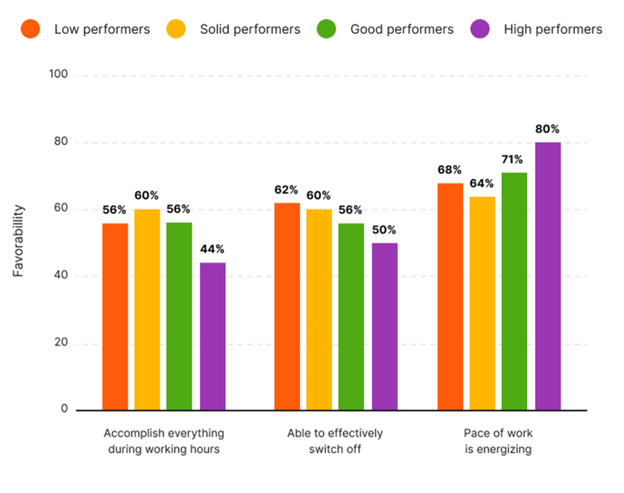
This could also be because high-performing employees have unsustainable habits. While they score the lowest on work-life balance questions (for example, being able to accomplish all they need to during normal working hours), they are most likely to say they are energized by the pace of work. While this may be true for high performers in the short term, without additional support, they will almost inevitably burn themselves out.
If you want high-performing employees to continue performing at peak levels and don’t want them to overwork to the point of leaving your company, you need to provide the right support and resources to help them manage stress and workload.
For example, make sure that managers regularly check in on the well-being of their employees during one-on-one meetings, asking questions such as “How are your work relationships going?” and “Are there any burdens or blocks that I can help you with?” While asking about well-being is important for all employees, it’s especially important for high-performing employees to continue performing to the same standards.
Focus on What Matters Most to Your High Performers
According to our data, what most high-performing employees value is a high-performance culture that focuses on providing constructive feedback and upholding rigorous standards of performance. We also found that remaining a high-performing employee is difficult, which means that they require additional support from the company to commit for years to come.
Editor's Note: The post was originally published on the Culture Amp website.
View Courses Recommended for You