
ATD Blog
4 Questions to Ask Before Providing Training
Wed Aug 09 2017
Content
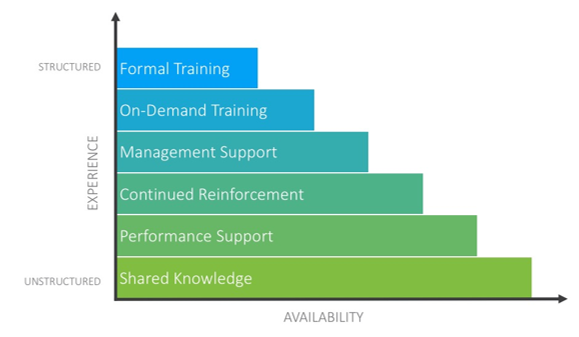
The bottom-up structure requires that L&D work through only the necessary layers to address an identified learning and performance challenge. This equips L&D with a much larger, more dynamic toolkit to support a modern workplace at the speed and scale it requires.
The bottom-up structure requires that L&D work through only the necessary layers to address an identified learning and performance challenge. This equips L&D with a much larger, more dynamic toolkit to support a modern workplace at the speed and scale it requires.
Content
Here are four questions L&D pros should ask when applying the Modern Learning Ecosystem Framework before reaching the structured training layers.
Here are four questions L&D pros should ask when applying the Modern Learning Ecosystem Framework before reaching the structured training layers.
What Shared Knowledge Is Already Available?
Content
People are able to solve incredibly difficult problems on their own due to the ubiquity of information. Unfortunately, this superpower wears off at work, where Google and YouTube are much less applicable when trying to address proprietary issues. By fostering curation activities to make relevant knowledge easily accessible, L&D can dramatically cut down on training requests and empower employees to solve their own problems—just like they do at home. Simply stated, don’t build a course when a job aid will do the trick.
People are able to solve incredibly difficult problems on their own due to the ubiquity of information. Unfortunately, this superpower wears off at work, where Google and YouTube are much less applicable when trying to address proprietary issues. By fostering curation activities to make relevant knowledge easily accessible, L&D can dramatically cut down on training requests and empower employees to solve their own problems—just like they do at home. Simply stated, don’t build a course when a job aid will do the trick.
Where Do Employees Go for Help?
Content
Making information available is a great place to start, but what happens when something is missing? What if the employee doesn’t understand how the information applies to their specific situation? Shared knowledge is only as good as the performance support that accompanies it. L&D must ensure a clear path to help when and where employees need it. Performance support can come in a variety of forms, from online systems to simple subject matter expert lists. Regardless of tactics, employees must be assured that they can access fast, reliable help, especially when they are new in their roles.
Making information available is a great place to start, but what happens when something is missing? What if the employee doesn’t understand how the information applies to their specific situation? Shared knowledge is only as good as the performance support that accompanies it. L&D must ensure a clear path to help when and where employees need it. Performance support can come in a variety of forms, from online systems to simple subject matter expert lists. Regardless of tactics, employees must be assured that they can access fast, reliable help, especially when they are new in their roles.
How Are Key Knowledge and Behaviors Being Reinforced?
Content
Shared knowledge and performance support are great for topics that can be accessed in the moment of need. But what about topics that must be retained for immediate application on the job? Continued reinforcement is critical for one simple reason: People forget. If employees will be expected to remember new knowledge long term—and especially if they will not be applying this knowledge immediately—a reinforcement strategy is a must-have. The more often people are exposed to new knowledge, the better they retain it and the more likely they are to apply it when the moment of need arises.
Shared knowledge and performance support are great for topics that can be accessed in the moment of need. But what about topics that must be retained for immediate application on the job? Continued reinforcement is critical for one simple reason: People forget. If employees will be expected to remember new knowledge long term—and especially if they will not be applying this knowledge immediately—a reinforcement strategy is a must-have. The more often people are exposed to new knowledge, the better they retain it and the more likely they are to apply it when the moment of need arises.
How Are Managers Being Enabled to Coach?
Content
The most important person in talent development is the frontline manager. This is even more true in large enterprises, where L&D does not have constant line of sight into the day-to-day operation. Managers not only control priorities and resources, but also are directly accountable for employee performance. Therefore, L&D must focus on helping managers become more effective coaches, especially for topics that are not sufficiently addressed by the layers in the ecosystem framework. By surfacing data and best practices in key performance areas, L&D can extend its reach into the operation and shift accountability for continued development to the front line.
The most important person in talent development is the frontline manager. This is even more true in large enterprises, where L&D does not have constant line of sight into the day-to-day operation. Managers not only control priorities and resources, but also are directly accountable for employee performance. Therefore, L&D must focus on helping managers become more effective coaches, especially for topics that are not sufficiently addressed by the layers in the ecosystem framework. By surfacing data and best practices in key performance areas, L&D can extend its reach into the operation and shift accountability for continued development to the front line.
Content
L&D should only consider developing structured training after addressing each of these questions. This will ensure training, which is often difficult and time-consuming to produce and maintain, is only used as a last resort rather than a silver bullet solution. This also aligns talent development with everyday learning. After all, how often do you take a formal class when you run into a problem at home?
L&D should only consider developing structured training after addressing each of these questions. This will ensure training, which is often difficult and time-consuming to produce and maintain, is only used as a last resort rather than a silver bullet solution. This also aligns talent development with everyday learning. After all, how often do you take a formal class when you run into a problem at home?
Content
Take a deeper dive into the Modern Learning Ecosystem Framework during the Building a Smarter Learning Ecosystem session at the ATD Core 4 Conference on September 28-29, 2017, in Austin, Texas.
Take a deeper dive into the Modern Learning Ecosystem Framework during the Building a Smarter Learning Ecosystem session at the ATD Core 4 Conference on September 28-29, 2017, in Austin, Texas.
Content
[
[


Content
People learn without training. What?! It’s true! Whether at work or at home, we build our knowledge and skills every day to become more effective contributors to our communities. However, traditional workplace L&D tactics remain focused on the small percentage of learning that takes place through structured training experiences. As work becomes more complex and organizations demand increased agility, L&D must adopt a new framework for addressing knowledge and performance challenges.
People learn without training. What?! It’s true! Whether at work or at home, we build our knowledge and skills every day to become more effective contributors to our communities. However, traditional workplace L&D tactics remain focused on the small percentage of learning that takes place through structured training experiences. As work becomes more complex and organizations demand increased agility, L&D must adopt a new framework for addressing knowledge and performance challenges.
Content
The Modern Learning Ecosystem Framework (see Figure 1 below) merges everyday learning behavior with the needs of today’s business. It provides guidance for L&D pros who are working to address learning needs in an increasingly challenging workplace. This]( http://core4.td.org/ ) layered approach to learning helps employees find support based on their specific performance needs—whether it’s long-term development or moment-of-need problem solving.
The Modern Learning Ecosystem Framework (see Figure 1 below) merges everyday learning behavior with the needs of today’s business. It provides guidance for L&D pros who are working to address learning needs in an increasingly challenging workplace. This](http://core4.td.org/) layered approach to learning helps employees find support based on their specific performance needs—whether it’s long-term development or moment-of-need problem solving.
Content
Figure 1: Modern Learning Ecosystem Framework
Figure 1: Modern Learning Ecosystem Framework