
ATD Blog
66% of Organizations Aren’t Using Mobile Learning . . . Yet
Wed Feb 17 2016

Content
Talent development professionals across the globe agree: There is a link between organizational learning and performance. However, the rate at which mobile learning is incorporated into their learning differs greatly.
Talent development professionals across the globe agree: There is a link between organizational learning and performance. However, the rate at which mobile learning is incorporated into their learning differs greatly.
Content
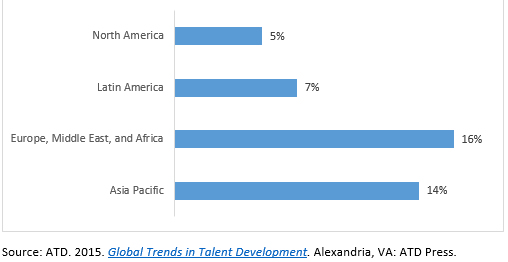
Globally, mobile learning is not a widely used delivery method, and the study found that countries in the eastern hemisphere are more likely to use mobile learning platforms. Looking at Figure 1, it’s pretty clear that mobile learning has a lot of room for development and expansion.
Globally, mobile learning is not a widely used delivery method, and the study found that countries in the eastern hemisphere are more likely to use mobile learning platforms. Looking at Figure 1, it’s pretty clear that mobile learning has a lot of room for development and expansion.
Content
Figure 1. Use of Mobile Learning to a High or Very High Extent
Figure 1. Use of Mobile Learning to a High or Very High Extent
Content
In fact, 66 percent of organizations do not have formal mobile learning platforms in place, according to The Mobile Learning Landscape 2015: Building Toward Anytime, Anywhere Learning, a May 2015 report from ATD Research and the Institute for Corporate Productivity (i4cp).
In fact, 66 percent of organizations do not have formal mobile learning platforms in place, according to The Mobile Learning Landscape 2015: Building Toward Anytime, Anywhere Learning, a May 2015 report from ATD Research and the Institute for Corporate Productivity (i4cp).
Content
If your company is like the majority of those participating in the research, check out these questions to consider about mobile learning.
If your company is like the majority of those participating in the research, check out these questions to consider about mobile learning.
What Is Mobile Learning?
Content
Training programs and learning platforms designed specifically for mobile devices are considered to be mobile learning. The most commonly used devices are smartphones and tablets. One unexpected platform? Automobiles. Check out the blog post, “Truly Mobile Learning,” by Darin Hartley to learn more about this trend.
Training programs and learning platforms designed specifically for mobile devices are considered to be mobile learning. The most commonly used devices are smartphones and tablets. One unexpected platform? Automobiles. Check out the blog post, “Truly Mobile Learning,” by Darin Hartley to learn more about this trend.
What Are the Benefits of Mobile Learning?
Content
Today’s employees need more information to complete their jobs than ever before. Mobile learning allows for quick access to information at any time on an as-needed basis. With its informal feel, Millennials may prefer this learning technology over virtual classrooms. Employers hoping to attract and retain this generation may consider developing mobile learning platforms.
Today’s employees need more information to complete their jobs than ever before. Mobile learning allows for quick access to information at any time on an as-needed basis. With its informal feel, Millennials may prefer this learning technology over virtual classrooms. Employers hoping to attract and retain this generation may consider developing mobile learning platforms.
Content
Additional benefits of mobile learning:
Additional benefits of mobile learning:
Content
easy to access
easy to access
Content
supports individual learning needs
supports individual learning needs
Content
24/7 availability
24/7 availability
Content
enables contextual learning
enables contextual learning
Content
allows for rapid learning.
allows for rapid learning.
What Are the Challenges of Mobile Programs?
Content
During their research, ATD and ic4p received feedback from organizations currently implementing mobile learning programs and organizations without mobile learning platforms. What did they say?
During their research, ATD and ic4p received feedback from organizations currently implementing mobile learning programs and organizations without mobile learning platforms. What did they say?
Content
“Individuals (are) reluctant to embrace mobile learning because they believe themselves too busy,” said a vice president in a construction industry.
“Individuals (are) reluctant to embrace mobile learning because they believe themselves too busy,” said a vice president in a construction industry.
Content
There is “no clear strategy. Everyone agrees we should do it, but no one is leading the charge,” stated a leading manager in a U.S based nonprofit.
There is “no clear strategy. Everyone agrees we should do it, but no one is leading the charge,” stated a leading manager in a U.S based nonprofit.
Content
“It’s hard to transition to the development of learning for the mobile form,” declared Steve Sniderman, an instructional designer.
“It’s hard to transition to the development of learning for the mobile form,” declared Steve Sniderman, an instructional designer.
Content
Mobile learning is still a relatively new frontier. This uncharted territory is bound to make those accustomed to traditional delivery methods uncertain; nonetheless, those willing to tackle the challenge will place themselves at the forefront of the talent development industry. For additional mobile learning challenges with potential solutions, check out the TD magazine article by Robert G. Rymell, “Self-Directed Mobile Learning.”
Mobile learning is still a relatively new frontier. This uncharted territory is bound to make those accustomed to traditional delivery methods uncertain; nonetheless, those willing to tackle the challenge will place themselves at the forefront of the talent development industry. For additional mobile learning challenges with potential solutions, check out the TD magazine article by Robert G. Rymell, “Self-Directed Mobile Learning.”
What Should Your Organization Consider Before Implementing Mobile Learning?
Content
Of the organizations with mobile learning programs, ATD Research found that only 31 percent considered their solutions to be “very effective” or “highly effective.” Before you adopt this emerging technology, there are several questions to consider:
Of the organizations with mobile learning programs, ATD Research found that only 31 percent considered their solutions to be “very effective” or “highly effective.” Before you adopt this emerging technology, there are several questions to consider:
Content
Will mobile learning enhance your learner’s experience?
Will mobile learning enhance your learner’s experience?
Content
Do you have an established goal for your mobile learning?
Do you have an established goal for your mobile learning?
Content
Is mobile learning the right choice for your learners and your industry?
Is mobile learning the right choice for your learners and your industry?
Content
Do you have the resources to spend on development and implementation?
Do you have the resources to spend on development and implementation?
Content
How will you ensure mobile learning effectiveness?
How will you ensure mobile learning effectiveness?
Content
These questions do not offer an exhaustive examination. Instead, they are meant to provide a starting point when thinking about mobile platforms. While mobile learning is a promising technology, you want to be strategic in how your organization moves into this new learning dimension.
These questions do not offer an exhaustive examination. Instead, they are meant to provide a starting point when thinking about mobile platforms. While mobile learning is a promising technology, you want to be strategic in how your organization moves into this new learning dimension.
Where Can You Learn More About Mobile Learning Trends?
Content
When used effectively, mobile learning can address crucial business issues, meet specific skill demands, and promote organizational learning goals. Success will come to those who build their mobile learning platforms and programs thoughtfully. For further discussion on mobile learning, The Mobile Learning Landscape 2015: Building Toward Anytime, Anywhere Learning , offers analyses based on survey responses from more than 400 organizations. Complete with case studies, charts and graphs, and key findings, the study is a go-to resource for the learning function in any industry.
When used effectively, mobile learning can address crucial business issues, meet specific skill demands, and promote organizational learning goals. Success will come to those who build their mobile learning platforms and programs thoughtfully. For further discussion on mobile learning, The Mobile Learning Landscape 2015: Building Toward Anytime, Anywhere Learning, offers analyses based on survey responses from more than 400 organizations. Complete with case studies, charts and graphs, and key findings, the study is a go-to resource for the learning function in any industry.