
ATD Blog
A Practical Guide to AI-Powered Skills-Based Talent Management
Content
This four-step blueprint below outlines a repeatable process to address your organization’s skill challenges.
This four-step blueprint below outlines a repeatable process to address your organization’s skill challenges.
Wed Aug 13 2025
Content
Ask any talent development manager their biggest pain points, and you’ll hear variations of the same story:
Ask any talent development manager their biggest pain points, and you’ll hear variations of the same story:
Content
“Our course catalog keeps growing, but capability gaps are not closing.”
“Our course catalog keeps growing, but capability gaps are not closing.”
Content
“Managers still screen résumés for keywords instead of proven skills.”
“Managers still screen résumés for keywords instead of proven skills.”
Content
“AI is taking off, yet we have no data showing who is ready and who needs help.”
“AI is taking off, yet we have no data showing who is ready and who needs help.”
Content
The root cause is simple: most organizations still manage talent by jobs, even though the real currency of work is skills. To stay competitive, we must shift from job-based to skills-based talent management.
The root cause is simple: most organizations still manage talent by jobs, even though the real currency of work is skills. To stay competitive, we must shift from job-based to skills-based talent management.
Why Now?
Content
Skills are evolving faster than titles. The World Economic Forum estimates that 44 percent of today’s role requirements will change within five years, and BCG states that by 2025, one-half of the global workforce will need to reskill. Moreover, skill shortages could cost the global economy up to $8.5 trillion by 2030, making skills-centric models essential for competitiveness and retention. Add the rapid advance of generative AI on top of those numbers, and the urgency is clear.
Skills are evolving faster than titles. The World Economic Forum estimates that 44 percent of today’s role requirements will change within five years, and BCG states that by 2025, one-half of the global workforce will need to reskill. Moreover, skill shortages could cost the global economy up to $8.5 trillion by 2030, making skills-centric models essential for competitiveness and retention. Add the rapid advance of generative AI on top of those numbers, and the urgency is clear.
Content
The good news is that moving to a skills-based model does not require a seven-figure budget or a large team of data scientists. Using data and tools you already own, a lean L&D team can spot, grow, and mobilize skills at the speed business demands.
The good news is that moving to a skills-based model does not require a seven-figure budget or a large team of data scientists. Using data and tools you already own, a lean L&D team can spot, grow, and mobilize skills at the speed business demands.
A Four-Step Blueprint
Content
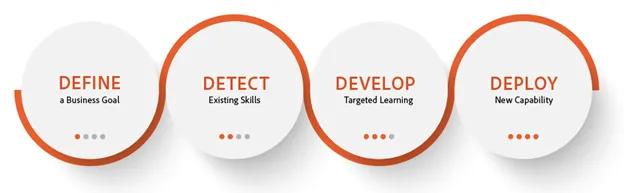
The blueprint below outlines a repeatable process to address your organization’s skill challenges. Completing it once solves one issue, but repeating it is key to adopting a strong skill-based talent management model. The process involves four steps:
The blueprint below outlines a repeatable process to address your organization’s skill challenges. Completing it once solves one issue, but repeating it is key to adopting a strong skill-based talent management model. The process involves four steps:
Content
DEFINE a Business Goal
DEFINE a Business Goal
Content
Start by identifying a business goal that aligns with executive priorities, such as “digital-first claims,” “next-generation tele-health,” or “AI consulting services.” Determine five or six critical skills essential to achieving this objective and document them clearly. This approach ensures that talent development is directly connected to tangible business outcomes.
Start by identifying a business goal that aligns with executive priorities, such as “digital-first claims,” “next-generation tele-health,” or “AI consulting services.” Determine five or six critical skills essential to achieving this objective and document them clearly. This approach ensures that talent development is directly connected to tangible business outcomes.
Content
DETECT Existing Skills
DETECT Existing Skills
Content
Use the existing organizational systems, such as LMS records, documentation, code repositories, and internal communications. Secure generative-AI platforms such as Microsoft Copilot, Google Vertex AI, or a private instance of ChatGPT that can scan the data, tag skills, and assign confidence levels. Think of it as high-speed pattern matching, providing a data-driven skills heat map for informed decision making. This will still require a bit of manual work since you will need to ask SMEs and colleagues to review and validate the results, but it will take much less time than doing all of it manually.
Use the existing organizational systems, such as LMS records, documentation, code repositories, and internal communications. Secure generative-AI platforms such as Microsoft Copilot, Google Vertex AI, or a private instance of ChatGPT that can scan the data, tag skills, and assign confidence levels. Think of it as high-speed pattern matching, providing a data-driven skills heat map for informed decision making. This will still require a bit of manual work since you will need to ask SMEs and colleagues to review and validate the results, but it will take much less time than doing all of it manually.
Content
DEVELOP Targeted Learning
DEVELOP Targeted Learning
Content
Address confirmed gaps with focused solutions: a four-week training module, micro-assessments, peer mentoring, or an on-demand AI coach that answers, “How do I apply this here?” Linking every activity back to the business goal keeps learners motivated and eliminates “nice-to-know” spending.
Address confirmed gaps with focused solutions: a four-week training module, micro-assessments, peer mentoring, or an on-demand AI coach that answers, “How do I apply this here?” Linking every activity back to the business goal keeps learners motivated and eliminates “nice-to-know” spending.
Content
DEPLOY New Capability
DEPLOY New Capability
Content
Start staffing newly assessed employees to in-demand positions, fill in new project assignments, or create stretch opportunities tailored to organizational needs. Monitor success by tracking both placement speed and employee confidence in their new roles. Continuously integrate these insights to refine further and enhance the talent development cycle.
Start staffing newly assessed employees to in-demand positions, fill in new project assignments, or create stretch opportunities tailored to organizational needs. Monitor success by tracking both placement speed and employee confidence in their new roles. Continuously integrate these insights to refine further and enhance the talent development cycle.
Why These Four Moves Work
Content
DEFINE keeps the effort strategic, ensuring executive sponsorship and relevance.
DEFINE keeps the effort strategic, ensuring executive sponsorship and relevance.
Content
DETECT replaces guesswork with data by letting AI surface real skill signals.
DETECT replaces guesswork with data by letting AI surface real skill signals.
Content
DEVELOP makes learning targeted and largely self-directed, saving time and budget.
DEVELOP makes learning targeted and largely self-directed, saving time and budget.
Content
DEPLOY delivers the payoff: the business sees ROI, and employees see that keeping their skill profiles current advances their careers.
DEPLOY delivers the payoff: the business sees ROI, and employees see that keeping their skill profiles current advances their careers.
A Quick Story: Sarah’s 1,000-Person Insurance Company
Content
Sarah is the vice president of people and culture at a mid-sized property-and-casualty insurer. Her CEO had just announced a strategic priority: move to “digital-first claims,” an operating model in which customers report losses online or via an app, receive instant status updates, and interact with adjusters primarily through digital channels. To make that vision real, the organization needed employees who could blend traditional claims expertise with data analytics, user-experience design, and automation tools.
Sarah is the vice president of people and culture at a mid-sized property-and-casualty insurer. Her CEO had just announced a strategic priority: move to “digital-first claims,” an operating model in which customers report losses online or via an app, receive instant status updates, and interact with adjusters primarily through digital channels. To make that vision real, the organization needed employees who could blend traditional claims expertise with data analytics, user-experience design, and automation tools.
Content
Sarah focused on five skills—workflow automation, policy-data interpretation, customer-experience design, SQL/Python analytics, and agile collaboration. Using Microsoft Copilot, she scanned SharePoint retrospectives, Jira tickets, LMS records, and process docs, then had managers validate the AI-generated skills heat map with a short survey. Detection took two weeks instead of the usual six.
Sarah focused on five skills—workflow automation, policy-data interpretation, customer-experience design, SQL/Python analytics, and agile collaboration. Using Microsoft Copilot, she scanned SharePoint retrospectives, Jira tickets, LMS records, and process docs, then had managers validate the AI-generated skills heat map with a short survey. Detection took two weeks instead of the usual six.
Content
She followed up with a four-week Digital Claims Academy that mixed microlearning, live cases, and AI-created quizzes. Four weeks later, 18 employees were certified and ready for a core-system upgrade. Sarah filled every project role in eight days—versus six weeks previously—and avoided thousands of overtime costs.
She followed up with a four-week Digital Claims Academy that mixed microlearning, live cases, and AI-created quizzes. Four weeks later, 18 employees were certified and ready for a core-system upgrade. Sarah filled every project role in eight days—versus six weeks previously—and avoided thousands of overtime costs.
Conclusion
Content
The shift from job-based to skills-based talent management isn’t a future trend—it’s a current imperative. By cycling through Define, Detect, Develop, and Deploy, even small L&D teams can connect learning to business value, fill critical roles faster, and give employees a clear line of sight between upskilling and career growth. Start with one priority, run the loop, and watch the results compound. The tools are already in your hands; now is the time to use them.
The shift from job-based to skills-based talent management isn’t a future trend—it’s a current imperative. By cycling through Define, Detect, Develop, and Deploy, even small L&D teams can connect learning to business value, fill critical roles faster, and give employees a clear line of sight between upskilling and career growth. Start with one priority, run the loop, and watch the results compound. The tools are already in your hands; now is the time to use them.
Content
Want to learn more? Join me on October 22 at the OrgDev Conference for the session: The Blueprint for AI-Powered, Skills-Based Talent Management.
Want to learn more? Join me on October 22 at the OrgDev Conference for the session: The Blueprint for AI-Powered, Skills-Based Talent Management.