
ATD Blog
Adapting to Change: Holistic Research Can Future-Proof Leadership Development
Content
Through holistic research, your learning strategies can quickly adjust while maintaining an underlying structure of what is needed now and in the future.
Through holistic research, your learning strategies can quickly adjust while maintaining an underlying structure of what is needed now and in the future.
Wed Apr 16 2025

Content
No one could have anticipated the magnitude of disruption 2025 would bring to the federal workforce. It’s like VUCA (volatility, uncertainty, complexity, and ambiguity) on steroids. With the insights from our multi-method research, we’re not waiting for change—we’re shaping it. Do you wish you felt as confident? We’ll share with you how focusing on the needs of the workforce, a broad understanding of best practices, and a deep understanding of enduring mission priorities can help you rapidly adapt to change while maintaining course with your leadership development initiatives.
No one could have anticipated the magnitude of disruption 2025 would bring to the federal workforce. It’s like VUCA (volatility, uncertainty, complexity, and ambiguity) on steroids. With the insights from our multi-method research, we’re not waiting for change—we’re shaping it. Do you wish you felt as confident? We’ll share with you how focusing on the needs of the workforce, a broad understanding of best practices, and a deep understanding of enduring mission priorities can help you rapidly adapt to change while maintaining course with your leadership development initiatives.
The Need for Adaptability in Leadership Development Initiatives
Content
In talent development, change is constant. Typically, it is budget cuts—requiring we do more with less. Sometimes it is technological changes affecting how training content is designed and delivered, but also how leaders lead. The advent of artificial intelligence (AI) is one example, and the quick move to a nearly fully remote workforce during the pandemic is another. Most recently, in the federal sector, there has been a shift in organizational priorities where leadership development has been deprioritized as a “non-mission essential” expense.
In talent development, change is constant. Typically, it is budget cuts—requiring we do more with less. Sometimes it is technological changes affecting how training content is designed and delivered, but also how leaders lead. The advent of artificial intelligence (AI) is one example, and the quick move to a nearly fully remote workforce during the pandemic is another. Most recently, in the federal sector, there has been a shift in organizational priorities where leadership development has been deprioritized as a “non-mission essential” expense.
Content
For talent development professionals unprepared to adapt their content and delivery, or unable to demonstrate how leadership development ties to mission-readiness, these changes could be a death knell for leadership development initiatives.
For talent development professionals unprepared to adapt their content and delivery, or unable to demonstrate how leadership development ties to mission-readiness, these changes could be a death knell for leadership development initiatives.
The Power of a Holistic Research Approach
Content
The ability to adapt and to defend the importance of leadership development in the face of deprioritization is difficult without a well-reasoned, well-documented mandate for its continuation and a tie to the agency’s mission. This is where holistic, multi-method research becomes the key to adapting AND sustaining.
The ability to adapt and to defend the importance of leadership development in the face of deprioritization is difficult without a well-reasoned, well-documented mandate for its continuation and a tie to the agency’s mission. This is where holistic, multi-method research becomes the key to adapting AND sustaining.
Content
Not a researcher? Don’t let the term multi-method research scare you off. For us, it included interviews with our executives, needs-analysis surveys, and focus groups with our workforce, benchmarking interviews with other agencies, and a review of the research literature.
Not a researcher? Don’t let the term multi-method research scare you off. For us, it included interviews with our executives, needs-analysis surveys, and focus groups with our workforce, benchmarking interviews with other agencies, and a review of the research literature.
Content
This holistic approach provided a broad perspective of the learning needs of our workforce—now and in the future—based on the input of our employees on current challenges and from our agency executives focused on the future challenges. It also fostered new ideas about underutilized approaches used successfully in other agencies and rationale based on peer-reviewed research for using or abandoning certain methodologies.
This holistic approach provided a broad perspective of the learning needs of our workforce—now and in the future—based on the input of our employees on current challenges and from our agency executives focused on the future challenges. It also fostered new ideas about underutilized approaches used successfully in other agencies and rationale based on peer-reviewed research for using or abandoning certain methodologies.
Building Future-Proof Learning Strategy
Content
Inspired by the Owens-Kadakia Learning Cluster Design (OK-LCD) methodology that promotes a multi-asset learning strategy, we used what we learned from our holistic multi-method research to design a future-proof leadership development strategy.
Inspired by the Owens-Kadakia Learning Cluster Design (OK-LCD) methodology that promotes a multi-asset learning strategy, we used what we learned from our holistic multi-method research to design a future-proof leadership development strategy.
Content
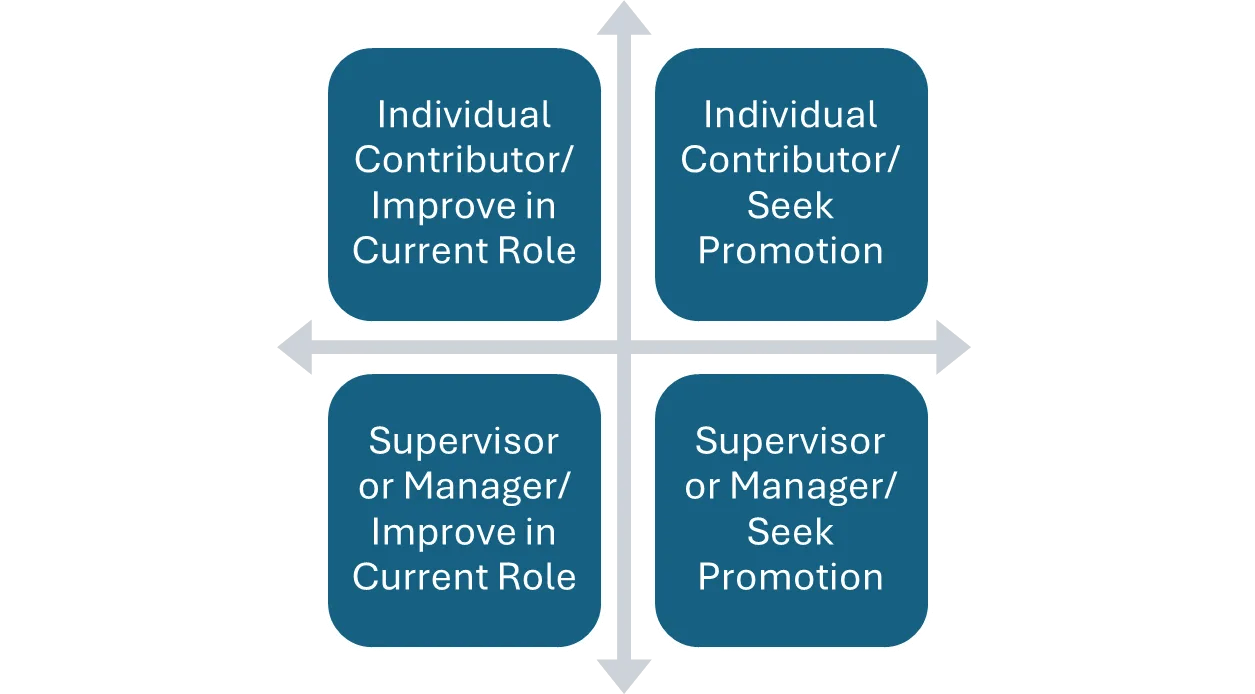
Our strategy was built on a learning-path matrix that accounted for the career goals of our workforce and their current role. Using multiple learning assets and a modular content approach, we built flexible leadership development career paths by offering multiple ways to complete each progressive step. We linked together formal classroom-based/virtual classes of varying lengths, mentoring or being mentored, engaging a coach, cohort programs, job rotations/details, and experiential learning opportunities, depending on the career goals and roles of the learner.
Our strategy was built on a learning-path matrix that accounted for the career goals of our workforce and their current role. Using multiple learning assets and a modular content approach, we built flexible leadership development career paths by offering multiple ways to complete each progressive step. We linked together formal classroom-based/virtual classes of varying lengths, mentoring or being mentored, engaging a coach, cohort programs, job rotations/details, and experiential learning opportunities, depending on the career goals and roles of the learner.
Content
Using the multi-asset learning strategy, learners select preferred learning approaches. Simultaneously, we can insert or subtract methodologies/content without creating gaps in the strategy. For instance, during budget constraints, we could reduce our reliance on vendor-delivered content. If we had insufficient mentors to fulfill demand, we could provide alternatives while recruiting additional mentors. If certain topic areas need to be added, removed, or updated, we could easily adapt without interrupting the flow of learning.
Using the multi-asset learning strategy, learners select preferred learning approaches. Simultaneously, we can insert or subtract methodologies/content without creating gaps in the strategy. For instance, during budget constraints, we could reduce our reliance on vendor-delivered content. If we had insufficient mentors to fulfill demand, we could provide alternatives while recruiting additional mentors. If certain topic areas need to be added, removed, or updated, we could easily adapt without interrupting the flow of learning.
Content
Perhaps even more importantly, based on our research, we could clearly tie our leadership development initiatives to the agency’s mission. For instance, mission-readiness concerns that leaders need to justify costs or adapt to advances in technology made it easier to justify topics like business acumen, technological literacy, and data-driven decision making as mission-essential.
Perhaps even more importantly, based on our research, we could clearly tie our leadership development initiatives to the agency’s mission. For instance, mission-readiness concerns that leaders need to justify costs or adapt to advances in technology made it easier to justify topics like business acumen, technological literacy, and data-driven decision making as mission-essential.
Navigating Uncertainty With Confidence
Content
Every day in 2025 brings new changes and priorities that affect leadership development strategies and the broader learning strategy. Through holistic research, these learning strategies can quickly adjust while maintaining an underlying structure of what is needed now and in the future. We encourage all learning professionals, federal or otherwise, to constantly gain input from multiple sources to make data-informed, strategic decisions that future-proof your initiatives by maintaining their effectiveness and relevance over time.
Every day in 2025 brings new changes and priorities that affect leadership development strategies and the broader learning strategy. Through holistic research, these learning strategies can quickly adjust while maintaining an underlying structure of what is needed now and in the future. We encourage all learning professionals, federal or otherwise, to constantly gain input from multiple sources to make data-informed, strategic decisions that future-proof your initiatives by maintaining their effectiveness and relevance over time.
Content
For a deeper dive, join us at ATD25 for the session: Next-Gen Leaders: A Holistic Blueprint for Modernizing Government Leadership Development .
For a deeper dive, join us at ATD25 for the session: Next-Gen Leaders: A Holistic Blueprint for Modernizing Government Leadership Development.
Content
View Courses Recommended for You