
ATD Blog
Alignment—What It Really Means
Tue Aug 20 2019

Content
“If you don’t know where you are going, any path will take you there.” Chinese Proverb
“If you don’t know where you are going, any path will take you there.” Chinese Proverb
Content
Open your email, go into your social media groups, read your professional journals, attend a course or conference. What is the consistent theme you hear? For learning experiences to be effective in delivering the desired performance, these assets must be aligned \[and integrated\] with the organization’s needs and goals .
Open your email, go into your social media groups, read your professional journals, attend a course or conference. What is the consistent theme you hear? For learning experiences to be effective in delivering the desired performance, these assets must be aligned \[and integrated\] with the organization’s needs and goals.
Content
But how does this really happen? This alignment and integration doesn’t just occur during learning sessions. It doesn’t even start with the design. It starts with awareness of the entire organizational system and understanding how its parts fit and interact to accomplish the mission. In The Baldrige Excellence Builder , published by the Baldrige Performance Excellence Program, “alignment” is defined as “. . . a state of consistency among plans, processes, information, resource decisions, workforce capability and capacity, actions, results, and analyses that support key organization-wide goals.” This alignment includes the processes, activities, and assets associated with maintaining needed competencies as well as building additional organizational capability for change initiatives (for example, learning). Baldrige criteria defines integration as the “. . . harmonization of plans, processes, information, resource decision, actions, results, and analyses . . .” This means that the plans, processes, and assets must be aligned and connected.
But how does this really happen? This alignment and integration doesn’t just occur during learning sessions. It doesn’t even start with the design. It starts with awareness of the entire organizational system and understanding how its parts fit and interact to accomplish the mission. In The Baldrige Excellence Builder, published by the Baldrige Performance Excellence Program, “alignment” is defined as “. . . a state of consistency among plans, processes, information, resource decisions, workforce capability and capacity, actions, results, and analyses that support key organization-wide goals.” This alignment includes the processes, activities, and assets associated with maintaining needed competencies as well as building additional organizational capability for change initiatives (for example, learning). Baldrige criteria defines integration as the “. . . harmonization of plans, processes, information, resource decision, actions, results, and analyses . . .” This means that the plans, processes, and assets must be aligned and connected.
Content
Alignment and integration are also important because learning professionals, including designers, trainers, and consultants, wear two hats—as technical experts in the functional domain of learning and performance and as business learning advisors (BLA) with the organization as they build competitive advantage through skilled and motivated employees in a culture that promotes innovative practices. As a BLA, your primary goal is enabling the organization to succeed—however success is defined—by increasing the overall capability. Much of the success includes creating an environment where all workers can achieve the desired results of the work they are assigned, are constantly gaining relevant capacity, and are inspired to excel personally and professionally.
Alignment and integration are also important because learning professionals, including designers, trainers, and consultants, wear two hats—as technical experts in the functional domain of learning and performance and as business learning advisors (BLA) with the organization as they build competitive advantage through skilled and motivated employees in a culture that promotes innovative practices. As a BLA, your primary goal is enabling the organization to succeed—however success is defined—by increasing the overall capability. Much of the success includes creating an environment where all workers can achieve the desired results of the work they are assigned, are constantly gaining relevant capacity, and are inspired to excel personally and professionally.
Content
In working with enterprises interested in gaining greater organizational alignment and integration several elements must be considered:
In working with enterprises interested in gaining greater organizational alignment and integration several elements must be considered:
Content
clear direction or focus
clear direction or focus
Content
internal processes to support customers
internal processes to support customers
Content
the customers and their changing requirements
the customers and their changing requirements
Content
measurements to monitor progress toward the desired state
measurements to monitor progress toward the desired state
Content
the impact of employees’ work.
the impact of employees’ work.
Content
These elements are anchored in a clear understanding of organizational challenges, goals and objectives, strategies designed to meet these challenges, awareness of the competition, and the change needed to excel. Additionally, all employees need to be motivated and incentivized toward this end, thus creating a winning culture.
These elements are anchored in a clear understanding of organizational challenges, goals and objectives, strategies designed to meet these challenges, awareness of the competition, and the change needed to excel. Additionally, all employees need to be motivated and incentivized toward this end, thus creating a winning culture.
Content
Organizational direction, also known as strategic direction, is the full spectrum of processes, actions, activities, procedures, and operations employed to achieve a desired future. The emphasis on using a strategy to guide the organization is being pushed by a myriad of environment circumstances including VUCA environments, emerging technologies that are disrupting the way work is done and the way people live, and the globalization of the workforce, which not only includes employees in multiple geographies but in five age demographics. Primary among these circumstances is the need to focus on customers’ needs and requirements and reduce costs to deliver services and products by making key internal processes faster, better, and cheaper to gain competitive advantage and stay in business.
Organizational direction, also known as strategic direction, is the full spectrum of processes, actions, activities, procedures, and operations employed to achieve a desired future. The emphasis on using a strategy to guide the organization is being pushed by a myriad of environment circumstances including VUCA environments, emerging technologies that are disrupting the way work is done and the way people live, and the globalization of the workforce, which not only includes employees in multiple geographies but in five age demographics. Primary among these circumstances is the need to focus on customers’ needs and requirements and reduce costs to deliver services and products by making key internal processes faster, better, and cheaper to gain competitive advantage and stay in business.
Content
Several skills associated with leading change and business acumen are required for alignment to be successful:
Several skills associated with leading change and business acumen are required for alignment to be successful:
Content
understanding of how the organization is designed
understanding of how the organization is designed
Content
having the business acumen to know how the organization develops products and services and makes money.
having the business acumen to know how the organization develops products and services and makes money.
Content
One way to gain this understanding is to complete the Organizational Profile from Baldrige. The questions provide a framework for putting the parts together.
One way to gain this understanding is to complete the Organizational Profile from Baldrige. The questions provide a framework for putting the parts together.
Content
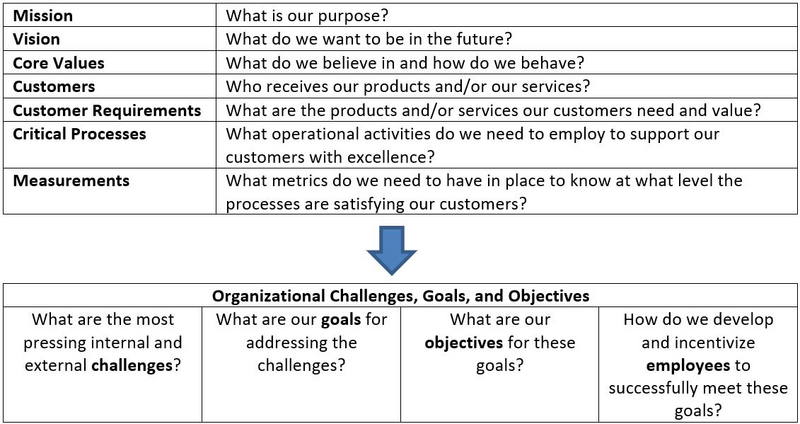
Prior to responding to the questions, it could be helpful to fill in this direction and alignment graphic:
Prior to responding to the questions, it could be helpful to fill in this direction and alignment graphic:
Content
These actions will help you see the organization from a different perspective, and with this understanding and insight you can be more proactive in aligning and integrating specific learning assets to meet major challenges.
These actions will help you see the organization from a different perspective, and with this understanding and insight you can be more proactive in aligning and integrating specific learning assets to meet major challenges.