
ATD Blog
Assessing a Sales Professional’s Performance: You Can’t Do a Result!
Fri Jun 21 2013
Content
Assessing a Sales Professional’s Performance: You Can’t Do a Result!
Assessing a Sales Professional’s Performance: You Can’t Do a Result!
Content
In ASTD’s Sales Coaching for Business Impact program one of the topics that always generates a lot of interest and conversation from sales leaders and managers is, “What are some of the best practices associated with assessing individual sales performance?”
In ASTD’s Sales Coaching for Business Impact program one of the topics that always generates a lot of interest and conversation from sales leaders and managers is, “What are some of the best practices associated with assessing individual sales performance?”
Content
Of course there are the established performance management policies and practices utilized within an organization’s sales culture that sales managers formal use (hopefully) to provide timely and ongoing feedback to their sales team. Many times there is a “mirror moment” during the workshop when participants candidly admit they don’t often enough use these company performance feedback tools. This can be rectified by greater personal discipline or accountability by sales managers contracting with their manager to ensure inspection is linked more closely to expectations throughout the sales chain.
Of course there are the established performance management policies and practices utilized within an organization’s sales culture that sales managers formal use (hopefully) to provide timely and ongoing feedback to their sales team. Many times there is a “mirror moment” during the workshop when participants candidly admit they don’t often enough use these company performance feedback tools. This can be rectified by greater personal discipline or accountability by sales managers contracting with their manager to ensure inspection is linked more closely to expectations throughout the sales chain.
Content
However, when a sales manager, executive, or sales leader acts as a coach what can be used to supplement and complement the existing performance management systems and structures to aid in the development of a sales professional?
However, when a sales manager, executive, or sales leader acts as a coach what can be used to supplement and complement the existing performance management systems and structures to aid in the development of a sales professional?
Content
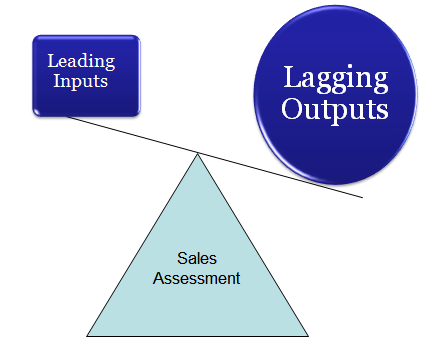
In the program module, Assessing Performance participants examine a fundamental truth that sounds so obvious and yet it can have profound impact on the coach approach to greater professional sales development – “You can’t do a result.” A sales professional can only “do” the things that lead to a result. When defining business objectives, it is important to separate “leading inputs” from “lagging outputs.” An easy way to define inputs and outputs is to think of sales activities (leading inputs) and the results they lead to (lagging outputs).
In the program module, Assessing Performance participants examine a fundamental truth that sounds so obvious and yet it can have profound impact on the coach approach to greater professional sales development – “You can’t do a result.” A sales professional can only “do” the things that lead to a result. When defining business objectives, it is important to separate “leading inputs” from “lagging outputs.” An easy way to define inputs and outputs is to think of sales activities (leading inputs) and the results they lead to (lagging outputs).
Content
Traditional sales results data collected like revenue—units sold, profit, signings, service level agreements, and so forth—are helpful metrics to use when assessing individual or team performance. However, by definition, these lagging output measures describe the past and many times information that can be somewhat dated.
Traditional sales results data collected like revenue—units sold, profit, signings, service level agreements, and so forth—are helpful metrics to use when assessing individual or team performance. However, by definition, these lagging output measures describe the past and many times information that can be somewhat dated.
Content
A sales manager or leader should consider using a balance of leading inputs when coaching along with lagging outputs for sales management. Leading inputs include measures like pre-call completions, the number of prospective calls by day, week, or month or the number of demonstrations, cold calls made or presentations performed. By observing a sales professional demonstrate through the behaviors associated with leading inputs, the sales manager, as coach, has the content to provide more frequent and timely feedback.
A sales manager or leader should consider using a balance of leading inputs when coaching along with lagging outputs for sales management. Leading inputs include measures like pre-call completions, the number of prospective calls by day, week, or month or the number of demonstrations, cold calls made or presentations performed. By observing a sales professional demonstrate through the behaviors associated with leading inputs, the sales manager, as coach, has the content to provide more frequent and timely feedback.
Content
A sales manager should consider how balanced the leading inputs are to lagging outputs when assessing sales rep performance. If there’s too much of a reliance on lagging outputs, an opportunity may be lost for early identification of behaviors getting in the way of better performance and results. This is the environment where sales coaching can thrive.
A sales manager should consider how balanced the leading inputs are to lagging outputs when assessing sales rep performance. If there’s too much of a reliance on lagging outputs, an opportunity may be lost for early identification of behaviors getting in the way of better performance and results. This is the environment where sales coaching can thrive.
Content
There’s also the benefit of the sales manager identifying good habits and desired behaviors that should be encouraged, accelerated, or increased by the sales professional. Unless the sales manager as coach is providing early and frequent feedback the sales rep may lapse into bad habits or not get the validation needed to keep on the path toward developing good prospecting, selling, and closing behaviors.
There’s also the benefit of the sales manager identifying good habits and desired behaviors that should be encouraged, accelerated, or increased by the sales professional. Unless the sales manager as coach is providing early and frequent feedback the sales rep may lapse into bad habits or not get the validation needed to keep on the path toward developing good prospecting, selling, and closing behaviors.
Content
If you’re a sales manager or sales leader ask yourself the following two questions for a “mirror moment” examination:
If you’re a sales manager or sales leader ask yourself the following two questions for a “mirror moment” examination:
Content
What are the short-term targets and long-term results that I’m using to assess and coach my sales professionals?
What are the short-term targets and long-term results that I’m using to assess and coach my sales professionals?
Content
If I were to “weigh” the quantity, quality, and use of leading inputs to lagging outputs, how many and which ones am I using and how balanced is my assessment approach?
If I were to “weigh” the quantity, quality, and use of leading inputs to lagging outputs, how many and which ones am I using and how balanced is my assessment approach?
Content
Content
Content
Content
Content
Content
Content
Content
Content
Content
Content
View the next offering of the Sales Coaching for Business Impact Certificate program.
View the next offering of the Sales Coaching for Business Impact Certificate program.