
ATD Blog
Building Authentic Relationships While Working Remotely
Thu Sep 01 2022

Brought to you by

Content
Building authentic relationships takes more intention while working remotely. Learn how to do it successfully.
Building authentic relationships takes more intention while working remotely. Learn how to do it successfully.
Content
As a result of the pandemic, a riddle has been presented to leaders: How do we want to lead differently now that we’ve had that experience?
As a result of the pandemic, a riddle has been presented to leaders: How do we want to lead differently now that we’ve had that experience?
Content
It’s tempting to focus on efficiency. If organizations cut back on office space and people cut back on commuting, organizations can save time and money while giving employees freedom and flexibility. Sounds good, right?
It’s tempting to focus on efficiency. If organizations cut back on office space and people cut back on commuting, organizations can save time and money while giving employees freedom and flexibility. Sounds good, right?
Content
But people don’t thrive under systems that are purely designed to maximize efficiency; we’ve known this since Henry Ford leveraged scientific management in the assembly line. People thrive under systems that provide meaningful interactions where they’re seen, valued, and heard. Absent meaningful interactions, employees become disengaged and may also suffer in their personal lives due to the loss of meaning in their work.
But people don’t thrive under systems that are purely designed to maximize efficiency; we’ve known this since Henry Ford leveraged scientific management in the assembly line. People thrive under systems that provide meaningful interactions where they’re seen, valued, and heard. Absent meaningful interactions, employees become disengaged and may also suffer in their personal lives due to the loss of meaning in their work.
Content
Naturally, these kinds of interactions are easier when everyone comes together to work under one roof. Things aren’t going back to the way they used to be, though. So, how do we build authentic relationships while working remotely or on a hybrid schedule?
Naturally, these kinds of interactions are easier when everyone comes together to work under one roof. Things aren’t going back to the way they used to be, though. So, how do we build authentic relationships while working remotely or on a hybrid schedule?
Content
We must commit to knowing what matters most to the people we’re collaborating with. This insight was previously good to know; now, it’s essential. Without it, teams won’t have enough trust and commitment to survive conflict or innovate.
We must commit to knowing what matters most to the people we’re collaborating with. This insight was previously good to know; now, it’s essential. Without it, teams won’t have enough trust and commitment to survive conflict or innovate.
Content
While working remotely or on a hybrid schedule, we don’t spend as much time getting to know coworkers—and building authentic relationships takes time. We need to accelerate the process of gaining insight into our colleagues and building trust.
While working remotely or on a hybrid schedule, we don’t spend as much time getting to know coworkers—and building authentic relationships takes time. We need to accelerate the process of gaining insight into our colleagues and building trust.
Customizing Remote Collaboration
Content
A productive work relationship builds trust, generates commitment, and drives results.
A productive work relationship builds trust, generates commitment, and drives results.
Content
The desire to build authentic, productive work relationships hasn’t changed with the shift to working remotely, but the process has. And, like most complex challenges, there’s not a one-size-fits-all solution for how to build them.
The desire to build authentic, productive work relationships hasn’t changed with the shift to working remotely, but the process has. And, like most complex challenges, there’s not a one-size-fits-all solution for how to build them.
Content
Some organizations collaborate like a football team, with everyone pooling their strengths to push toward a common goal. Others collaborate like a track team, with different teams and individuals working solo, and others cheering them on.
Some organizations collaborate like a football team, with everyone pooling their strengths to push toward a common goal. Others collaborate like a track team, with different teams and individuals working solo, and others cheering them on.
Content
The necessary level of coordination at your organization will influence how much remote and in-person work your culture needs, which will influence how you build authentic work relationships. Each person must be trained to understand what matters most to the people they’re collaborating with, whether through a screen or in a conference room.
The necessary level of coordination at your organization will influence how much remote and in-person work your culture needs, which will influence how you build authentic work relationships. Each person must be trained to understand what matters most to the people they’re collaborating with, whether through a screen or in a conference room.
Understanding Colleague Motivations
Content
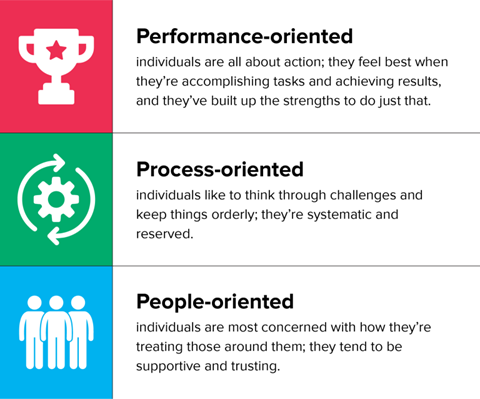
So, how do people find out what matters most to everyone they work with? It starts with understanding three core motives:
So, how do people find out what matters most to everyone they work with? It starts with understanding three core motives:
Content
Performance
Performance
Content
Process
Process
Content
People
People
Content
Everyone has all three motives at some level; however, some people have one primary motive, others have two, and a few people value all three motives equally.
Everyone has all three motives at some level; however, some people have one primary motive, others have two, and a few people value all three motives equally.
Content
Understanding these core motives becomes critical in a remote setting, but coming to that understanding is harder because we don’t run into people in the hallway anymore. We have to be more intentional about learning our colleagues’ motives and values if we want to build authentic relationships while working remotely.
Understanding these core motives becomes critical in a remote setting, but coming to that understanding is harder because we don’t run into people in the hallway anymore. We have to be more intentional about learning our colleagues’ motives and values if we want to build authentic relationships while working remotely.
Content
Learning your colleagues’ motives can help you accomplish many things:
Learning your colleagues’ motives can help you accomplish many things:
Content
Help every person feel seen, valued, and heard.
Help every person feel seen, valued, and heard.
Content
Achieve smarter collaboration.
Achieve smarter collaboration.
Content
Improve employee engagement.
Improve employee engagement.
Content
Gain a better sense of psychological safety.
Gain a better sense of psychological safety.
Content
Develop a better sense of purpose.
Develop a better sense of purpose.
Content
Establish trust faster.
Establish trust faster.
Content
Motivation is just one lens people have on the world, but it’s a very important one in a professional setting; it can help colleagues (who may never have met in person) understand what gives other people purpose and meaning, which, according to a recent Microsoft report, 40 percent of employees ranked as “very important” to them.
Motivation is just one lens people have on the world, but it’s a very important one in a professional setting; it can help colleagues (who may never have met in person) understand what gives other people purpose and meaning, which, according to a recent Microsoft report, 40 percent of employees ranked as “very important” to them.
Using Meetings to Your Advantage
Content
Much of remote collaboration happens in scheduled meetings. Meetings have become very efficient over the past couple of years with people joining at the appointed time, sticking to the agenda, and leaving immediately afterwards without any casual chatting.
Much of remote collaboration happens in scheduled meetings. Meetings have become very efficient over the past couple of years with people joining at the appointed time, sticking to the agenda, and leaving immediately afterwards without any casual chatting.
Content
But efficiency doesn’t create thriving employees. And at a time when employees are quitting en masse, employers can’t afford for them not to thrive.
But efficiency doesn’t create thriving employees. And at a time when employees are quitting en masse, employers can’t afford for them not to thrive.
Content
Organizations need to create new team norms for remote or hybrid meetings by sparking informal discussions that reveal motivation and foster authentic relationships.
Organizations need to create new team norms for remote or hybrid meetings by sparking informal discussions that reveal motivation and foster authentic relationships.
Content
There are a few ways to create opportunities for these informal discussions:
There are a few ways to create opportunities for these informal discussions:
Content
Take a few minutes to generate conversation around a virtual watercooler, where you find out how people are feeling and what’s on their minds outside of work.
Take a few minutes to generate conversation around a virtual watercooler, where you find out how people are feeling and what’s on their minds outside of work.
Content
Go around the “room” to let everyone share one thing that gave them meaning in the last week.
Go around the “room” to let everyone share one thing that gave them meaning in the last week.
Content
Ask everyone to share one thing they’ve recently learned from someone different from themselves.
Ask everyone to share one thing they’ve recently learned from someone different from themselves.
Content
Give people an opportunity to ask for help and to offer help to someone who might need it.
Give people an opportunity to ask for help and to offer help to someone who might need it.
Content
Ask everyone to share a recent problem they solved and the strengths they used to solve it.
Ask everyone to share a recent problem they solved and the strengths they used to solve it.
Content
Taking the time to have these conversations is one of the most valuable things you can do as a leader. It gives people a chance to build authentic relationships when they’re isolated from each other and tap into a deeper sense of purpose at work.
Taking the time to have these conversations is one of the most valuable things you can do as a leader. It gives people a chance to build authentic relationships when they’re isolated from each other and tap into a deeper sense of purpose at work.