
ATD Blog
Capturing the Expertise of Your Stars
Tue Oct 15 2013

Content
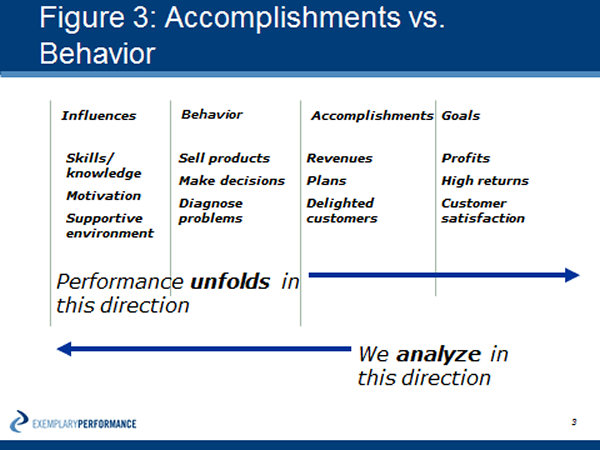
We learned to read left to right. However, we analyze performance right to left!
We learned to read left to right. However, we analyze performance right to left!
Content
Our approach for capturing the expertise of exemplary performers is by using a “right to left” analysis. This tactic enables managers to move from strategy and goals to critical accomplishments, then from accomplishments to the key activities and decisions that produce those accomplishments. From those key behaviors, managers can move to the identification of essential support required across the six components of a high-performance work system—the Exemplary Performance System.
Our approach for capturing the expertise of exemplary performers is by using a “right to left” analysis. This tactic enables managers to move from strategy and goals to critical accomplishments, then from accomplishments to the key activities and decisions that produce those accomplishments. From those key behaviors, managers can move to the identification of essential support required across the six components of a high-performance work system—the Exemplary Performance System.
Content
The most effective and efficient way to capture expertise is to work with your existing accomplished performers—your internal benchmarks. These are the individuals who have established methods to their work that produce the desired accomplishments at a consistently high level. These exemplary performers are often unconsciously competent, so you will need to capture their expertise in a way to make it explicit and transferable to other team members.
The most effective and efficient way to capture expertise is to work with your existing accomplished performers—your internal benchmarks. These are the individuals who have established methods to their work that produce the desired accomplishments at a consistently high level. These exemplary performers are often unconsciously competent, so you will need to capture their expertise in a way to make it explicit and transferable to other team members.
Content
Our experience has shown us that asking stars why they are good at what they do or how they go about doing their work just leads to meaningless banter about their education, work history, intelligence, competencies, and other variables that have little or nothing to do with how these individuals produce exceptional results.
Our experience has shown us that asking stars why they are good at what they do or how they go about doing their work just leads to meaningless banter about their education, work history, intelligence, competencies, and other variables that have little or nothing to do with how these individuals produce exceptional results.
Content
Instead, the analysis of accomplished performers must be context-intensive and case-based . For example, if you're working with a sales team that consistently wins competitive displacements, it’s best to ask them to walk you through several recent wins in a detailed and methodical way.
Instead, the analysis of accomplished performers must be context-intensive and case-based. For example, if you're working with a sales team that consistently wins competitive displacements, it’s best to ask them to walk you through several recent wins in a detailed and methodical way.
Content
Exemplars make the assumption that their colleagues approach their work using the same rich mental models that they have developed based on codifying years and years of experience. In fact, it is the rich models of behavior that differentiates the star performers from the merely solid performers.
Exemplars make the assumption that their colleagues approach their work using the same rich mental models that they have developed based on codifying years and years of experience. In fact, it is the rich models of behavior that differentiates the star performers from the merely solid performers.
Content
By capturing these models (a key element of the star’s profile) you can shorten the ‘time the competence’ for the other members of the team. We’ll get specific during the next two blog entries, when you’ll start creating a Profile of Exemplary Performance (PEP).
By capturing these models (a key element of the star’s profile) you can shorten the ‘time the competence’ for the other members of the team. We’ll get specific during the next two blog entries, when you’ll start creating a Profile of Exemplary Performance (PEP).
Content
For more on how to shift the performance curve, check out Al’s previous blog article in this series .
For more on how to shift the performance curve, check out Al’s previous blog article in this series.