
ATD Blog
Closing the Skills Gap: What Upskilling Strategies Are Delivering Results
Upskilling is now HR’s biggest challenge, and data-driven, personalized, and tech-enabled strategies are becoming essential to close widening skills gaps.
Tue Feb 10 2026

Brought to you by
Upskilling is now HR’s biggest challenge, and data-driven, personalized, and tech-enabled strategies are becoming essential to close widening skills gaps.
As artificial intelligence (AI) and digital transformation accelerate, organizations face growing pressure to ensure employees can adapt to new tools, roles, and ways of working. Upskilling has shifted from an occasional HR initiative to an ongoing business priority tied to retention, innovation, and long-term stability.
Data from Capterra’s 2025 HR Software Trends Survey shows that training and upskilling are the top challenges facing HR leaders today. In parallel, 68 percent of businesses expect their upskilling costs to increase, reflecting a clear shift away from generic training and toward more customized, technology-supported learning models.
Why Upskilling Sits at the Top of HR’s Agenda
Nearly half (45 percent) of HR leaders say training and upskilling current employees is their biggest challenge this year, outpacing recruitment and employee well-being. This pressure is amplified by AI adoption, which is reshaping job requirements across functions—not just in technical roles.
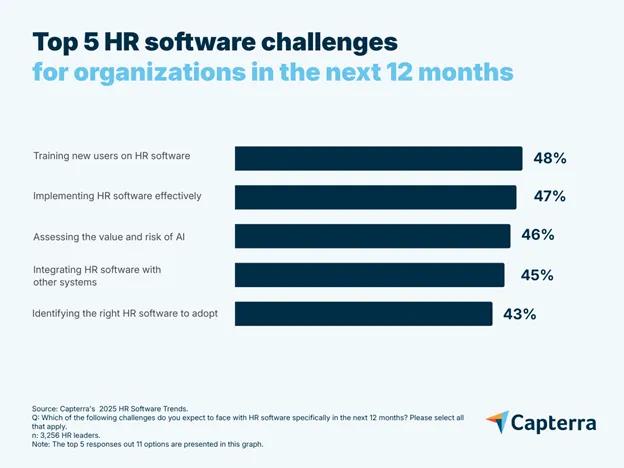
The challenge is not limited to HR. Business leaders increasingly recognize that employees must keep building new skills to remain effective as roles, tools, and expectations continue to evolve—AI adoption being one contributor.
When done well, investing in employee development delivers several benefits:
Closing evolving skills gaps as job roles change faster than traditional hiring cycles
Improving retention by giving employees visible growth paths
Supporting innovation through a culture of continuous learning
Future-proofing the business against emerging disruptions
Rising Costs Highlight What Often Goes Wrong
While 68 percent of organizations expect upskilling costs to rise, this increase often reflects smarter investment—not just higher spending. Larger companies, in particular, face growing costs due to niche roles, global compliance needs, and demand for specialized credentials.
However, many programs fall short due to common missteps, including:
One-size-fits-all training that ignores role-specific needs
Limited tracking of learning progress or outcomes
Minimal involvement from managers
Little learner feedback to improve future programs
Avoiding these pitfalls requires a more structured approach to upskilling.
The Three Pillars of Effective Upskilling
Successful upskilling strategies tend to rest on three foundational pillars: data-driven assessment, solution-oriented learning, and strong reporting.
1. Data-Driven Assessment
Effective programs start with understanding current capabilities and future needs. Performance data, skills audits, and business goals help pinpoint where gaps truly exist. Performance management tools, learning management systems (LMS), and human resource information systems (HRIS) provide the data foundation needed to align training with measurable outcomes.
2. Solution-Oriented Learning Approaches
Once gaps are identified, training must be relevant and applicable. This means moving beyond static e‑learning toward approaches that are:
Personalized, based on roles and performance
Modular, with bite-sized content delivered in the flow of work
Experiential, including simulations, real projects, or peer learning
Manager-supported, reinforcing real-world application
Learning management systems and learning experience platforms (LXPs) increasingly support these approaches by combining structured learning with AI-driven personalization and social learning features.
3. Reporting and Progress Tracking
Clear metrics are essential to evaluate what works. Organizations that track engagement, completion rates, and performance improvement can refine programs over time and link learning efforts to business results.
Five Trends Shaping the Future of Upskilling
As organizations rethink workforce development, five trends are redefining how upskilling is delivered.
AI-powered learning uses real-time data to recommend personalized learning paths, reducing irrelevant training and improving engagement.
Skill marketplaces connect employees to short-term internal projects based on their skills and interests, supporting internal mobility and practical learning.
Immersive training using virtual or augmented reality enables hands-on learning for complex or high-risk tasks while improving retention and safety.
Skills-based hiring shifts focus from credentials to real capabilities, expanding talent pools and aligning hiring with fast-changing role requirements.
Performance-linked upskilling embeds learning into growth conversations, tying skill development directly to performance reviews and career progression.
Turning Strategy Into Action
Closing the skills gap requires more than increasing training budgets. By using data to identify real gaps, delivering targeted learning experiences, and measuring outcomes, organizations can turn upskilling into a sustained advantage. The companies that embed continuous learning into everyday work will be best positioned to adapt as skills—and technologies—continue to evolve.
View Courses Recommended for You