ATD, association for talent development

ATD Blog

Coaching the Coach: Key to Enabling the Sales Manager

By

Mon May 16 2016

Coaching the Coach: Key to Enabling the Sales Manager
Loading...
Coaching the Coach: Key to Enabling the Sales Manager-ecdc91f60228acec3c7185ff74e071bc5d5ab1e9e89ff5f669a79c4938276c74

Content

“Training plus coaching led to an increase of 88 percent in productivity, versus 23 percent from training alone.”

“Training plus coaching led to an increase of 88 percent in productivity, versus 23 percent from training alone.”

Content

—Centre for Management and Organizational Effectiveness

—Centre for Management and Organizational Effectiveness

Content

Organizations looking to improve their sales pipeline and close more deals often focus on ways to better equip and train their sales reps. This is a natural, commonsense approach and is certainly part of an effective sales performance intervention. I’ve often quipped, however, that if I had a dollar to spend on a sales improvement initiative, I’d spend 75 cents on the sales managers. That’s hyperbole, to make a point, but there’s some real truth behind that statement.

Organizations looking to improve their sales pipeline and close more deals often focus on ways to better equip and train their sales reps. This is a natural, commonsense approach and is certainly part of an effective sales performance intervention. I’ve often quipped, however, that if I had a dollar to spend on a sales improvement initiative, I’d spend 75 cents on the sales managers. That’s hyperbole, to make a point, but there’s some real truth behind that statement.

Content

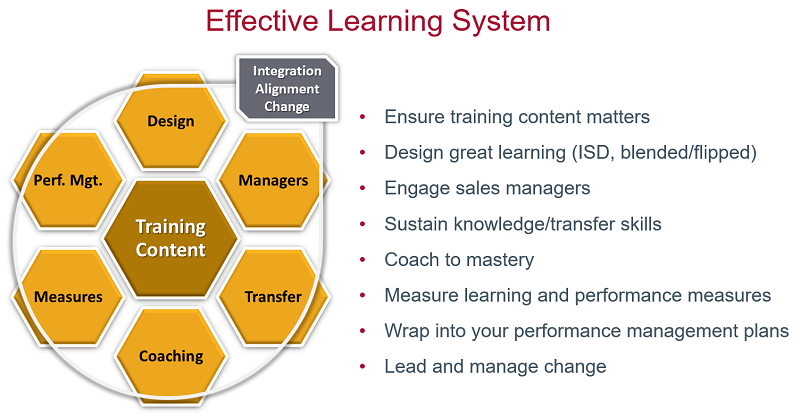
The only way I’ve ever seen an organization truly capitalize on a sales training investment and achieve a significant ROI through better sales outcomes, is to build and implement what I call “an effective learning system.” Without going into great detail, see the graphic below and consider how often your sales managers need to be engaged for such a system to produce real results in the field.

The only way I’ve ever seen an organization truly capitalize on a sales training investment and achieve a significant ROI through better sales outcomes, is to build and implement what I call “an effective learning system.” Without going into great detail, see the graphic below and consider how often your sales managers need to be engaged for such a system to produce real results in the field.

Engaging the Sales Manager

Content

Consider the following facts about frontline sales managers:

Consider the following facts about frontline sales managers:

  • Content

    They are a great source of training content (typically they were top sales producers).

    They are a great source of training content (typically they were top sales producers).

  • Content

    They must buy-in to the training content you’ll teach reps.

    They must buy-in to the training content you’ll teach reps.

  • Content

    They should attend training to learn what their reps will learn—as deeply as the reps.

    They should attend training to learn what their reps will learn—as deeply as the reps.

  • Content

    They should also attend training with their reps to provide coaching support.

    They should also attend training with their reps to provide coaching support.

  • Content

    They must review the performance support materials you develop, to help the reps and assist with rep skill transfer.

    They must review the performance support materials you develop, to help the reps and assist with rep skill transfer.

  • Content

    They should attend coaching training to prepare them to coach their reps to mastery, as effectively as possible.

    They should attend coaching training to prepare them to coach their reps to mastery, as effectively as possible.

  • Content

    They must respond appropriately to analytics and reports about learning metrics and sales performance.

    They must respond appropriately to analytics and reports about learning metrics and sales performance.

  • Content

    They should manage rep expectations, behaviors and results (performance management).

    They should manage rep expectations, behaviors and results (performance management).

  • Content

    They need to drive behavior change with reps on the front lines to improve sales results.

    They need to drive behavior change with reps on the front lines to improve sales results. 

Content

That’s a lot of engagement, right? The truth is that change (especially with incumbent reps) rarely happens on the front lines of a sales organization without consistent sales manager involvement until the change is cemented. Unfortunately, sales managers are often consumed with reviewing and reporting on numbers to senior leadership, involved in opportunity management or selling personally, unclear about the priority and expectations for coaching, and over-burdened with non-coaching tasks. The result: They are left with little time to focus on training reinforcement and sales coaching—during and after the onboarding process, as well as for other training initiatives.

That’s a lot of engagement, right? The truth is that change (especially with incumbent reps) rarely happens on the front lines of a sales organization without consistent sales manager involvement until the change is cemented. Unfortunately, sales managers are often consumed with reviewing and reporting on numbers to senior leadership, involved in opportunity management or selling personally, unclear about the priority and expectations for coaching, and over-burdened with non-coaching tasks. The result: They are left with little time to focus on training reinforcement and sales coaching—during and after the onboarding process, as well as for other training initiatives. 

Content

So the challenge becomes how do organizations help their managers become better coaches and coach more frequently? There are multiple answers to this question, including removing cultural obstacles to coaching and freeing up the time through disciplined prioritization. But the solution we’ll focus on here is the power of “coaching the coach.”

So the challenge becomes how do organizations help their managers become better coaches and coach more frequently? There are multiple answers to this question, including removing cultural obstacles to coaching and freeing up the time through disciplined prioritization. But the solution we’ll focus on here is the power of “coaching the coach.”

Coaching the Sales Coach

Content

Managers are people too, and they work inside complex, busy organizations with conflicting priorities just like reps. What’s more, managers are just as unlikely to change their own behaviors and become more effective without the same type of support. Yet, we often overlook this factor and expect managers to “just do it” after training.

Managers are people too, and they work inside complex, busy organizations with conflicting priorities just like reps. What’s more, managers are just as unlikely to change their own behaviors and become more effective without the same type of support. Yet, we often overlook this factor and expect managers to “just do it” after training. 

Content

Therefore, it is equally important—if not more so—to develop purposeful plans for knowledge sustainment, skills transfer, and coaching to mastery for your sales managers (aka the coaches). In other words, it’s time to coach the sales coach. Here are some ideas you might find helpful as you consider how to do this in your organization.

Therefore, it is equally important—if not more so—to develop purposeful plans for knowledge sustainment, skills transfer, and coaching to mastery for your sales managers (aka the coaches). In other words, it’s time to coach the sales coach.  Here are some ideas you might find helpful as you consider how to do this in your organization. 

  • Content

    Communicate expectations: Set clear expectations and goals, and provide managers with the ability to focus on meeting them.

    Communicate expectations: Set clear expectations and goals, and provide managers with the ability to focus on meeting them. 

  • Content

    Replicate the best: Study top-producing managers in order to help others replicate what they are doing differently to drive better results.

    Replicate the best: Study top-producing managers in order to help others replicate what they are doing differently to drive better results.

  • Content

    Free manager time: Coaching is a high-priority activity and gets results. Provide managers with time to review team and individual results to look for behavior patterns and performance gaps, to effectively coach toward closing the gaps.

    Free manager time: Coaching is a high-priority activity and gets results. Provide managers with time to review team and individual results to look for behavior patterns and performance gaps, to effectively coach toward closing the gaps.

  • Content

    Foster coaching excellence: Select a coaching model that is proven effective. Look for one that is behavioral-based (for developmental coaching), with an approach to engage the reps in the analysis of their results, activities, and methods (behaviors), as well as the co-creation of the best solution and an action plan to implement it.

    Foster coaching excellence: Select a coaching model that is proven effective. Look for one that is behavioral-based (for developmental coaching), with an approach to engage the reps in the analysis of their results, activities, and methods (behaviors), as well as the co-creation of the best solution and an action plan to implement it.

  • Content

    Leverage technology: There are virtual coaching products and other sales management e-tools and apps that can support coaching, increase manager efficiency, and improve their coaching effectiveness. This should be part of your overall sales enablement and sales manager enablement strategy.

    Leverage technology: There are virtual coaching products and other sales management e-tools and apps that can support coaching, increase manager efficiency, and improve their coaching effectiveness. This should be part of your overall sales enablement and sales manager enablement strategy.  

  • Content

    Go up a level: Provide training and performance support for the managers’ manager to help him or her coach the frontline sales managers on implementing what they’ve been taught, especially how to reinforce, sustain, transfer, and coach their reps more effectively.

    Go up a level: Provide training and performance support for the managers’ manager to help him or her coach the frontline sales managers on implementing what they’ve been taught, especially how to reinforce, sustain, transfer, and coach their reps more effectively.

  • Content

    Manage expectations: In addition to building expectations into the management by objectives (MBOs) and performance plans for frontline sales managers, build the “coaching the coach” expectation into the senior leadership roles—with performance management elements and MBOs.

    Manage expectations: In addition to building expectations into the management by objectives (MBOs) and performance plans for frontline sales managers, build the “coaching the coach” expectation into the senior leadership roles—with performance management elements and MBOs.

  • Content

    Gain leadership support: Have senior leaders’ buy-in (top-down support) for all of this and develop measures and reports, so leaders can inspect what they expect.

    Gain leadership support: Have senior leaders’ buy-in (top-down support) for all of this and develop measures and reports, so leaders can inspect what they expect.  

  • Content

    Outsource for more support: Provide expert help for sales managers from the outside (sometimes more realistic). Look for people who can work with the managers over a period of time (weekly or biweekly for at least one quarter or longer).

    Outsource for more support: Provide expert help for sales managers from the outside (sometimes more realistic). Look for people who can work with the managers over a period of time (weekly or biweekly for at least one quarter or longer). 

Content

Bottom line: Behavior change is a process, not an event. Consider executive coaching for the senior leaders and for those who coach frontline sales managers, as well. If you aren’t already coaching your sales coaches or considering how to provide additional support for sales managers, I hope this post has provided you with food for thought—and some ideas to get started. As always, I’d enjoy hearing your feedback in the Comments section.

Bottom line: Behavior change is a process, not an event. Consider executive coaching for the senior leaders and for those who coach frontline sales managers, as well. If you aren’t already coaching your sales coaches or considering how to provide additional support for sales managers, I hope this post has provided you with food for thought—and some ideas to get started. As always, I’d enjoy hearing your feedback in the Comments section. 

Additional Resources

Content

Effective Learning System

Effective Learning System

Content

Top Producer Analysis

Top Producer Analysis

Content

Sales Manager Enablement

Sales Manager Enablement

You've Reached ATD Member-only Content

Become an ATD member to continue

Already a member?Sign In


Copyright © 2026 ATD

ASTD changed its name to ATD to meet the growing needs of a dynamic, global profession.

Terms of UsePrivacy NoticeCookie Policy