
ATD Blog
Companies Talk AI, but Skip It When Onboarding New Hires
Onboarding is the first moment when organizations can demonstrate how AI supports the way work gets done.
Mon Oct 27 2025

AI is reshaping the workplace. It screens resumes, supports interviews, and analyzes performance data. Yet when new employees join an organization, AI is often missing from the onboarding experience.
Research from TalentLMS and BambooHR highlights the gap. More than half of employees said AI wasn’t used during their onboarding. Six in 10 received no training on AI tools. And one in 10 found the tools they did encounter difficult to navigate.
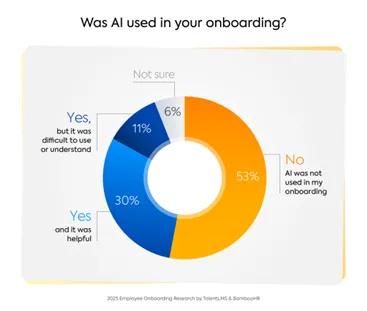
This gap matters. Onboarding is where employee experience, learning, and performance intersect. It’s also the first moment when organizations can demonstrate how AI supports—not complicates —the way work gets done.
Why Onboarding Is a Natural Fit for AI
Onboarding is built around structured steps, such as completing forms, accessing systems, and beginning role-based training. These repeatable, data-driven processes are well-suited for AI.
With AI-powered onboarding, companies can:
Automate setup tasks and paperwork, saving employees from spending their first day on forms.
Recommend personalized learning paths, directing employees to the most relevant content based on their role.
Provide instant answers to routine questions, such as where to find company policies or benefits information.
Spot early skilla gaps, highlighting when a new hire may need additional training on tools or workflows.
The Training Gap That Slows Adoption
If AI can add so much value to onboarding, why is adoption still limited? The answer often lies in how the tools are introduced.
The first weeks in a role are when employees need structure and direction. They’re learning new systems, adjusting to workflows, and finding out how their role contributes to the organization. Without clear guidance, introducing AI at this stage can confuse rather than support.
The risks are easy to spot. Employees avoid or misuse the tools. Time-to-productivity is delayed as new hires spend more time troubleshooting than learning. And early chances to build digital fluency are lost, leaving employees less prepared for the technology they will be expected to use later.
Closing the gap means going beyond simply showing how the tools work. Effective onboarding training introduces AI in context, helping employees see how it supports their role and fits into daily workflows. It gives them space to practice in a low-stakes setting and understand when to lean on technology and when to apply human insight. Approached this way, AI becomes a source of confidence, not confusion.
Making AI Meaningful in Onboarding
For AI to add lasting value during onboarding, it must be introduced with transparency. And in a way that connects to the realities of each role. Here’s what that looks like in practice:
Show the “why.” Employees are far more likely to embrace new tools when they understand not only how they work but also why they’re being used. An AI-powered skills assessment, for example, can be presented to help new hires identify their strengths and areas for growth. At the same time, managers can guide them on how those skills connect to real projects.
Balance technology with people. AI can manage scale, but people provide context. Pairing AI tools with onboarding buddies or managers ensures employees receive both efficient support and personal guidance.
Monitor adoption signals. Early feedback shows whether AI tools are helpful or frustrating. Simple surveys or quick check-ins give L&D teams the insights they need to fine-tune AI offerings.
From Pilot to Practice
Introducing AI in onboarding doesn’t require a full rollout. A phased approach is usually a more effective way to achieve a lasting impact:
Start small: Pilot one AI tool. A chatbot for policy questions, perhaps, or AI-driven learning recommendations. Then follow up by tracking clear outcomes such as fewer HR queries, faster response times, or higher engagement with training content.
Expand gradually: Once results are clear, extend AI into additional areas. For example, use AI to recommend stretch assignments that match a new hire’s skill profile, or to adjust onboarding content in real time based on quiz results. As you scale, keep tracking meaningful indicators like time-to-productivity, new hires’ satisfaction, and manager assessments of readiness to see where AI adds the most impact.
Share results: Communicating early wins builds credibility and helps secure leadership support for broader adoption. Sharing data on how AI shortens ramp-up or improves the employee experience keeps momentum strong.
Onboarding as AI’s Proving Ground
For L&D leaders, onboarding can be the proving ground for AI.
When introduced with purpose and paired with training, AI turns onboarding into a launchpad—accelerating learning, building skills, and creating stronger employee experiences from day one.
View Courses Recommended for You