
ATD Blog
Connect and Enable: Revisiting Facilitation Fundamentals for the Modern Age
As learning environments continue to shift, facilitators must be intentional about how connection is created and how enablement is supported.
Tue Feb 03 2026

Today’s learners are navigating constant digital input, compressed time, and increasing cognitive load. Whether we’re facilitating in person, virtually, or in hybrid settings, it’s become easier for the doing of activities to crowd out their deeper intent. Setups get rushed. Debriefs get shortened or skipped. Engagement is treated as the goal rather than a means.
When I wrote Interact and Engage, my intention was to help facilitators move beyond lecture-driven learning and design experiences where participants actively contributed. The activities in that book were intentionally practical, designed to spark interaction, and invite learners into the experience. That work still holds. What has changed is the environment in which we now use those activities and the level of intentionality required to make their purpose unmistakable.
That realization led me to revisit my own facilitation techniques, not to replace them, but to add greater clarity around two elements that can easily be missed under pressure: connection and enablement.
I now refer to this revisiting work as “Connect and Enable.” In practice, this lens is applied alongside a third question: How can today’s tools and facilitation strategies support connection and enablement without becoming the focus?
From Interaction and Engagement to Connection and Enablement
“Connect and Enable” is not a new methodology. It’s a lens applied to familiar practices.
It asks two essential questions of any facilitation activity:
Does this activity intentionally create connection?
Does it enable people to think, decide, or act differently afterward?
Connection is the foundation. Enablement is the outcome.
In many learning environments, connection was once implicit, supported by shared physical space and informal conversation. Today, connection must be designed deliberately. People need to feel seen, comfortable, and included before meaningful engagement can occur.
Enablement pushes facilitation beyond participation. An activity can be lively and interactive and still fall short if it doesn’t help people clarify a belief or identify an action they’re willing to take.
Turning the Lens Inward
One of the most valuable outcomes of this process has been examining my own facilitation habits.
Which activities do I default to because they are familiar?
Which questions do I ask out of routine rather than intention?
Where have I mistaken visible energy for meaningful learning?
This isn’t about discarding what works. It’s about resisting autopilot.
Strong facilitation is not static. It requires reflection as learning environments and expectations evolve. Revisiting foundational activities helps preserve their value while sharpening their purpose.
A simple example of this revisiting work is an activity I call “Quote Connect.”
An Example: Quote Connect Through the Connect and Enable Lens
“Quote Connect” is a flexible facilitation activity that can be used with any set of quotes on any topic, depending on what learners need to explore. The quotes themselves are not the lesson; they are a prompt for thinking and discussion.
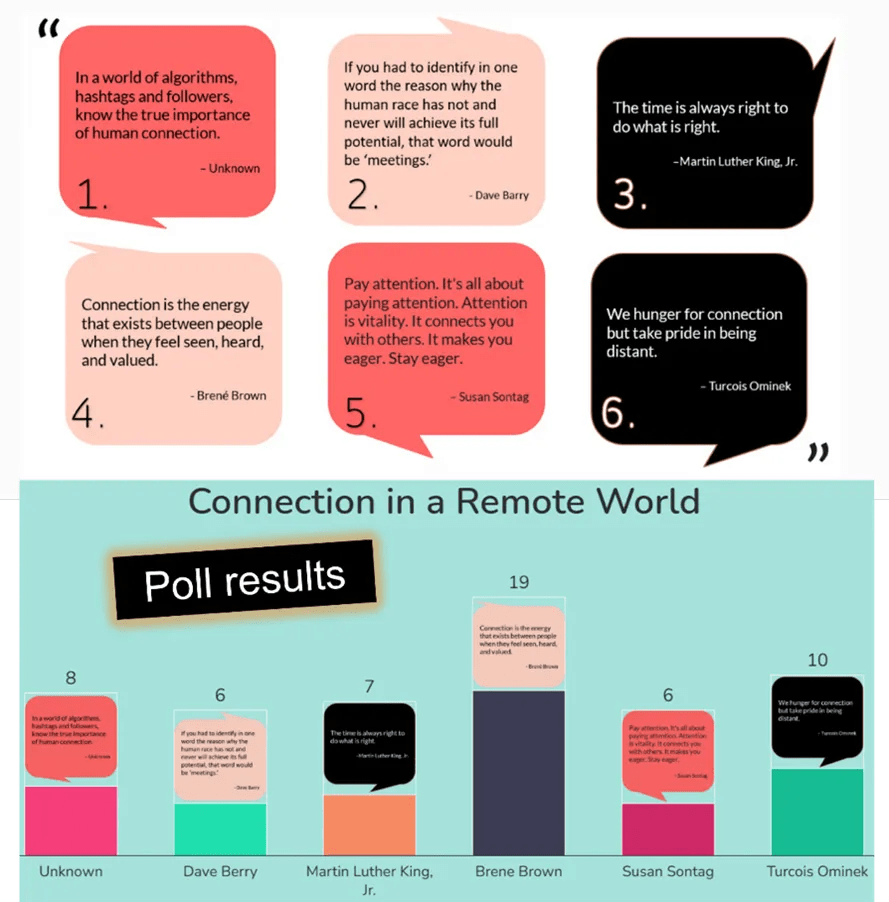
In the example shown here, I use quotes related to human connection. In another context, though, the same activity could focus on leadership, feedback, change, or decision making. The structure remains the same. The learning focus shifts.
Participants are asked one guiding question: “Which quote stands out to you when you think about digital connection?”
They discuss their choice in small breakout groups and then return to a full-group debrief. After the conversation, participants vote on the quote that resonated most, giving the facilitator immediate insight into what surfaced during the discussion.
What matters most is not the quote selected, but what the activity creates: connection.
How Quote Connect Creates Connection
Connection happens before participation feels safe or meaningful. In “Quote Connect,” connection is designed, not assumed.
First, people are invited to choose. The act of selecting a quote gives participants agency and ownership, which lowers resistance and increases engagement.
Second, the quotes are open to interpretation. There’s no right answer. This removes performance pressure and creates a sense of psychological safety for sharing perspectives.
Third, small-group conversation invites people to talk about beliefs and lived experience rather than abstract concepts. Participants reflect on how ideas show up in their own work.
Together, these elements help people feel seen, heard, and included. Connection becomes the foundation for everything that follows.
How Quote Connect Enables People
Enablement isn’t about completing an activity. It is about what people are able to do differently because of it. In “Quote Connect,” this enablement begins in the debrief.
Rather than asking participants to summarize the discussion, the facilitator guides reflection using questions such as:
How does this quote challenge or affirm your current beliefs?
What’s one mindset shift or action you could take from this quote into your next meeting or workday?
These questions invite people to pause, examine their thinking, and make conscious choices. Participants are not just reacting to content. They are identifying how their own assumptions, habits, or behaviors might shift.
The follow-up vote adds another layer of enablement. When participants select the quote that resonated most, individual reflection becomes visible. The group can see where perspectives align, where they differ, and where curiosity may be worth exploring further.
For the facilitator, this creates focus. Instead of guessing what landed, the debrief centers on what people found most meaningful. For participants, it reinforces that their thinking matters and that learning is something they actively shape.
People leave the activity with clearer awareness, stronger language for their beliefs, and a concrete idea they can carry into their next interaction.
Why Revisiting Familiar Activities Matters
The purpose of “Connect and Enable” isn’t to add novelty or complexity. It’s to make intention explicit.
“Quote Connect” works not because of the quotes themselves, but because the activity is deliberately designed to create connection first and enable action second.
Revisiting facilitation fundamentals helps ensure that learning doesn’t get lost in motion. It encourages us as facilitators to slow down, examine assumptions, and design experiences that lead to meaningful outcomes rather than just participation.
Continuing the Practice
Revisiting facilitation practices isn’t a one-time exercise. It’s an ongoing discipline.
As learning environments continue to shift, facilitators must be intentional about how connection is created and how enablement is supported. Engagement alone is not the finish line.
The fundamentals still matter: how we apply them must continue to evolve.
Explore more thoughts on revisiting facilitation fundamentals in Kassy LaBorie’s ongoing LinkedIn series, starting with this post on how the right question can turn engagement into action.
View Courses Recommended for You