
ATD Blog
Designing for Online Collaborative Learning
Thu Apr 14 2016

Content
This is the second post in series on how to design, conduct, and assess an effective online collaborative learning program.
This is the second post in series on how to design, conduct, and assess an effective online collaborative learning program.
Content
The first installment of this series looked at why collaborative learning is an important instrument in the L&D professional’s toolbox. Now, let’s take a closer look at specific design elements of collaborative learning.
The first installment of this series looked at why collaborative learning is an important instrument in the L&D professional’s toolbox. Now, let’s take a closer look at specific design elements of collaborative learning.
Content
To ensure participation and responsiveness, consider the following questions when designing the structure of an online collaborative learning program:
To ensure participation and responsiveness, consider the following questions when designing the structure of an online collaborative learning program:
Content
Is it clear, doable, and agreed upon by stakeholders?
Is it clear, doable, and agreed upon by stakeholders?
Content
Is it flexible enough to accommodate changes and improvements, if required?
Is it flexible enough to accommodate changes and improvements, if required?
Content
Does it support the goal of online collaborative learning?
Does it support the goal of online collaborative learning?
Content
Does it require participants to contribute equally?
Does it require participants to contribute equally?
Content
Will it provide an environment for open interaction, guidance, feedback, and evaluation?
Will it provide an environment for open interaction, guidance, feedback, and evaluation?
Content
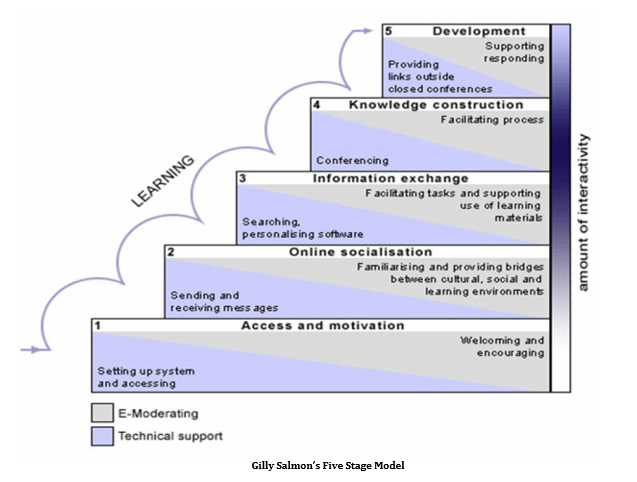
For an active online discussion, use the Five Stage model by Gilly Salmon to gradually build on participants’ previous experiences and break isolation for greater participation.
For an active online discussion, use the Five Stage model by Gilly Salmon to gradually build on participants’ previous experiences and break isolation for greater participation.
Content
For effective online learning and reflection, participants should be able to take control of their own learning, then build on acquired ideas and apply them on the job, thereby maximizing the value of online collaborative learning. Scaffolding within the approach helps to bring participants close to the desired level of contribution.
For effective online learning and reflection, participants should be able to take control of their own learning, then build on acquired ideas and apply them on the job, thereby maximizing the value of online collaborative learning. Scaffolding within the approach helps to bring participants close to the desired level of contribution.
Content
Here are some tips for designing an online collaborative learning program:
Here are some tips for designing an online collaborative learning program:
Content
Include introductory topics to familiarize participants with the online collaborative learning program, its importance, and its monitoring process.
Include introductory topics to familiarize participants with the online collaborative learning program, its importance, and its monitoring process.
Content
Explain the goal and communicate the reward . This will cater to the initial stages of the Five Stage model.
Explain the goal and communicate the reward. This will cater to the initial stages of the Five Stage model.
Content
Help participants understand their role . They need to take ownership of participation, articulation, reflection, learning, supporting the learning process for others, and self-assessment. Try to group participants with similar levels of knowledge to gain more cognitive benefits through collaboration.
Help participants understand their role. They need to take ownership of participation, articulation, reflection, learning, supporting the learning process for others, and self-assessment. Try to group participants with similar levels of knowledge to gain more cognitive benefits through collaboration.
Content
Build a sense of community for a shared purpose, so that participants get to know and rely on one another and feel comfortable enough to collaborate. Support the growing group cohesion and confidence.
Build a sense of community for a shared purpose, so that participants get to know and rely on one another and feel comfortable enough to collaborate. Support the growing group cohesion and confidence.
Content
Set group rewards based on individual learning. This reward interdependence will help achieve individual accountability.
Set group rewards based on individual learning. This reward interdependence will help achieve individual accountability.
Content
Organize discussion topics with prestructured threads to avoid repetition, redundancy, and discussion chaos. Well-defined threaded discussions facilitate in-depth discussion and interactive responses within easy-to-find clusters.
Organize discussion topics with prestructured threads to avoid repetition, redundancy, and discussion chaos. Well-defined threaded discussions facilitate in-depth discussion and interactive responses within easy-to-find clusters.
Content
Ensure that the environment is conducive to learning through meaningful discussions and guidance sharing. Also, make sure that the learning environment is intuitive and accessible from outside the workplace for ease of use and flexibility.
Ensure that the environment is conducive to learning through meaningful discussions and guidance sharing. Also, make sure that the learning environment is intuitive and accessible from outside the workplace for ease of use and flexibility.
Content
Include various types of collaborative activities . Some activities may require participants to work on different elements of an activity individually that can be combined at a final stage. This can be tweaked to form another kind of activity where participants are required to work sequentially (building on the progressive version of output one after the other) and then finally bring together a complete product. Another common way to collaborate is to get all the members of a team to work together to produce an output.
Include various types of collaborative activities. Some activities may require participants to work on different elements of an activity individually that can be combined at a final stage. This can be tweaked to form another kind of activity where participants are required to work sequentially (building on the progressive version of output one after the other) and then finally bring together a complete product. Another common way to collaborate is to get all the members of a team to work together to produce an output.
Content
Give participants opportunities to think , rethink, and self-evaluate their understanding through written exercises.
Give participants opportunities to think, rethink, and self-evaluate their understanding through written exercises.
Content
Include incremental, reflective open-ended questions , so participants can build on their knowledge by assimilating new knowledge into their job duties. This supports a continual learning process and will help demonstrate learning in the workplace. The questions should be very specific to the discussion topics and directly link to participants’ work requirements.
Include incremental, reflective open-ended questions, so participants can build on their knowledge by assimilating new knowledge into their job duties. This supports a continual learning process and will help demonstrate learning in the workplace. The questions should be very specific to the discussion topics and directly link to participants’ work requirements.
Content
Establish clear and transparent criteria for assessment . It should indicate the success and failure criteria or the level of acceptable performance for each activity or assignment. This directly affects participants’ performance. The criteria may include quality of posts, performance in group tasks, extent of collaboration, and evidence of improvement in knowledge, skills, or behavior.
Establish clear and transparent criteria for assessment. It should indicate the success and failure criteria or the level of acceptable performance for each activity or assignment. This directly affects participants’ performance. The criteria may include quality of posts, performance in group tasks, extent of collaboration, and evidence of improvement in knowledge, skills, or behavior.
Content
In addition to strategically designing and structuring an online collaborative program, conducting the sessions in a way that results in deeper learning and reflection is equally critical.
In addition to strategically designing and structuring an online collaborative program, conducting the sessions in a way that results in deeper learning and reflection is equally critical.
Content
The third post in this series will cover guidelines for moderators and facilitators on how to effectively conduct an online collaborative learning program.
The third post in this series will cover guidelines for moderators and facilitators on how to effectively conduct an online collaborative learning program.