
ATD Blog
Elevator Pitch 2.0: Part 2
Tue Nov 19 2013

Content
The major take-away from the post, “ The Elevator Pitch 2.0: Part 1 ,” quite simply, is that you must move from a situation of “knowing something” to a higher position of “being known for something.”
The major take-away from the post, “The Elevator Pitch 2.0: Part 1,” quite simply, is that you must move from a situation of “knowing something” to a higher position of “being known for something.”
Content
The real impact from an “elevator pitch” comes when you are able to position yourself rather than just pitch your product or service. Bottom line: The Elevator Pitch 2.0 aims “to get their attention” by saying something that is compelling—so compelling, in fact, that you don’t see glazed over eyes.
The real impact from an “elevator pitch” comes when you are able to position yourself rather than just pitch your product or service. Bottom line: The Elevator Pitch 2.0 aims “to get their attention” by saying something that is compelling—so compelling, in fact, that you don’t see glazed over eyes.
Content
Avoiding glazed-over expression
Avoiding glazed-over expression
Content
When you only refer to issues or challenges that are known and often spoken about, be ready to see glazed-over expressions from your listeners. You know what I’m talking about. Avoid covering the ideas—and buzz phrases—that everyone already knows are important: earn more money, achieve more sales, or improve teamwork. It’s because everyone else talks about them that they have become bland and mediocre attention grabbers.
When you only refer to issues or challenges that are known and often spoken about, be ready to see glazed-over expressions from your listeners. You know what I’m talking about. Avoid covering the ideas—and buzz phrases—that everyone already knows are important: earn more money, achieve more sales, or improve teamwork. It’s because everyone else talks about them that they have become bland and mediocre attention grabbers.
Content
Instead, the Elevator Pitch 2.0 must tap into issues or challenges that the prospect knows about but are not often discussed. It is more powerful because it actually creates real empathy; they get a sense that you feel the same way they feel about something that keeps them up at night.
Instead, the Elevator Pitch 2.0 must tap into issues or challenges that the prospect knows about but are not often discussed. It is more powerful because it actually creates real empathy; they get a sense that you feel the same way they feel about something that keeps them up at night.
Content
Case in point
Case in point
Content
All sales managers have sales rep (SR) development as a part of their responsibilities. So, of course, managers spend a lot of time coaching sales reps to “sell better.” But here’s the thing: managers only really spend about one in every 10 sales calls actually with an SR in-person.
All sales managers have sales rep (SR) development as a part of their responsibilities. So, of course, managers spend a lot of time coaching sales reps to “sell better.” But here’s the thing: managers only really spend about one in every 10 sales calls actually with an SR in-person.
Content
When they are with the SR, they can discuss better approaches, better questions, better anything. And they can even test strategies and tactics during calls and role play the changes. But that probably only happens in 10 percent of the calls a SR makes. The other 90 percent of the time the SR is working solo without the face-to-face influence of their sales manager.
When they are with the SR, they can discuss better approaches, better questions, better anything. And they can even test strategies and tactics during calls and role play the changes. But that probably only happens in 10 percent of the calls a SR makes. The other 90 percent of the time the SR is working solo without the face-to-face influence of their sales manager.
Content
How do sales managers know that their coaching actually sticks—that the SR’s behavior has changed when the sales manager is not there?
How do sales managers know that their coaching actually sticks—that the SR’s behavior has changed when the sales manager is not there?
Content
The answer is that they don’t know. Worse: they rarely even talk about it. And that’s what makes my “nothing changes” approach so powerfully empathetic.
The answer is that they don’t know. Worse: they rarely even talk about it. And that’s what makes my “nothing changes” approach so powerfully empathetic.
Content
The next step
The next step
Content
If I get a nod, a wry smile, or a wince of embarrassment, I say, “Well, that’s what I do. I make sure that you’ll never have those feelings again.”
If I get a nod, a wry smile, or a wince of embarrassment, I say, “Well, that’s what I do. I make sure that you’ll never have those feelings again.”
Content
Here’s where I pause. I actually stop talking until the prospect says something. This is a moment of truth and my most effective qualifier of whether this person is in fact a prospect or not.
Here’s where I pause. I actually stop talking until the prospect says something. This is a moment of truth and my most effective qualifier of whether this person is in fact a prospect or not.
Content
If they then ask, “How do you do that?” I’ll set up an appointment to talk further. It’s at that next meeting that I take out my “talking pad” to discuss and draw my value proposition and my sales coaching mastery process. If there’s no response, they are not a prospect. I move on.
If they then ask, “How do you do that?” I’ll set up an appointment to talk further. It’s at that next meeting that I take out my “talking pad” to discuss and draw my value proposition and my sales coaching mastery process. If there’s no response, they are not a prospect. I move on.
Content
New Look at an old problem
New Look at an old problem
Content
My own Elevator Pitch breakthrough came after reading some Harvard Business Review articles by Ted Levitt, a Harvard Business School professor who was often called “the founder of modern marketing.” What I discovered was a simple, really clever technique to focus (or maybe refocus) me on creating a crackerjack Elevator Pitch. It involved taking a slightly different big picture view of the business.
My own Elevator Pitch breakthrough came after reading some Harvard Business Review articles by Ted Levitt, a Harvard Business School professor who was often called “the founder of modern marketing.” What I discovered was a simple, really clever technique to focus (or maybe refocus) me on creating a crackerjack Elevator Pitch. It involved taking a slightly different big picture view of the business.
Content
Levitt has said that success in business is determined by asking two simple questions:
Levitt has said that success in business is determined by asking two simple questions:
Content
What do we do?
What do we do?
Content
What business are we in?
What business are we in?
Content
Let me illustrate this subtle, though powerful, distinction with an example. If we ask those two questions about McDonalds then we’d get something like, “What we do is sell fast food.” No surprizes there.
Let me illustrate this subtle, though powerful, distinction with an example. If we ask those two questions about McDonalds then we’d get something like, “What we do is sell fast food.” No surprizes there.
Content
But to the second question, we get answers like, “We are in the convenience, consistency, predictable, family-oriented business.” All of those words have a feeling or emotion inherent in them. They describe the experience—not the logic or facts associated with their products. So, McDonalds has recently added salads and café coffees. To do this they would FIRST have ensured that delivering the new food would still be “convenient, consistent, and predictable.”
But to the second question, we get answers like, “We are in the convenience, consistency, predictable, family-oriented business.” All of those words have a feeling or emotion inherent in them. They describe the experience—not the logic or facts associated with their products. So, McDonalds has recently added salads and café coffees. To do this they would FIRST have ensured that delivering the new food would still be “convenient, consistent, and predictable.”
Content
The answer(s) to first question taps into the logic/facts/processes of the physical things that they do. The second question taps into the emotional connection with customers.
The answer(s) to first question taps into the logic/facts/processes of the physical things that they do. The second question taps into the emotional connection with customers.
Content
They may well be able to change the answer to the first question easily (add salads). But what would happen to their business if customers found the experience inconvenient, inconsistent, and unpredictable?
They may well be able to change the answer to the first question easily (add salads). But what would happen to their business if customers found the experience inconvenient, inconsistent, and unpredictable?
Content
Want another example? Charles Revson, the founder of Revlon said, “In the factory we make cosmetics. In the stores we sell hope.” There was never any confusion with the “What do we do?” question. Revlon made, marketed, and sold cosmetics, skin care products, and fragrances. The answer to the question, “What business are we in?” was crystal clear to Revson, as well—the hope business.
Want another example? Charles Revson, the founder of Revlon said, “In the factory we make cosmetics. In the stores we sell hope.” There was never any confusion with the “What do we do?” question. Revlon made, marketed, and sold cosmetics, skin care products, and fragrances. The answer to the question, “What business are we in?” was crystal clear to Revson, as well—the hope business.
Content
The subtlety between the two questions is so powerful, in fact, that it defines a compelling value proposition. First, that’s not to say that the quality and efficacy of Revlon’s (or anyone’s) products are not important. It is still as important as it always has been. It’s just that customers almost take this aspect as a given.
The subtlety between the two questions is so powerful, in fact, that it defines a compelling value proposition. First, that’s not to say that the quality and efficacy of Revlon’s (or anyone’s) products are not important. It is still as important as it always has been. It’s just that customers almost take this aspect as a given.
Content
Second, the real distinction between Revlon and its competitors—and its level of commercial success—was everyone in the company having a grasp of the question, “What business we are in?” More important, they had to be able to act on it.
Second, the real distinction between Revlon and its competitors—and its level of commercial success—was everyone in the company having a grasp of the question, “What business we are in?” More important, they had to be able to act on it.
Content
Basically, it’s all about how the customer feels during the sales process. You can’t bore people into buying from you. Really successful business people understand the interplay, and the required imbalance, between an adequate ability with the “What do you do?” facts, logic, and processes, AND a fantastic ability to connect emotionally with prospective customers.
Basically, it’s all about how the customer feels during the sales process. You can’t bore people into buying from you. Really successful business people understand the interplay, and the required imbalance, between an adequate ability with the “What do you do?” facts, logic, and processes, AND a fantastic ability to connect emotionally with prospective customers.
Content
The magic of the Elevator Pitch 2.0 occurs when you nail that imbalance and prospects “get it.”
The magic of the Elevator Pitch 2.0 occurs when you nail that imbalance and prospects “get it.”
Content
Reviewing the model
Reviewing the model
Content
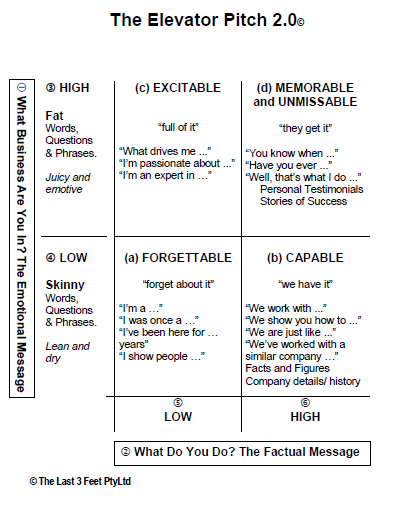
Take a look at the complete Elevator Pitch 2.0 model (see below) that incorporates all the likely personal interactions I’ll have from people at a neighbourhood BBQ to executives around a boardroom table.
Take a look at the complete Elevator Pitch 2.0 model (see below) that incorporates all the likely personal interactions I’ll have from people at a neighbourhood BBQ to executives around a boardroom table.
Content
First, look at the vertical axis on the model (#1) and the horizontal axis (#2). Next, each axis is divided into “high attention grabbing” (#3 and #6) and “low attention grabbing” (#4 and #5).
First, look at the vertical axis on the model (#1) and the horizontal axis (#2). Next, each axis is divided into “high attention grabbing” (#3 and #6) and “low attention grabbing” (#4 and #5).
Content
I then looked at each of the four combinations: (a), (b), (c), and (d). I went back through my research and own experience and developed descriptors of how someone (using these words and phrases) would look, sound, and feel to the prospect, and the typical words and phrases they would use.
I then looked at each of the four combinations: (a), (b), (c), and (d). I went back through my research and own experience and developed descriptors of how someone (using these words and phrases) would look, sound, and feel to the prospect, and the typical words and phrases they would use.
Content
Have a look over the model now. I’m sure you’ll find it straightforward.
Have a look over the model now. I’m sure you’ll find it straightforward.
Content
Applying the Elevator Pitch 2.0
Applying the Elevator Pitch 2.0
Content
My experience with my Elevator Pitch 2.0 has been that decision makers and executives who have a high energy feel about them are more responsive to “What business are you in?” words and phrases. Meanwhile, the more operational leaders (and low energy people) respond to “What do you do?” words and phrases.
My experience with my Elevator Pitch 2.0 has been that decision makers and executives who have a high energy feel about them are more responsive to “What business are you in?” words and phrases. Meanwhile, the more operational leaders (and low energy people) respond to “What do you do?” words and phrases.
Content
The more informal the gathering is, the more likely I’ll use “What do you do?” words and phrases. As a result, I select those words and phrases from 2 or 3 boxes that suit the person I’m talking with.
The more informal the gathering is, the more likely I’ll use “What do you do?” words and phrases. As a result, I select those words and phrases from 2 or 3 boxes that suit the person I’m talking with.
Content
Using all the words and phrases is a great way to describe the totality of your company. Review your last proposal and you’ll find examples of each and every phrase. If you really want to grab their attention, determine which words and phrases (from which boxes) should be at the start.
Using all the words and phrases is a great way to describe the totality of your company. Review your last proposal and you’ll find examples of each and every phrase. If you really want to grab their attention, determine which words and phrases (from which boxes) should be at the start.