
ATD Blog
Embedding Mindfulness to Meet the Challenges of a Changing Workplace
Mon Dec 20 2021

Content
Workplaces are changing at an unprecedented pace. What’s more, the forces for change are coming from all angles: how work is done (technology such as artificial intelligence and big data analytics), where work is performed (in person, remote, or hybrid environments), demographics and geography of talent (think fewer homogeneous individuals working in globally matrixed organizations), and a need for shifting skill sets for employees performing work.
Content
How can leaders and managers prepare their teams for potential unstable conditions in 2022 and beyond? How can workers develop a solid grounding in the fundamental, cross-functional skills, knowledge, and capabilities that will help them meet and adapt?
Content
One answer involves leaders, managers, and individual contributors developing critical self-management and interpersonal skills by:
Content
Gaining insight into thoughts and feelings to avoid being blinded by or unconsciously ruled by them
Content
Regulating emotions, especially highly negative ones that can lead to destructive actions
Content
Down regulating the nervous system to mitigate amygdala hijack and high-stress episodes
Content
Increasing cognitive flexibility to be creative and see other possibilities even in the face of difficulty
Content
As the World Economic Forum and LinkedIn noted , having a foundation in emotional intelligence will be essential for employees across all industries, no matter how jobs change in the future. Mindfulness is the doorway to the acquisition of emotional intelligence.
As the World Economic Forum and LinkedIn noted, having a foundation in emotional intelligence will be essential for employees across all industries, no matter how jobs change in the future. Mindfulness is the doorway to the acquisition of emotional intelligence.
Increased Interest in Mindfulness and Meditation
Content
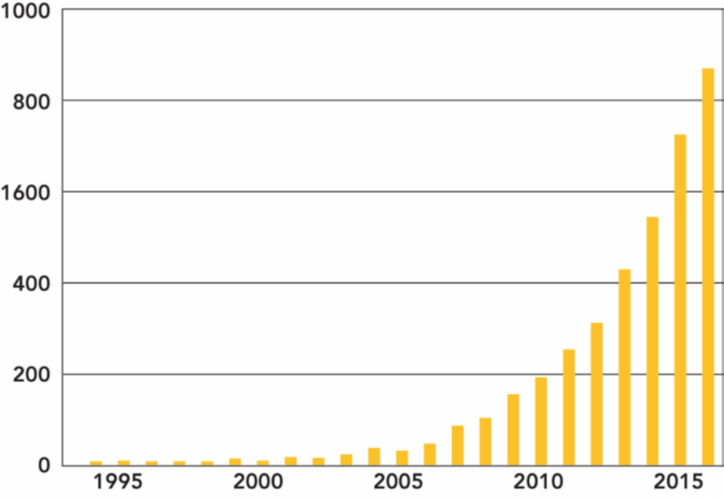
Most American workers have heard of meditation and mindfulness. In fact, we are seeing a surge of mindfulness research, as the chart below illustrates.

Content
But what do meditation and mindfulness really mean?
Content
Meditation is the practice and ability to stay focused on a single object or task without the mind wandering away. Years ago, while studying in India, one of my first teachers taught me to concentrate by chanting “Om” for an hour.
Content
Today, I teach students to concentrate by staying with the full cycle of movement as their breath moves in, pauses, and moves out of their bodies. Meditation is a concentration practice. As it relates to our work, it has the benefit of training our minds to stay with a task without being easily distracted so that we feel less scattered and work with greater ease and productivity.
Content
Practicing mindfulness has the immediate aim of bringing conscious awareness to matters surfacing in our inner
Content
and outer worlds in the present moment. Because we spend so much of our lives engaged in unconscious behavior that can be distracting, mindfulness has the benefit of bringing us back to the here and now in an intentional way. In keeping with the classic tradition, I teach using the breath and the body as tools to help employees gain insight into their thoughts, emotions, and bodily sensations that can be happening at any point in time.
Content
Mindfulness meditation is sometimes called vipassana or insight meditation because its aim is to promote insight so that we can engage in more skillful actions in our everyday lives, such as when we interact with colleagues, clients, family members, neighbors, or strangers.
Work-Adjacent Mindfulness: Your Right Now Strategy
Content
An increasing number of organizations have been implementing work-adjacent mindfulness programs at their workplaces. These mindfulness-based courses, which range anywhere from one hour to multiweek programs, are designed to help employees be more skillful in responding to the difficulties and stresses of work. Such programs may include regular, facilitated group meditation, learning various mindfulness techniques, dedicated quiet rooms, expert speakers, and a resource library. According to research from the Business Group on Health and Fidelity Investments, 22 percent of companies offer mindfulness training programs, and 9.3 million Americans meditate.
Content
Companies report impressive gains, particularly in the domains of stress reduction and increased resilience. For example, companies have reported reductions in employee stress ranging from 14 percent (Google) to as high as 50 percent (Dow Chemical) and increased resilience as high as 40 percent (Google).
Content
Mindfulness programming aimed at stress reduction, burnout recovery, and increased resilience is just the beginning, however. Work-adjacent mindfulness has the potential to dramatically improve the way we work , not just react to it.
Mindfulness programming aimed at stress reduction, burnout recovery, and increased resilience is just the beginning, however. Work-adjacent mindfulness has the potential to dramatically improve the way we work, not just react to it.
Content
Developing a more mindful state, particularly during moments of consequential decision making, helps position leaders for greater goal achievement. For example, I use mindfulness as a central strategy to combat unconscious bias. If a manager wants to hire a less homogeneous workforce but doesn’t realize he has a negative reaction to candidates who don’t look like him, he is less likely to fulfill this aspirational goal, even if this shortcoming is not driven by a malicious motivation.
Content
Managing workplace conflict is another opportunity for managers and leaders to take advantage of mindfulness. As matrixed organizations become more common and teams become increasingly less homogenous, there’s greater prospect for conflict . When the workplace is laden with conflict but leaders unconsciously (or consciously) avoid dealing with it, they will likely fail to foster creative, engaged, and cohesive teams.
Managing workplace conflict is another opportunity for managers and leaders to take advantage of mindfulness. As matrixed organizations become more common and teams become increasingly less homogenous, there’s greater prospect for conflict. When the workplace is laden with conflict but leaders unconsciously (or consciously) avoid dealing with it, they will likely fail to foster creative, engaged, and cohesive teams.
Content
Conflict management as an opportunity to embed mindfulness is important. I write about it in my forthcoming book, Resilient in Conflict: How Managers Use Mindfulness to Navigate Workplace Conflict With Courage . The book describes the SNAP BC model—a hands-on, integrated approach to developing greater self-mastery in the face of adversity and conflict. The acronym SNAP BC stands for:
Conflict management as an opportunity to embed mindfulness is important. I write about it in my forthcoming book, Resilient in Conflict: How Managers Use Mindfulness to Navigate Workplace Conflict With Courage. The book describes the SNAP BC model—a hands-on, integrated approach to developing greater self-mastery in the face of adversity and conflict. The acronym SNAP BC stands for:
Content
See it.
See it.
Content
Name it.
Name it.
Content
Accept it.
Accept it.
Content
Pause.
Pause.
Content
Breathe.
Breathe.
Content
Choose it.
Choose it.
Content
Bottom Line
Bottom Line
Content
Embedding mindfulness means affirmatively and intentionally applying mindfulness techniques and practices to our work, not just in response to what the work is doing to us (a recent Deloitte Insights article similarly discusses embedding versus adjacency with respect to employee well-being). When we do this, the results from personal experience, anecdotal evidence, and formal studies show:
Content
Mindfulness generates greater awareness of ourselves and of others. In fact, the UK’s government’s department of health reports employees’ self-awareness and awareness of others improved by 30 percent.
Content
Mindfulness can improve our work relationships. The investment management company BlackRock reports 52 percent of survey respondents say they are “better able to manage work relationships.” Likewise, multinational software company SAP reports relationships improved by 7.1 percent.
Content
Mindfulness helps us collaborate better. For instance, SAP reports collaboration improved by 5.2 percent.
Content
Mindfulness enables employees to be more innovative and creative. Nearly half of BlackRock employees (46 percent) report improvement in innovation and creativity.
Content
So, the next time you consider a mindfulness training intervention, leverage it to grab the low-hanging fruit of stress reduction, increased resilience, and so on. But don’t overlook the higher branches. Consider reaching for the higher hanging, but no less succulent, fruit of embedded mindfulness, which can offer deeper, sustained organizational rewards.