
ATD Blog
Ensure Sales Training Success with Change Leadership and Management – Part 1
Tue Aug 06 2013

Content
Welcome back, sales enablers!
Welcome back, sales enablers!
Content
My daughter occasionally shops at Hot Topic. Every time I’m forced to veer in there, I amuse myself by making bad puns (in my head, of course), about what I perceive as real hot topics, like global economic issues, unemployment, healthcare regulations, or perhaps…making significant investments in sales training without any adoption, sustainment, or change plans.
My daughter occasionally shops at Hot Topic. Every time I’m forced to veer in there, I amuse myself by making bad puns (in my head, of course), about what I perceive as real hot topics, like global economic issues, unemployment, healthcare regulations, or perhaps…making significant investments in sales training without any adoption, sustainment, or change plans.
Content
Oops. That last one hits a little too close to home, doesn’t it?
Oops. That last one hits a little too close to home, doesn’t it?
Content
In my recent series of posts on the Sales Performance Ecosystem and follow-up posts on selecting and prioritizing sales enablement solutions ( Part 1 and Part 2 ), I promised I’d talk next about change management and change leadership. Let’s start by defining those terms.
In my recent series of posts on the Sales Performance Ecosystem and follow-up posts on selecting and prioritizing sales enablement solutions (Part 1 and Part 2), I promised I’d talk next about change management and change leadership. Let’s start by defining those terms.
Content
Change what you think about change
Change what you think about change
Content
Much has been written about the difference between management and leadership. Unfortunately, it’s often at the expense of management, with leadership being touted.
Much has been written about the difference between management and leadership. Unfortunately, it’s often at the expense of management, with leadership being touted.
Content
In reality, both are required to run an organization effectively. Some say leadership and management are both skill sets that can be learned; others posit that you can’t be both a leader and a manager. Many leadership experts have astute and varying viewpoints. There’s similarity, of course, but everyone has a somewhat different take. To capture the essence of the difference between management and leadership, I’ve always liked Peter Drucker’s simple quote: “Management is doing things right; leadership is doing the right things.”
In reality, both are required to run an organization effectively. Some say leadership and management are both skill sets that can be learned; others posit that you can’t be both a leader and a manager. Many leadership experts have astute and varying viewpoints. There’s similarity, of course, but everyone has a somewhat different take. To capture the essence of the difference between management and leadership, I’ve always liked Peter Drucker’s simple quote: “Management is doing things right; leadership is doing the right things.”
Content
I define change leadership as:
I define change leadership as:
Content
developing the over-arching vision (“here’s what we want to be”) and direction (“so take that hill! charge!”)
developing the over-arching vision (“here’s what we want to be”) and direction (“so take that hill! charge!”)
Content
forging the connection between the vision, strategy, critical business initiatives, and people’s roles (the power of “connecting dots” simply can’t be overstated)
forging the connection between the vision, strategy, critical business initiatives, and people’s roles (the power of “connecting dots” simply can’t be overstated)
Content
changing the conversation at all levels to motivate and inspect the change (you move people with language and stories – or for Aristotle fans – with ethos, pathos, and logos).
changing the conversation at all levels to motivate and inspect the change (you move people with language and stories – or for Aristotle fans – with ethos, pathos, and logos).
Content
modeling and reinforcing the messages (awareness) and the urgency consistently, with discipline (not “flavor of the month” but the “flavor of our future”).
modeling and reinforcing the messages (awareness) and the urgency consistently, with discipline (not “flavor of the month” but the “flavor of our future”).
Content
I think of change management as:
I think of change management as:
Content
delivering the same consistent messaging as leadership, to sustain awareness and urgency at frontline levels, where the work with customers occurs
delivering the same consistent messaging as leadership, to sustain awareness and urgency at frontline levels, where the work with customers occurs
Content
implementing processes, programs, and directives to support the change and new desired state
implementing processes, programs, and directives to support the change and new desired state
Content
following a plan to meet milestones of measurement and achievement (project management)
following a plan to meet milestones of measurement and achievement (project management)
Content
engaging the entire workforce with “what to do and how to do it” (since they already know “why” from the messaging)
engaging the entire workforce with “what to do and how to do it” (since they already know “why” from the messaging)
Content
Here are some resources on the distinctions between change leadership and change management:
Here are some resources on the distinctions between change leadership and change management:
Content
Peter Drucker on Leadership – Forbes
Peter Drucker on Leadership – Forbes
Content
Change Management vs. Change Leadership - What's the Difference? – John Kotter
Change Management vs. Change Leadership - What's the Difference? – John Kotter
Content
Why Change Management? – Prosci.
Why Change Management? – Prosci.
Content
Should you always orchestrate a full-fledged change initiative?
Should you always orchestrate a full-fledged change initiative?
Content
This is the big question, right? The real question is whether you really need to drive full-scale change and sustainment or simply foster transfer and adoption. (By the way, “simply” in this case does not mean “easy.” Although, it may be “easier” in comparison.)
This is the big question, right? The real question is whether you really need to drive full-scale change and sustainment or simply foster transfer and adoption. (By the way, “simply” in this case does not mean “easy.” Although, it may be “easier” in comparison.)
Content
Training transfer (or what I like to call “planned transfer”) includes plans to get the training out of the learning environment and used on the job. In Kirkpatrick Level 3, this is “Application.”
Training transfer (or what I like to call “planned transfer”) includes plans to get the training out of the learning environment and used on the job. In Kirkpatrick Level 3, this is “Application.”
Content
The goal of transfer is often a deeper level of adoption…not just being able to demonstrate the skills and use them on-the-job, but to adopt them consistently, in the right circumstances. Adoption occurs as a learner moves through the stages of learning toward mastery (conscious incompetence to conscious competence to unconscious competence).
The goal of transfer is often a deeper level of adoption…not just being able to demonstrate the skills and use them on-the-job, but to adopt them consistently, in the right circumstances. Adoption occurs as a learner moves through the stages of learning toward mastery (conscious incompetence to conscious competence to unconscious competence).
Content
Change and sustainment efforts are required when you need behavior changes at multiple levels in the organization, in order to achieve strategic goals (make money, save money, manage risk) and need the change to stick.
Change and sustainment efforts are required when you need behavior changes at multiple levels in the organization, in order to achieve strategic goals (make money, save money, manage risk) and need the change to stick.
Content
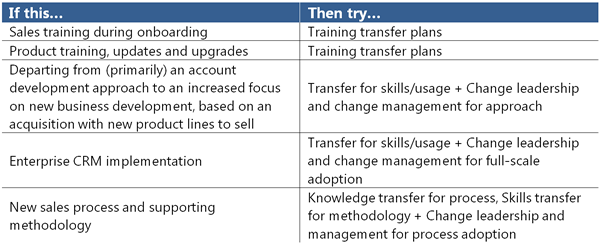
As always, specifics vary by context and circumstance, but here are some examples of what I mean:
As always, specifics vary by context and circumstance, but here are some examples of what I mean:
Content
Make sense? Here are some factors that we guide clients to consider at Richardson . Consider a change initiative when:
Make sense? Here are some factors that we guide clients to consider at Richardson. Consider a change initiative when:
Content
“Behavior change” will be a key element of achieving ambitious goals over the next eight years.
“Behavior change” will be a key element of achieving ambitious goals over the next eight years.
Content
The key to this change is not only what’s done in the learning environment, but in the adoption and reinforcement afterward.
The key to this change is not only what’s done in the learning environment, but in the adoption and reinforcement afterward.
Content
You are asking every level of leader to change behaviors in a significant way.
You are asking every level of leader to change behaviors in a significant way.
Content
Leaders must actively engage at all levels to drive and sustain the behavior changes with staff.
Leaders must actively engage at all levels to drive and sustain the behavior changes with staff.
Content
Which methodologies should I use?
Which methodologies should I use?
Content
Okay, so you’ve decided that you need to really guide a major change in your organization. Now what?
Okay, so you’ve decided that you need to really guide a major change in your organization. Now what?
Content
I’ve used a variety of methodologies over the years and will link to some others at the end of Part 2, but I’ve gotten to know Prosci’s ADKAR® methodology recently and like it quite a bit. My employer uses it internally and with clients, with great success.
I’ve used a variety of methodologies over the years and will link to some others at the end of Part 2, but I’ve gotten to know Prosci’s ADKAR® methodology recently and like it quite a bit. My employer uses it internally and with clients, with great success.
Content
ADKAR ® is:
ADKAR® is:
Content
Awareness of the need to change
Awareness of the need to change
Content
Desire to participate in the change
Desire to participate in the change
Content
Knowledge of how to do things differently
Knowledge of how to do things differently
Content
Ability to apply tools, processes, and knowledge
Ability to apply tools, processes, and knowledge
Content
Reinforcement to sustain personal efforts to change despite setbacks.
Reinforcement to sustain personal efforts to change despite setbacks.
Content
Here is some additional information about ADKAR® which should enable anyone who’s interested to learn much more about this well-researched and proven approach:
Here is some additional information about ADKAR® which should enable anyone who’s interested to learn much more about this well-researched and proven approach:
Content
Leading Your Sales Organization Through a Change Management Program – Gregg Kober of Richardson on ADKAR
Leading Your Sales Organization Through a Change Management Program – Gregg Kober of Richardson on ADKAR
Content
Change Management Learning Center - ADKAR Tutorial – Sponsored by Prosci
Change Management Learning Center - ADKAR Tutorial – Sponsored by Prosci
Content
ADKAR: A Model for Change in Business, Government and our Community – Paperback on Amazon
ADKAR: A Model for Change in Business, Government and our Community – Paperback on Amazon
Content
Part 1: A Practical Approach to Change Management – YouTube video on ADKAR (9 minutes) Part 2: A Practical Approach to Change Management – YouTube video on ADKAR (12 minutes). I’ll stop here for now and pick up next time to share some specific differentiating elements that we’ve found very effective, such as the Change Story Framework , the P + P + A + S > R formula, and Adoption Questions . Until then, happy enabling!
Part 1: A Practical Approach to Change Management – YouTube video on ADKAR (9 minutes) Part 2: A Practical Approach to Change Management – YouTube video on ADKAR (12 minutes). I’ll stop here for now and pick up next time to share some specific differentiating elements that we’ve found very effective, such as the Change Story Framework, the P + P + A + S > R formula, and Adoption Questions. Until then, happy enabling!