
ATD Blog
From Content to Capability: The AI Shift L&D Can’t Ignore
Content
A recent ATD Forum Roundtable explored several ways AI tools can be applied.
A recent ATD Forum Roundtable explored several ways AI tools can be applied.
Wed Jan 21 2026

Content
I’ve been around the L&D block long enough to see tools, trends, and “the next big thing” cycle through every few years. It’s a familiar pattern: something new arrives with the promise of scaling our work, speeding up delivery, or finally making us efficient. At first, the hype is everywhere, and to be fair, these tools usually save us time. But eventually, the shiny newness wears off, and we start asking the harder, more uncomfortable questions. Are people actually learning anything? Is behavior shifting on the ground?
I’ve been around the L&D block long enough to see tools, trends, and “the next big thing” cycle through every few years. It’s a familiar pattern: something new arrives with the promise of scaling our work, speeding up delivery, or finally making us efficient. At first, the hype is everywhere, and to be fair, these tools usually save us time. But eventually, the shiny newness wears off, and we start asking the harder, more uncomfortable questions. Are people actually learning anything? Is behavior shifting on the ground?
Content
Those same questions are back on the table with AI. Only this time, the stakes feel higher, and the answers feel less clear. At a recent ATD Forum Roundtable , Dr. Karl M. Kapp, professor of instructional design & technology at Commonwealth University, tackled this head-on. His session, “From Content Generation to Capability Acceleration,” forced us to look at AI through a different lens. He started by calling out the elephant in the room: We’re all getting really good at churning out massive amounts of content, but are we actually helping people get better at their jobs?
Those same questions are back on the table with AI. Only this time, the stakes feel higher, and the answers feel less clear. At a recent ATD Forum Roundtable, Dr. Karl M. Kapp, professor of instructional design & technology at Commonwealth University, tackled this head-on. His session, “From Content Generation to Capability Acceleration,” forced us to look at AI through a different lens. He started by calling out the elephant in the room: We’re all getting really good at churning out massive amounts of content, but are we actually helping people get better at their jobs?
Content
In most organizations, AI adoption in L&D has focused on the most obvious tasks. We see it used for summarizing documents, building outlines, translating text, and generating microlearning. While these are helpful and certainly save time, they are only the first step in a much larger process. If AI is only helping us produce more content faster, we’re missing the point. The real opportunity lies in using AI to accelerate performance by helping people learn, apply new skills, and grow faster than they could on their own.
In most organizations, AI adoption in L&D has focused on the most obvious tasks. We see it used for summarizing documents, building outlines, translating text, and generating microlearning. While these are helpful and certainly save time, they are only the first step in a much larger process. If AI is only helping us produce more content faster, we’re missing the point. The real opportunity lies in using AI to accelerate performance by helping people learn, apply new skills, and grow faster than they could on their own.
Content
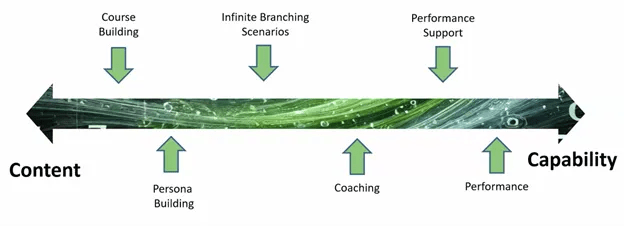
Dr. Kapp described this shift as a continuum that moves from simple content generation toward true capability development. On one end, you have tools that automate content creation. On the other hand, you have AI integrated directly into workflows, supporting real-time decision making, simulating complex scenarios, and providing personalized coaching. As you move further along that spectrum, the technology becomes more sophisticated and more effective.
Dr. Kapp described this shift as a continuum that moves from simple content generation toward true capability development. On one end, you have tools that automate content creation. On the other hand, you have AI integrated directly into workflows, supporting real-time decision making, simulating complex scenarios, and providing personalized coaching. As you move further along that spectrum, the technology becomes more sophisticated and more effective.
Content
We explored several ways these tools can be applied, and it quickly became obvious where most L&D teams tend to stop short.
We explored several ways these tools can be applied, and it quickly became obvious where most L&D teams tend to stop short.
Content
Creating content: AI can already produce slide decks, knowledge checks, and comprehensive course outlines. Certain tools can analyze a book chapter and generate glossaries, flashcards, or quizzes in minutes. However, this is just the beginning of the continuum and is where most L&D teams currently focus their efforts.
Creating content: AI can already produce slide decks, knowledge checks, and comprehensive course outlines. Certain tools can analyze a book chapter and generate glossaries, flashcards, or quizzes in minutes. However, this is just the beginning of the continuum and is where most L&D teams currently focus their efforts.
Content
Building learner personas : By using AI to create detailed learner personas, you can simulate specific human attitudes and behaviors. This enables you to test your learning designs and development strategies against realistic profiles.
Building learner personas: By using AI to create detailed learner personas, you can simulate specific human attitudes and behaviors. This enables you to test your learning designs and development strategies against realistic profiles.
Content
Designing infinite-branching simulations : By training AI on specific business interactions, you can simulate real conversations in which AI responds to a learner’s tone, pacing, and word choice. Learners then receive personalized, real-time feedback on their communication, helping them improve skills such as empathy and persuasion.
Designing infinite-branching simulations: By training AI on specific business interactions, you can simulate real conversations in which AI responds to a learner’s tone, pacing, and word choice. Learners then receive personalized, real-time feedback on their communication, helping them improve skills such as empathy and persuasion.
Content
Delivering coaching: It has historically been impossible to provide one-on-one tutoring at scale without blowing up budgets or burning out coaches. AI-powered simulations now enable us to offer the benefits of personalized coaching to a much larger audience. This is not about replacing human coaches but about making that level of support accessible to everyone.
Delivering coaching: It has historically been impossible to provide one-on-one tutoring at scale without blowing up budgets or burning out coaches. AI-powered simulations now enable us to offer the benefits of personalized coaching to a much larger audience. This is not about replacing human coaches but about making that level of support accessible to everyone.
Content
Providing performance support : By embedding guidance into everyday software such as CRMs or ERP systems, AI provides help exactly when a person is doing their job.
Providing performance support: By embedding guidance into everyday software such as CRMs or ERP systems, AI provides help exactly when a person is doing their job.
Content
Delivering performance: At the far end of the continuum, AI can complete tasks rather than merely support them. One example shared by Dr. Kapp involved using a chatbot to interview subject matter experts for requirements gathering and training needs analysis. Rather than L&D teams spending hours in meetings and documenting findings, the chatbot collects the necessary information and organizes it into a format ready for design.
Delivering performance: At the far end of the continuum, AI can complete tasks rather than merely support them. One example shared by Dr. Kapp involved using a chatbot to interview subject matter experts for requirements gathering and training needs analysis. Rather than L&D teams spending hours in meetings and documenting findings, the chatbot collects the necessary information and organizes it into a format ready for design.
Content
When Forum participants were polled about the AI Content-to-Capability Continuum, the results were as expected. Most people reported using AI for content creation, such as building courses, developing job aids, and generating instructional materials. Few indicated using AI for more advanced applications.
When Forum participants were polled about the AI Content-to-Capability Continuum, the results were as expected. Most people reported using AI for content creation, such as building courses, developing job aids, and generating instructional materials. Few indicated using AI for more advanced applications.
Content
We also examined the underlying technology that makes this shift possible. If you have followed recent discussions on AI, you have likely heard the term RAG, which stands for retrieval-augmented generation. Simply put, this is the process in which AI models retrieve relevant information from specific sources, such as company policies, internal documents, or websites, before providing an answer.
We also examined the underlying technology that makes this shift possible. If you have followed recent discussions on AI, you have likely heard the term RAG, which stands for retrieval-augmented generation. Simply put, this is the process in which AI models retrieve relevant information from specific sources, such as company policies, internal documents, or websites, before providing an answer.
Content
To make this process even more effective, Dr. Kapp introduced two additional concepts that ensure the retrieved information is more relevant and useful:
To make this process even more effective, Dr. Kapp introduced two additional concepts that ensure the retrieved information is more relevant and useful:
Content
Knowledge Graphs map the relationships between concepts within an organization, providing AI with better context. They go beyond standard search engines by helping the system understand how different pieces of information connect within an organization. This reduces errors and makes answers more reliable.
Knowledge Graphs map the relationships between concepts within an organization, providing AI with better context. They go beyond standard search engines by helping the system understand how different pieces of information connect within an organization. This reduces errors and makes answers more reliable.
Content
Experience-augmented generation (XAG) involves capturing the behavioral patterns of top performers and embedding them into AI models. While this concept is still in its early stages, combining it with knowledge graphs and RAG creates an incredibly powerful learning tool .
Experience-augmented generation (XAG) involves capturing the behavioral patterns of top performers and embedding them into AI models. While this concept is still in its early stages, combining it with knowledge graphs and RAG creates an incredibly powerful learning tool.
Content
One of the points that hit home for me in Dr. Kapp’s talk was this: Our jobs as L&D professionals are not going away as we’ve feared. In fact, they are becoming more exciting. We no longer have to spend most of our time on content creation. As that part of the process becomes more efficient, we have more time to focus on building capability and to use new technology as it evolves. Our role is shifting toward understanding the technology well enough to guide it, verify its accuracy, and shape it responsibly.
One of the points that hit home for me in Dr. Kapp’s talk was this: Our jobs as L&D professionals are not going away as we’ve feared. In fact, they are becoming more exciting. We no longer have to spend most of our time on content creation. As that part of the process becomes more efficient, we have more time to focus on building capability and to use new technology as it evolves. Our role is shifting toward understanding the technology well enough to guide it, verify its accuracy, and shape it responsibly.
A final note about this blog
Content
Here’s a fun twist: This blog was proudly co-written with my ChatGPT assistant.
Here’s a fun twist: This blog was proudly co-written with my ChatGPT assistant.
Content
If I had written this blog two years ago, it would’ve taken me a week and at least five rounds of edits. I would’ve spent hours rewatching the recording, sorting notes, drafting, revising, and second-guessing every sentence. This time, I started with the recording and my session notes, then used ChatGPT to organize the main ideas. This allowed me to spend less time wrestling with structure and more time thinking about what I really wanted to say. I still completely rewrote sections and made specific word choices to reflect my own voice, but the entire process was faster and more focused.
If I had written this blog two years ago, it would’ve taken me a week and at least five rounds of edits. I would’ve spent hours rewatching the recording, sorting notes, drafting, revising, and second-guessing every sentence. This time, I started with the recording and my session notes, then used ChatGPT to organize the main ideas. This allowed me to spend less time wrestling with structure and more time thinking about what I really wanted to say. I still completely rewrote sections and made specific word choices to reflect my own voice, but the entire process was faster and more focused.
Content
We keep saying AI won’t replace us; it will enhance us. In this case, I’m happy to say it did.
We keep saying AI won’t replace us; it will enhance us. In this case, I’m happy to say it did.
View Courses Recommended for You