
ATD Blog
Getting Round Pegs in Round Holes
Mon Dec 02 2013

Content
Do you know any talented people who are average performers? Of course you do! Do you know of any teams with lots of talent that don’t perform? The imagery of forcing a square peg into a round hole is an easily adapted metaphor to hiring processes.
Do you know any talented people who are average performers? Of course you do! Do you know of any teams with lots of talent that don’t perform? The imagery of forcing a square peg into a round hole is an easily adapted metaphor to hiring processes.
Content
Most selection processes are based on capability or potential to perform. There is an underlying assumption that talented, high-potential hires will end up being exemplary performers.
Most selection processes are based on capability or potential to perform. There is an underlying assumption that talented, high-potential hires will end up being exemplary performers.
Content
Unfortunately, this simply is not a valid assumption. One way to think about the hiring process is by associating information about the job or position as the “requirements” and those who would be successful hires as the “solutions.”
Unfortunately, this simply is not a valid assumption. One way to think about the hiring process is by associating information about the job or position as the “requirements” and those who would be successful hires as the “solutions.”
Content
Defining job requirements
Defining job requirements
Content
Frequently, job requirements are built through simple job analysis or an online survey answered by representative samples of job experts, incumbents, or managers. The problem with this approach is that each step in this logic chain is an approximation or estimate. The further we stray from well-defined performance (producing accomplishments that have value to the organization), the less likely to make a great job fit.
Frequently, job requirements are built through simple job analysis or an online survey answered by representative samples of job experts, incumbents, or managers. The problem with this approach is that each step in this logic chain is an approximation or estimate. The further we stray from well-defined performance (producing accomplishments that have value to the organization), the less likely to make a great job fit.
Content
Providing clarity
Providing clarity
Content
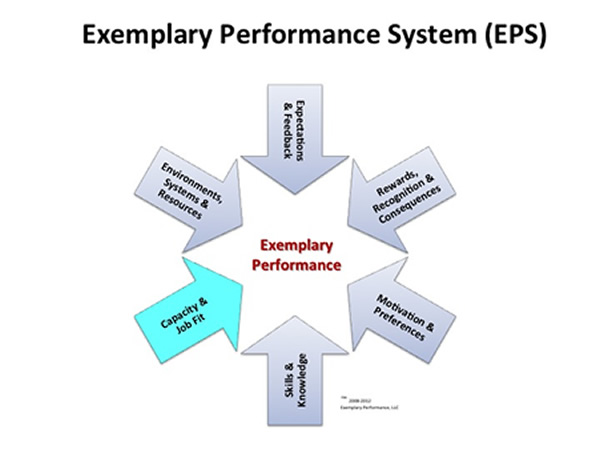
“Job Fit” in EPS is about the selection and assignment of people, but it is also about “truth in advertising.” Often, the job description used in a hiring decision is a far reach from the actual job requirements. This spells trouble from the start, since the initial search for candidates does not match what the organization requires.
“Job Fit” in EPS is about the selection and assignment of people, but it is also about “truth in advertising.” Often, the job description used in a hiring decision is a far reach from the actual job requirements. This spells trouble from the start, since the initial search for candidates does not match what the organization requires.
Content
There is also the less obvious implication that those seeking the position are not clear about their own fit. In chapter 11 of our book, Exemplary Performance – Driving Business Results by Benchmarking Your Star Performers , we cover some interesting projects in the military as well as with managers and sales teams related to clarity in job descriptions.
There is also the less obvious implication that those seeking the position are not clear about their own fit. In chapter 11 of our book, Exemplary Performance – Driving Business Results by Benchmarking Your Star Performers , we cover some interesting projects in the military as well as with managers and sales teams related to clarity in job descriptions.
Content
Leveraging job accomplishments in selection
Leveraging job accomplishments in selection
Content
Getting job fit right begins by selecting persons who have previously produced the job output, such as accomplishment, to standard.
Getting job fit right begins by selecting persons who have previously produced the job output, such as accomplishment, to standard.
Content
Consider the example of Swarovski , a global producer of cut crystal and gemstones. The company operates hundreds of retail stores throughout the United States and Canada. In 2009, the company terminated 66 percent of new sales consultants within the first year. By “putting the right person in the right job, right at the start,” this turnover was slashed in 2010 to 30 percent and translated into $22 million in additional sales.
Consider the example of Swarovski, a global producer of cut crystal and gemstones. The company operates hundreds of retail stores throughout the United States and Canada. In 2009, the company terminated 66 percent of new sales consultants within the first year. By “putting the right person in the right job, right at the start,” this turnover was slashed in 2010 to 30 percent and translated into $22 million in additional sales.
Content
A comparison of old and new talent management strategies tells the tale of how this was accomplished:
A comparison of old and new talent management strategies tells the tale of how this was accomplished:
Content | Content |
Content Previous Hiring Process Previous Hiring Process | Content New Hiring Process New Hiring Process |
Content Decentralized Decentralized | Content Centralizes assessment with hiring managers decentralized Centralizes assessment with hiring managers decentralized |
Content Order of actions: Order of actions: Content Recruiting Recruiting Content Interviewing Interviewing Content Assessment of behavioral competencies (but not aligned with competencies and skills required for sales consultant success) Assessment of behavioral competencies (but not aligned with competencies and skills required for sales consultant success) | Content Order of actions: Order of actions: Content Assessment test administered Assessment test administered Content Recruiting (résumé exchanged) Recruiting (résumé exchanged) Content Interviewing Interviewing |
Content The effects of not getting the right person in the right job can manifest itself in numerous ways. Fixing the problems after persons are hired may be challenging at best or result in terminations. Preventing the bad fit by making the accomplishments clear at the onset of the hiring process makes more sense. The effects of not getting the right person in the right job can manifest itself in numerous ways. Fixing the problems after persons are hired may be challenging at best or result in terminations. Preventing the bad fit by making the accomplishments clear at the onset of the hiring process makes more sense. |
Content
For more on how to shift the performance curve, browse the full series .
For more on how to shift the performance curve, browse the full series.