
ATD Blog
Getting Unstuck: Human Resource Paradoxes
Tue Nov 19 2013

Content
One of the major hazards I felt as a human resources generalist and later as a vice president of HR was the feeling of being trapped between conflicting sets of interests, capabilities, perspectives, and power. The role itself demanded that I sometimes act as the corporate police officer, making sure that internal and government policies and processes were followed. At other times, I was the coach and wanted people to view me as a trusted advisor.
One of the major hazards I felt as a human resources generalist and later as a vice president of HR was the feeling of being trapped between conflicting sets of interests, capabilities, perspectives, and power. The role itself demanded that I sometimes act as the corporate police officer, making sure that internal and government policies and processes were followed. At other times, I was the coach and wanted people to view me as a trusted advisor.
Content
I found navigating these conflicts professionally challenging. Trying to do the right thing was not easy and could result in career-limiting moves. While my peers would talk about the implementation of best practices and new programs or the challenges of perhaps dealing with certain people, we never shared the emotional challenges we mutually encountered in fulfilling our roles.
I found navigating these conflicts professionally challenging. Trying to do the right thing was not easy and could result in career-limiting moves. While my peers would talk about the implementation of best practices and new programs or the challenges of perhaps dealing with certain people, we never shared the emotional challenges we mutually encountered in fulfilling our roles.
Content
It often felt as if I was the only one who experienced these issues. Perhaps if I just did my job differently I could be more successful in dealing with these aspects of the job
It often felt as if I was the only one who experienced these issues. Perhaps if I just did my job differently I could be more successful in dealing with these aspects of the job
Content
Twenty years ago, I decided to start my own consultancy, which allowed me the opportunity to look at the challenge from a broader perspective. I learned several things during this part of my professional journey.
Twenty years ago, I decided to start my own consultancy, which allowed me the opportunity to look at the challenge from a broader perspective. I learned several things during this part of my professional journey.
Content
First, I learned that my experiences were shared by many human resource professionals.
First, I learned that my experiences were shared by many human resource professionals.
Content
What’s behind the tension?
What’s behind the tension?
Content
While completing the research for my first book, Leading for a Change: How to Master the Five Challenges Faced by Every Leader, I stumbled across a powerful concept that helped to explain the feeling of being trapped between two contradictory options that were simultaneously right AND wrong: Paradox. Indeed, the issues I was feeling were likely universally experienced. There were more effective ways for me to address them.
While completing the research for my first book, Leading for a Change: How to Master the Five Challenges Faced by Every Leader, I stumbled across a powerful concept that helped to explain the feeling of being trapped between two contradictory options that were simultaneously right AND wrong: Paradox. Indeed, the issues I was feeling were likely universally experienced. There were more effective ways for me to address them.
Content
Here is what I learned:
Here is what I learned:
Content
Paradoxes cause tension.
Paradoxes cause tension.
Content
If we reduce the tension by treating the issue with the same approaches we use to solve problems, the issues will worsen over time.
If we reduce the tension by treating the issue with the same approaches we use to solve problems, the issues will worsen over time.
Content
There are tools to address paradoxes, but most of us don’t know them.
There are tools to address paradoxes, but most of us don’t know them.
Content
The use of paradox tools can help us to more effectively work through the issues.
The use of paradox tools can help us to more effectively work through the issues.
Content
We experience paradoxes in our personal and professional lives; there are strategic, role, leader, organization, and societal paradoxes.
We experience paradoxes in our personal and professional lives; there are strategic, role, leader, organization, and societal paradoxes.
Content
For example, the issues of the budget, the economy, healthcare reform, the environment, and antibiotics in agriculture at their core contain paradoxes. Treating them as problems to be solved creates gridlock, resistance to change, and less than optimum solutions.
For example, the issues of the budget, the economy, healthcare reform, the environment, and antibiotics in agriculture at their core contain paradoxes. Treating them as problems to be solved creates gridlock, resistance to change, and less than optimum solutions.
Content
Understanding the power to effectively address the paradoxical challenges adds value not only for HR professionals, but also for the organizations we serve. Effectively working through paradox builds organization resilience and the capacity to adapt to change.
Understanding the power to effectively address the paradoxical challenges adds value not only for HR professionals, but also for the organizations we serve. Effectively working through paradox builds organization resilience and the capacity to adapt to change.
Content
It can also put the HR function at a strategically higher plane. For example, I interviewed a number of C-level leaders as part of the research for my second book, Getting Unstuck: Using Leadership Paradox to Execute with Confidence. To my surprise, most of the leaders did not know the true meaning of the word; only two of them consciously used paradox tools to address the major issues faced by the business. But most of the work that confronts C-level leaders are not problems…they are paradoxes.
It can also put the HR function at a strategically higher plane. For example, I interviewed a number of C-level leaders as part of the research for my second book, Getting Unstuck: Using Leadership Paradox to Execute with Confidence. To my surprise, most of the leaders did not know the true meaning of the word; only two of them consciously used paradox tools to address the major issues faced by the business. But most of the work that confronts C-level leaders are not problems…they are paradoxes.
Content
Identifying the critical paradoxes
Identifying the critical paradoxes
Content
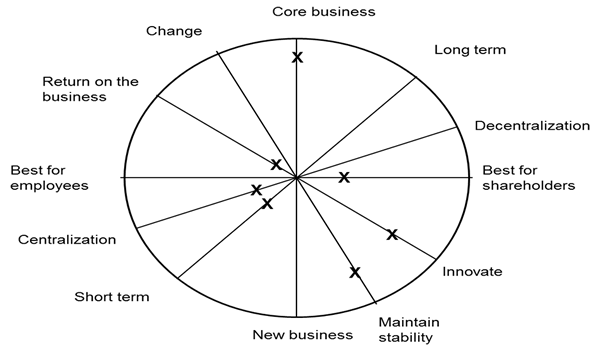
To identify paradoxes affecting your job, department, company, or your personal life, you can create your paradox minefield. Here is an organizational example:
To identify paradoxes affecting your job, department, company, or your personal life, you can create your paradox minefield. Here is an organizational example:
Content
Here’s a breakdown of the next steps:
Here’s a breakdown of the next steps:
Content
Gather the appropriate group together.
Gather the appropriate group together.
Content
Explain the concept of paradox with examples.
Explain the concept of paradox with examples.
Content
Draw a circle with lines as illustrated above.
Draw a circle with lines as illustrated above.
Content
Write the polarities on either end of the line.
Write the polarities on either end of the line.
Content
Gain group consensus on where we are on each of the paradoxes and place in X on the proper point on the continuum.
Gain group consensus on where we are on each of the paradoxes and place in X on the proper point on the continuum.
Content
Focus on those where the X is closest to the edge of the circle.
Focus on those where the X is closest to the edge of the circle.