
ATD Blog
Highlights From ATD’s 2026 State of the Industry Report
Content
TD professionals are generally optimistic about the TD function’s ability to meet organizational needs.
TD professionals are generally optimistic about the TD function’s ability to meet organizational needs.
Mon May 11 2026
Content
ATD Research recently published its 2026 State of the Industry report , which explores 2025 industry data that organizations can use to understand TD trends and make data-informed decisions for their TD functions. Three hundred and forty organizations, representing a diverse range of industries and organizations, provided the data for this report.
ATD Research recently published its 2026 State of the Industry report, which explores 2025 industry data that organizations can use to understand TD trends and make data-informed decisions for their TD functions. Three hundred and forty organizations, representing a diverse range of industries and organizations, provided the data for this report.
Content
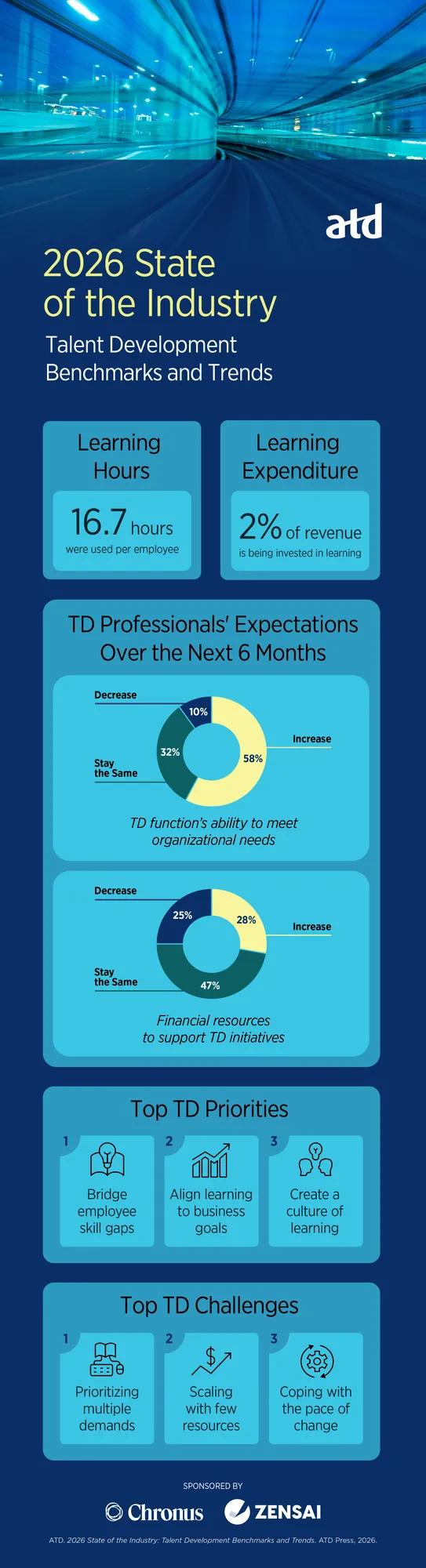
When asked to consider the future of talent development, TD professionals were generally optimistic about the TD function’s ability to meet organizational needs and its impact on corporate performance over the next six months. They were less optimistic about TD’s ability to secure financial resources to support learning initiatives. In 2025, 28 percent of respondents said they expect financial resources to increase over the next six months, and 25 percent expect them to decrease. In 2024, 48 percent said they expected financial resources to increase, while 8 percent expected them to decrease.
When asked to consider the future of talent development, TD professionals were generally optimistic about the TD function’s ability to meet organizational needs and its impact on corporate performance over the next six months. They were less optimistic about TD’s ability to secure financial resources to support learning initiatives. In 2025, 28 percent of respondents said they expect financial resources to increase over the next six months, and 25 percent expect them to decrease. In 2024, 48 percent said they expected financial resources to increase, while 8 percent expected them to decrease.
Content
For the first time in five years, the amount of formal learning hours used per employee increased. In 2025, employees used an average of 16.7 hours per year, whereas in 2024 they used 13.7 hours per year. At the same time, learning budgets moved in the opposite direction. The average direct learning expenditure across all participating organizations was $846 per employee, a $408 decrease from 2024. Several factors may explain this decline, including greater use of virtual instructor-led classrooms, which reduced instructor travel costs; reductions in TD headcount, which lowered salary expenses; and efficiency gains from automated administrative processes.
For the first time in five years, the amount of formal learning hours used per employee increased. In 2025, employees used an average of 16.7 hours per year, whereas in 2024 they used 13.7 hours per year. At the same time, learning budgets moved in the opposite direction. The average direct learning expenditure across all participating organizations was $846 per employee, a $408 decrease from 2024. Several factors may explain this decline, including greater use of virtual instructor-led classrooms, which reduced instructor travel costs; reductions in TD headcount, which lowered salary expenses; and efficiency gains from automated administrative processes.
Content
Survey respondents shared that, for the future, they are prioritizing bridging employee skills gaps and aligning learning goals with organizational goals. Today, less than a quarter actually measure the achievement of their training programs' organizational goals. An even smaller percentage measures return on investment (ROI). This is an important activity to monitor over the coming year. Due to the volatile economic forecasts throughout 2025, TD functions may feel pressure to better demonstrate their value. Improving the approach to demonstrating value will likely benefit the function in the long term.
Survey respondents shared that, for the future, they are prioritizing bridging employee skills gaps and aligning learning goals with organizational goals. Today, less than a quarter actually measure the achievement of their training programs' organizational goals. An even smaller percentage measures return on investment (ROI). This is an important activity to monitor over the coming year. Due to the volatile economic forecasts throughout 2025, TD functions may feel pressure to better demonstrate their value. Improving the approach to demonstrating value will likely benefit the function in the long term.
Content
This is a brief snapshot of the data included in ATD’s 2026 State of the Industry report . Download the full report to explore additional data points and view the data broken out by organization size and industry. The report is free to members and available at an additional cost for non-members. Thank you to both Chronus and Zensai for sponsoring this report.
This is a brief snapshot of the data included in ATD’s 2026 State of the Industry report. Download the full report to explore additional data points and view the data broken out by organization size and industry. The report is free to members and available at an additional cost for non-members. Thank you to both Chronus and Zensai for sponsoring this report.
Content