ATD Blog
How to Explain the ID Process to Your SMEs
Thu Feb 19 2015

Content
This is the second post in a four-part series by Diane Valenti on working with SMEs in the development of training.
This is the second post in a four-part series by Diane Valenti on working with SMEs in the development of training.
Content
ADDIE? SAM? ID? SME? Our alphabet soup of acronyms is as confusing to our subject matter experts (SMEs) as their acronyms are to us. So how do you explain the instructional design (ID) process to the SMEs with whom you work?
ADDIE? SAM? ID? SME? Our alphabet soup of acronyms is as confusing to our subject matter experts (SMEs) as their acronyms are to us. So how do you explain the instructional design (ID) process to the SMEs with whom you work?
Content
My recommendation is to forget about ADDIE and SAM. They both fall into the category of too much information (TMI). Rather, you can explain ID within the context of the typical problem-solving process of Plan, Do, Check, Act (P-D-C-A).
My recommendation is to forget about ADDIE and SAM. They both fall into the category of too much information (TMI). Rather, you can explain ID within the context of the typical problem-solving process of Plan, Do, Check, Act (P-D-C-A).
Content
When you talk to SMEs, be sure to use problem-solving language to describe the ID process. This will help them avoid becoming tangled in instructional design acronyms so they can better understand what comes next and how they can contribute.
When you talk to SMEs, be sure to use problem-solving language to describe the ID process. This will help them avoid becoming tangled in instructional design acronyms so they can better understand what comes next and how they can contribute.
Content
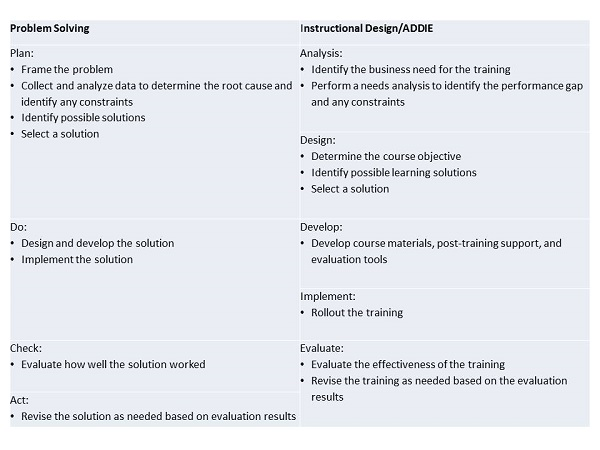
The table below compares the traditional instructional design methods with problem solving.
The table below compares the traditional instructional design methods with problem solving.