
ATD Blog
How to Select and Prioritize Sales Enablement Initiatives – Part 2
Thu Aug 01 2013
Content
Welcome back, sales enablers!
Welcome back, sales enablers!
Content
If you’re just tuning in, this series started with a post on Key Gaps in Our Sales Performance Ecosystem .
If you’re just tuning in, this series started with a post on Key Gaps in Our Sales Performance Ecosystem.
Content
In the next post, which was How to Select and Prioritize Sales Enablement Initiatives – Part 1
In the next post, which was How to Select and Prioritize Sales Enablement Initiatives – Part 1
Content
I stated Issue 1 as, “How do you conduct a root cause analysis, prioritize initiatives, and determine where to start, to get the best results?”
I stated Issue 1 as, “How do you conduct a root cause analysis, prioritize initiatives, and determine where to start, to get the best results?”
Content
Defined eight steps for tackling this issue, and discussed steps one through four.
Defined eight steps for tackling this issue, and discussed steps one through four.
Content
Identify problems (gaps in performance).
Identify problems (gaps in performance).
Content
Define problems.
Define problems.
Content
Define desired outcomes.
Define desired outcomes.
Content
Conduct a Force Field analysis.
Conduct a Force Field analysis.
Content
Develop possible solutions.
Develop possible solutions.
Content
Select the best solutions.
Select the best solutions.
Content
Tie to the Sales Performance Ecosystem.
Tie to the Sales Performance Ecosystem.
Content
Plan and execute (segues into the change leadership and management).
Plan and execute (segues into the change leadership and management).
Content
In this post, I’ll discuss steps five through eight. To close out this series, over the next two posts, I’ll expand on step eight to tackle Issue 2 , which is about ensuring that you lead and manage the change effectively, for the selected initiatives. With that framed, let’s address steps five through eight now.
In this post, I’ll discuss steps five through eight. To close out this series, over the next two posts, I’ll expand on step eight to tackle Issue 2, which is about ensuring that you lead and manage the change effectively, for the selected initiatives. With that framed, let’s address steps five through eight now.
Content
Develop and Select Solutions
Develop and Select Solutions
Content
We left off last time with the Force Field Analysis. Driving forces are the factors that push us toward our desire state while restraining forces are the factors that push back, holding us in place.
We left off last time with the Force Field Analysis. Driving forces are the factors that push us toward our desire state while restraining forces are the factors that push back, holding us in place.
Content
I think about the situation as if I’m in a car, with one foot on the gas and the other on the brake. The car is vibrating in place—engine racing, brakes smoking. So, if you want to move forward the fastest, do you push harder on the gas pedal, or take your foot off the brake?
I think about the situation as if I’m in a car, with one foot on the gas and the other on the brake. The car is vibrating in place—engine racing, brakes smoking. So, if you want to move forward the fastest, do you push harder on the gas pedal, or take your foot off the brake?
Content
Release the Brake First—Then Put the Pedal to the Metal
Release the Brake First—Then Put the Pedal to the Metal
Content
Exactly, release the brake first. To do that, brainstorm (first) and select (second) how you can minimize or eliminate the restraining forces, starting with those that you weighted most heavily.
Exactly, release the brake first. To do that, brainstorm (first) and select (second) how you can minimize or eliminate the restraining forces, starting with those that you weighted most heavily.
Content
After doing that, move on to brainstorm and select how to strengthen or add driving forces.
After doing that, move on to brainstorm and select how to strengthen or add driving forces.
Content
This method will help you identify, select, develop, and prioritize some solutions. The solutions are the actions you’ll take to minimize or eliminate restraining forces and strengthen or add driving forces. One caution: as important as they are, the forces and their weights aren’t the only things to consider. As part of the solution development and selection process, for each problem, consider the cost of doing nothing, the costs of the various solutions, and the expected value that the solutions will provide if they are executed well and close the gaps between Point A and Point B. A solution that costs $2 million and returns $1 million may solve a problem or produce the required change, but unless it is truly a required investment or foundation for the future (and will eventually produce much larger returns) it’s not a good business decision.
This method will help you identify, select, develop, and prioritize some solutions. The solutions are the actions you’ll take to minimize or eliminate restraining forces and strengthen or add driving forces. One caution: as important as they are, the forces and their weights aren’t the only things to consider. As part of the solution development and selection process, for each problem, consider the cost of doing nothing, the costs of the various solutions, and the expected value that the solutions will provide if they are executed well and close the gaps between Point A and Point B. A solution that costs $2 million and returns $1 million may solve a problem or produce the required change, but unless it is truly a required investment or foundation for the future (and will eventually produce much larger returns) it’s not a good business decision.
Content
Since solving the problems well is just as important as defining them, before we move on, I’ll offer two other methods that can be helpful in both the definition and solution stages. This may seem to veer slightly off track, but both methods can be used in conjunction with Force Field Analysis. They offer additional ways to help you know exactly where to focus, in high-priority areas, which should yield a good return.
Since solving the problems well is just as important as defining them, before we move on, I’ll offer two other methods that can be helpful in both the definition and solution stages. This may seem to veer slightly off track, but both methods can be used in conjunction with Force Field Analysis. They offer additional ways to help you know exactly where to focus, in high-priority areas, which should yield a good return.
Content
The Customer Acquisition Method (Opportunity Management Analysis)
The Customer Acquisition Method (Opportunity Management Analysis)
Content
This method focuses on the customer acquisition process, determining what’s working well, what’s not (yes, problem definition), and the impact of fixing problems at the various stages. This may vary in some businesses, but here’s one example:
This method focuses on the customer acquisition process, determining what’s working well, what’s not (yes, problem definition), and the impact of fixing problems at the various stages. This may vary in some businesses, but here’s one example:
Content
Identify or confirm your Target Market and Ideal Prospect Profiles or Buyer Personas.
Identify or confirm your Target Market and Ideal Prospect Profiles or Buyer Personas.
Content
Examine effectiveness of your lead generation methods.
Examine effectiveness of your lead generation methods.
Content
Conduct a pipeline analysis (and clean it up while you’re at it), including all normal aspects of pipeline management, buying process mapping (buying and selling processes), sales methodology, and the training/coaching and other Sales Performance Ecosystem elements that support your sales process and methodology. Include the voice of your customer in some way; win-loss analysis is certainly one great way to do it.
Conduct a pipeline analysis (and clean it up while you’re at it), including all normal aspects of pipeline management, buying process mapping (buying and selling processes), sales methodology, and the training/coaching and other Sales Performance Ecosystem elements that support your sales process and methodology. Include the voice of your customer in some way; win-loss analysis is certainly one great way to do it.
Content
Examine measurement systems, related to customer acquisition.
Examine measurement systems, related to customer acquisition.
Content
Examine performance management practices, related to customer acquisition.
Examine performance management practices, related to customer acquisition.
Content
Throughout this analysis process, problems (a lack of desired results or opportunities for improvement) will emerge at various points. Use the same methods of problem definition recommended in part one of this series. This should naturally lead toward a discussion of various possible solutions from the ecosystem. In my experience, I have found that it often (I won’t say “always”) makes sense to fix the problems from left-to-right, meaning fix them in the order of the process flow: target market/buyer personas, lead gen methods, buying/selling process mapping, sales methodology, measurement (awareness and analytics), and performance management.
Throughout this analysis process, problems (a lack of desired results or opportunities for improvement) will emerge at various points. Use the same methods of problem definition recommended in part one of this series. This should naturally lead toward a discussion of various possible solutions from the ecosystem. In my experience, I have found that it often (I won’t say “always”) makes sense to fix the problems from left-to-right, meaning fix them in the order of the process flow: target market/buyer personas, lead gen methods, buying/selling process mapping, sales methodology, measurement (awareness and analytics), and performance management.
Content
While I won’t detail it here, you can do the same thing with Key Account Management, Channel Management, or any customer acquisition and sales process. I’ve often done this for onboarding, by mapping the path to “first new business” (first sale) and working on reducing average ramp-up times.
While I won’t detail it here, you can do the same thing with Key Account Management, Channel Management, or any customer acquisition and sales process. I’ve often done this for onboarding, by mapping the path to “first new business” (first sale) and working on reducing average ramp-up times.
Content
Strategy, Tactics, and Gaps Methods
Strategy, Tactics, and Gaps Methods
Content
This method focuses on the current sales strategy, the tactical go-to-market plans, and then finds and addresses the gaps in results.
This method focuses on the current sales strategy, the tactical go-to-market plans, and then finds and addresses the gaps in results.
Content
Review the business strategy and the sales strategy that supports it.
Review the business strategy and the sales strategy that supports it.
Content
Review the go-to-market tactics in place to achieve those strategic results.
Review the go-to-market tactics in place to achieve those strategic results.
Content
Review the gaps in results, also known as “execution gaps.” (Yes, those gaps are problems, and yes, you need to clearly define them.) Find the gaps, tie them to the activities that aren’t producing the results, and document well. Then, move on to the ecosystem.
Review the gaps in results, also known as “execution gaps.” (Yes, those gaps are problems, and yes, you need to clearly define them.) Find the gaps, tie them to the activities that aren’t producing the results, and document well. Then, move on to the ecosystem.
Content
Here are some additional resources for problem solving.
Here are some additional resources for problem solving.
Content
Additional problem-solving resources:
Additional problem-solving resources:
Content
5 Whys: http://www.mindtools.com/pages/article/newTMC\_5W.htm
5 Whys: http://www.mindtools.com/pages/article/newTMC\_5W.htm
Content
Soft Systems Methodology: http://en.wikipedia.org/wiki/Soft\_systems\_methodology
Soft Systems Methodology: http://en.wikipedia.org/wiki/Soft\_systems\_methodology
Content
Affinity Diagrams: http://www.mindtools.com/pages/article/newTMC\_86.htm
Affinity Diagrams: http://www.mindtools.com/pages/article/newTMC\_86.htm
Content
Cause and Effect Analysis: http://www.mindtools.com/pages/article/newTMC\_03.htm
Cause and Effect Analysis: http://www.mindtools.com/pages/article/newTMC\_03.htm
Content
Kepner-Tregoe’s Method: http://iancos.wordpress.com/2013/01/14/kepner-tregoe-problem-analysis/
Kepner-Tregoe’s Method: http://iancos.wordpress.com/2013/01/14/kepner-tregoe-problem-analysis/
Content
McKinsey 7s Framework: http://www.mindtools.com/pages/article/newSTR\_91.htm
McKinsey 7s Framework: http://www.mindtools.com/pages/article/newSTR\_91.htm
Content
Impact Analysis: http://www.mindtools.com/pages/article/newTED\_96.htm
Impact Analysis: http://www.mindtools.com/pages/article/newTED\_96.htm
Content
Tie to the Sales Performance Ecosystem
Tie to the Sales Performance Ecosystem
Content
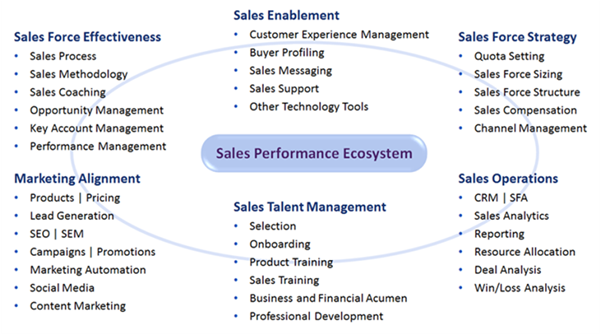
Lastly, unless you are doing a longer-term ecosystem alignment project (a larger, different transformational approach for a future post), this is where the ecosystem really comes into play.
Lastly, unless you are doing a longer-term ecosystem alignment project (a larger, different transformational approach for a future post), this is where the ecosystem really comes into play.
Content
Taking the gaps, problems and potential solutions or ideas identified using the methods above, determine how these gaps interface with the ecosystem elements, and bring ecosystem owners together. Hopefully you’ve had the right people involved from the start, or from the earlier peek at the ecosystem. But if not, get them engaged now, review what’s been done so far, and start to develop detailed plans with them. Plug in more Force Field Analysis wherever it makes sense.
Taking the gaps, problems and potential solutions or ideas identified using the methods above, determine how these gaps interface with the ecosystem elements, and bring ecosystem owners together. Hopefully you’ve had the right people involved from the start, or from the earlier peek at the ecosystem. But if not, get them engaged now, review what’s been done so far, and start to develop detailed plans with them. Plug in more Force Field Analysis wherever it makes sense.
Content
Plan and Execute
Plan and Execute
Content
In this stage, create your plans to implement your final solutions, also with the appropriate ecosystems owners (who at this point should be driving the development of the plans they’ll own). Execute those plans with discipline. Books are written on this topic, so I’ll stop here for now with a promise to discuss change leadership and change management in the two upcoming posts.
In this stage, create your plans to implement your final solutions, also with the appropriate ecosystems owners (who at this point should be driving the development of the plans they’ll own). Execute those plans with discipline. Books are written on this topic, so I’ll stop here for now with a promise to discuss change leadership and change management in the two upcoming posts.
Content
It Can Be Done
It Can Be Done
Content
This sounds like a lot, but based on the industry, company, and various sales nuances, I’ve seen it done it over the course of a few months, a few weeks, and even less time, if dedicated (probably sequestered) planning time is scheduled. This is a small price to pay to really nail the problems and develop plans to deliver the greatest impact. In these methods, where to focus in the ecosystem becomes clear through the logical process of problem identification and problem solving, not by staring at the elements in the ecosystem in a cold-sweat fueled by panic, or by thrashing around with various initiatives that haven’t been vetted and well-thought out.
This sounds like a lot, but based on the industry, company, and various sales nuances, I’ve seen it done it over the course of a few months, a few weeks, and even less time, if dedicated (probably sequestered) planning time is scheduled. This is a small price to pay to really nail the problems and develop plans to deliver the greatest impact. In these methods, where to focus in the ecosystem becomes clear through the logical process of problem identification and problem solving, not by staring at the elements in the ecosystem in a cold-sweat fueled by panic, or by thrashing around with various initiatives that haven’t been vetted and well-thought out.
Content
Obviously, this is my perspective on just a few possible approaches. I hope it has been helpful and thought-provoking. There are certainly other valid approaches. I’d enjoy hearing your reactions in the comments, and especially what has worked for you.
Obviously, this is my perspective on just a few possible approaches. I hope it has been helpful and thought-provoking. There are certainly other valid approaches. I’d enjoy hearing your reactions in the comments, and especially what has worked for you.
Content
As always, I’ve provided even more related reading. In the next two posts, we’ll discuss change management and change leadership. Until then, happy enabling!
As always, I’ve provided even more related reading. In the next two posts, we’ll discuss change management and change leadership. Until then, happy enabling!
Content
Additional Related Reading:
Additional Related Reading:
Content
How to Get All Your Ducks in a Row for a Successful Sales Transformation
How to Get All Your Ducks in a Row for a Successful Sales Transformation
Content
http://blogs.richardson.com/2012/12/04/plan-process-and-players-how-to-get-all-of-your-ducks-in-a-row-for-a-successful-sales-transformation-initiative/
Content
Silver Bullets Won’t Fix Your Sales Force
Silver Bullets Won’t Fix Your Sales Force
Content
http://blogs.richardson.com/2013/07/17/3-pitfalls-that-still-make-sales-teams-waste-time-and-lower-sales-effectiveness/