ATD, association for talent development

ATD Blog

If You’re Not at the Table, You’re on the Menu

By

Thu Apr 05 2018

If You’re Not at the Table, You’re on the Menu
Loading...

Content

For many years, L&D has been trying to demonstrate the value of learning. It has modernized the services it provides, reorganized its distribution methods for greater efficiency, and professionalized its measurement processes. But it is still failing. This raises some important questions: Should we continue to focus on learning value? Or is this the time to redefine the future of L&D and focus on business value? This blog post takes a closer look at how L&D can have a seat at the table instead of simply being on the menu.

For many years, L&D has been trying to demonstrate the value of learning. It has modernized the services it provides, reorganized its distribution methods for greater efficiency, and professionalized its measurement processes. But it is still failing. This raises some important questions: Should we continue to focus on learning value? Or is this the time to redefine the future of L&D and focus on business value? This blog post takes a closer look at how L&D can have a seat at the table instead of simply being on the menu.

L&D Under Stress?

Content

In recent years, trend reports and articles have signaled that L&D is generally not working well in organizations. In his LinkedIn article, “How to Save the L&D Brand from Irrelevance, Step by Radical Step,” sees the problem in this way: “Saying the responsibility for learning doesn’t belong to L&D feels like saying medicine doesn’t belong with doctors or hi-tech doesn’t belong in Silicon Valley.”

In recent years, trend reports and articles have signaled that L&D is generally not working well in organizations. In his LinkedIn article, “How to Save the L&D Brand from Irrelevance, Step by Radical Step,” sees the problem in this way: “Saying the responsibility for learning doesn’t belong to L&D feels like saying medicine doesn’t belong with doctors or hi-tech doesn’t belong in Silicon Valley.”

Content

Indeed, Deloitte’s 2017 study, Adapt Workplace Learning to the Speed of Business , presents an alarming signal for L&D: 74 percent of organizations surveyed focus primarily on traditional learning methods that can fall short of empowering employees to acquire skills to keep pace with change and improve the work itself.Therefore, it is not surprising for Josh Bersin to state, “In the 15 years I’ve been studying corporate L&D, I haven’t seen the industry under so much stress. We are in a disruptive time, forcing companies of all sizes to literally reinvent their entire learning strategy, infrastructure and employee experience like never before.”

Indeed, Deloitte’s 2017 study, Adapt Workplace Learning to the Speed of Business, presents an alarming signal for L&D: 74 percent of organizations surveyed focus primarily on traditional learning methods that can fall short of empowering employees to acquire skills to keep pace with change and improve the work itself.Therefore, it is not surprising for Josh Bersin to state, “In the 15 years I’ve been studying corporate L&D, I haven’t seen the industry under so much stress. We are in a disruptive time, forcing companies of all sizes to literally reinvent their entire learning strategy, infrastructure and employee experience like never before.”

Content

According to J.D. Dillon , an evolution is insufficient to improve the L&D function. He writes that a transformation is necessary: “Kick-starting the transformation to become a modern learning organization requires a fundamental mindset shift. Rather than put our library at the center of our efforts, we must shift our focus to the individual employee and design a right-fit learning and support experience that enables organizational goals.”

According to J.D. Dillon , an evolution is insufficient to improve the L&D function. He writes that a transformation is necessary: “Kick-starting the transformation to become a modern learning organization requires a fundamental mindset shift. Rather than put our library at the center of our efforts, we must shift our focus to the individual employee and design a right-fit learning and support experience that enables organizational goals.”

Content

Over the past decades, L&D has been busy trying to demonstrate the value of learning. However, this is no longer seen as being sufficient or even relevant. Learning in organizations is intended to improve performance measurably. Simply measuring the process without measuring the results will not provide insight into realized value. This is one reason the interest to demonstrate business impact is so high in L&D.

Over the past decades, L&D has been busy trying to demonstrate the value of learning. However, this is no longer seen as being sufficient or even relevant. Learning in organizations is intended to improve performance measurably. Simply measuring the process without measuring the results will not provide insight into realized value. This is one reason the interest to demonstrate business impact is so high in L&D.

Realigning L&D’s Focus

Content

Demonstrating impact is impossible if L&D fails to realign its service from a focus on the learning paradigm to a focus on the business paradigm. For this to happen, L&D needs to extend beyond the exclusive offering of formal learning solutions ( Arets, Jennings, Heijnen 2015 ). Indeed, it is impossible to connect learning to the business if learning and working are separated from each other.

Demonstrating impact is impossible if L&D fails to realign its service from a focus on the learning paradigm to a focus on the business paradigm. For this to happen, L&D needs to extend beyond the exclusive offering of formal learning solutions (Arets, Jennings, Heijnen 2015). Indeed, it is impossible to connect learning to the business if learning and working are separated from each other.

Content

Optimally, there is a need for a consistent process of re-evaluation and deduction to determine the best solutions to deliver the desired organizational results. For this to occur, it is necessary to stop seeing formal learning as the basis of the L&D service.

Optimally, there is a need for a consistent process of re-evaluation and deduction to determine the best solutions to deliver the desired organizational results. For this to occur, it is necessary to stop seeing formal learning as the basis of the L&D service.

Content

L&D needs to embrace a culture of supporting learning by doing. From an economic point of view, learning by doing always involves organizational learning when people are working to improve productivity ( Stiglitz 2014 ; De Grip 2015 ). The opportunities for L&D to change, and to remain relevant, lie in discarding the learning paradigm and adopting the business paradigm.

L&D needs to embrace a culture of supporting learning by doing. From an economic point of view, learning by doing always involves organizational learning when people are working to improve productivity (Stiglitz 2014; De Grip 2015). The opportunities for L&D to change, and to remain relevant, lie in discarding the learning paradigm and adopting the business paradigm.

Content

Table 1 lists the key changes required for this realignment. For instance, the L&D function of the future is no longer led by the chief learning officer, but by the chief performance officer, who focuses on key elements of organizational learning and performance, such as organizational adaptability and agility.

Table 1 lists the key changes required for this realignment. For instance, the L&D function of the future is no longer led by the chief learning officer, but by the chief performance officer, who focuses on key elements of organizational learning and performance, such as organizational adaptability and agility.

Content

Table 1. L&D on the Move From the Learning paradigm to the Business Paradigm

Table 1. L&D on the Move From the Learning paradigm to the Business Paradigm

Content

Content

Content

Learning Paradigm

Learning Paradigm

Content

Business Paradigm

Business Paradigm

Content

Knowledge deficits

Knowledge deficits

Content

Performance and business problems

Performance and business problems

Content

Learning analysis

Learning analysis

Content

Performance and business analysis

Performance and business analysis

Content

Learning goals

Learning goals

Content

Performance and business goals

Performance and business goals

Content

Formal learning

Formal learning

Content

Organizational learning (including informal and social learning)

Organizational learning (including informal and social learning)

Content

Learning is seperated from work

Learning is seperated from work

Content

Organizational learning is embedded in work

Organizational learning is embedded in work

Content

Talent development

Talent development

Content

Organizational development

Organizational development

Content

Aligned with HR

Aligned with HR

Content

Aligned with business

Aligned with business

Content

Competency frameworks

Competency frameworks

Content

Business models

Business models

Content

Educational roles

Educational roles

Content

Performance roles

Performance roles

Content

Learning expert

Learning expert

Content

70:20:10 expert

70:20:10 expert

Content

Learning consultancy

Learning consultancy

Content

Performance consultancy

Performance consultancy

Content

Learning solutions

Learning solutions

Content

Business solutions

Business solutions

Content

Measuring learning outcomes

Measuring learning outcomes

Content

Measuring business outcomes

Measuring business outcomes

Content

Kirkpatrick Levels 1, 2, 3, and possibly 4

Kirkpatrick Levels 1, 2, 3, and possibly 4

Content

Business KPIs and ROI (Phillips)

Business KPIs and ROI (Phillips)

Content

Learning value

Learning value

Content

Business value

Business value

Content

Chief learning officer (CLO)

Chief learning officer (CLO)

Content

Chief performance officer (CPO)

Chief performance officer (CPO)

New Roles for L&D: The 70-20-10 Methodology

Content

L&D’s current roles and tasks are based in the learning paradigm. Extending and renewing L&D services requires a different role-based view, which will make it possible to act within the business paradigm.

L&D’s current roles and tasks are based in the learning paradigm. Extending and renewing L&D services requires a different role-based view, which will make it possible to act within the business paradigm.

Content

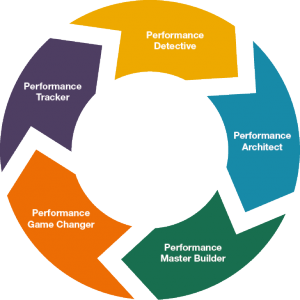
Consider the 70-20-10 methodology. This is a standardized, carefully considered way of acting to achieve the specific result of demonstrating business impact, and of working methodically to do so in a systematic, goal-oriented, process- and development-based way. As part of the 70-20-10 methodology, five new roles have been defined with 31 associated critical tasks. These five roles support L&D to demonstrate measurable business impact with a new and extensive set of 70-20-10 services.

Consider the 70-20-10 methodology. This is a standardized, carefully considered way of acting to achieve the specific result of demonstrating business impact, and of working methodically to do so in a systematic, goal-oriented, process- and development-based way. As part of the 70-20-10 methodology, five new roles have been defined with 31 associated critical tasks. These five roles support L&D to demonstrate measurable business impact with a new and extensive set of 70-20-10 services.

Content

Figure 1 shows the five new roles of the 70-20-10 methodology (within the business paradigm). The differences in roles and tasks are significant and illustrate how the shift offers L&D new opportunities within the new business paradigm.

Figure 1 shows the five new roles of the 70-20-10 methodology (within the business paradigm). The differences in roles and tasks are significant and illustrate how the shift offers L&D new opportunities within the new business paradigm.

Content

Figure 1. 70-20-10 Roles for L&D

Figure 1. 70-20-10 Roles for L&D

If You’re Not at the Table, You’re on the Menu-Arets_FiveRoles.png

Content

Figure 2 provides a high-level view of the interconnection of the roles and the processes to achieve business impact. The characteristics of the methodology, in general, are:

Figure 2 provides a high-level view of the interconnection of the roles and the processes to achieve business impact. The characteristics of the methodology, in general, are:

  • Content

    goal-oriented

    goal-oriented

  • Content

    systematic

    systematic

  • Content

    standards-based

    standards-based

  • Content

    process-based

    process-based

  • Content

    method-based.

    method-based.

Content

Figure 2. The Dynamic, Cyclical Connections Between the Roles of the 70-20-10 Methodology
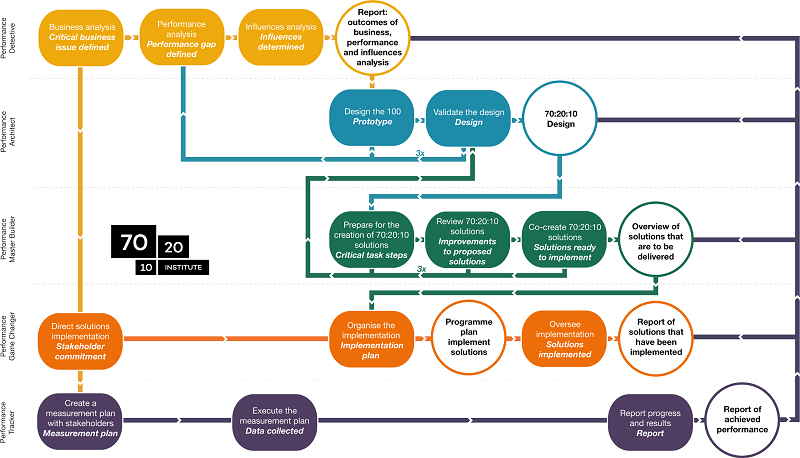
Figure 2. The Dynamic, Cyclical Connections Between the Roles of the 70-20-10 Methodology

If You’re Not at the Table, You’re on the Menu-Arets_Figure 2.png

Enter New Business Models for L&D

Content

New roles for L&D are not enough. For a deep change, we need to make strategic changes and reflect on the current versus the desired models for L&D, and then design and implement new business models.

New roles for L&D are not enough. For a deep change, we need to make strategic changes and reflect on the current versus the desired models for L&D, and then design and implement new business models.

Content

A business model makes it possible to highlight the added value to the organization in terms of income and expenditure, or in nonfinancial terms, and the factors that influence this. Alex Osterwalder offers a useful definition in Business Model Generation. A Handbook for Visionairies, Game Changers, and Challengers : “A business model describes the value an organization offers to various customers and portrays the capabilities and partners required for creating, marketing, and delivering this value and relationship capital with the goal of generating profitable and sustainable revenue streams.”

A business model makes it possible to highlight the added value to the organization in terms of income and expenditure, or in nonfinancial terms, and the factors that influence this. Alex Osterwalder offers a useful definition in Business Model Generation. A Handbook for Visionairies, Game Changers, and Challengers: “A business model describes the value an organization offers to various customers and portrays the capabilities and partners required for creating, marketing, and delivering this value and relationship capital with the goal of generating profitable and sustainable revenue streams.”

Content

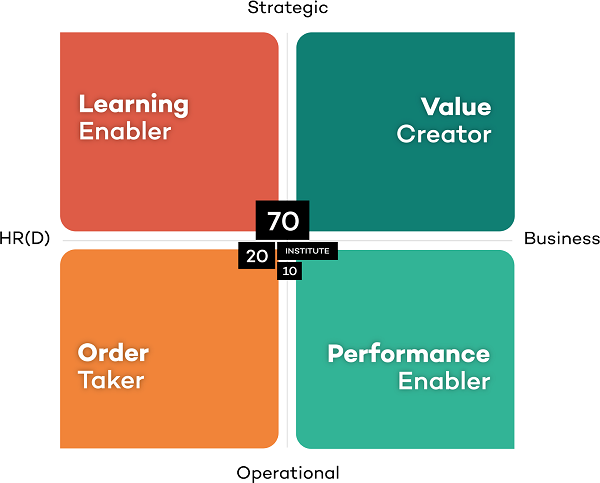
The 70-20-10 Institute’s book, 70:20:10 Towards 100% Performance , makes a distinction between four L&D business models to redefine the future of L&D.The book draws horizontal and vertical axes for L&D as a function of the organization. The horizontal axis represents the continuum between HRD and the core business; the vertical one represents the continuum between strategy and operations.

The 70-20-10 Institute’s book, 70:20:10 Towards 100% Performance, makes a distinction between four L&D business models to redefine the future of L&D.The book draws horizontal and vertical axes for L&D as a function of the organization. The horizontal axis represents the continuum between HRD and the core business; the vertical one represents the continuum between strategy and operations.

Content

The two axes create four quadrants (see Figure 3), There are the learning-focused L&D business models: order taker and learning enabler. And the business-focused L&D business models are performance enabler and value creator.

The two axes create four quadrants (see Figure 3), There are the learning-focused L&D business models: order taker and learning enabler. And the business-focused L&D business models are performance enabler and value creator.

Content

Organizations increasingly assess the different components of their primary processes based on business models, including determining measurable, added value. This is a logical process and applies at organizational and department levels. The L&D department is no exception. L&D is expected to show the value it creates for the organization, in the same way other departments are required to demonstrate value.

Organizations increasingly assess the different components of their primary processes based on business models, including determining measurable, added value. This is a logical process and applies at organizational and department levels. The L&D department is no exception. L&D is expected to show the value it creates for the organization, in the same way other departments are required to demonstrate value.

Content

The four L&D business models described here support the transition from learning to business value. To stay relevant in an ever-changing world, it seems appropriate for L&D to undertake a deep change to move from the learning to business paradigm, moving from the left to the right in our business model framework for L&D.

The four L&D business models described here support the transition from learning to business value. To stay relevant in an ever-changing world, it seems appropriate for L&D to undertake a deep change to move from the learning to business paradigm, moving from the left to the right in our business model framework for L&D.

Content

Figure 3. 4 Business Models for L&D

Figure 3. 4 Business Models for L&D

If You’re Not at the Table, You’re on the Menu-Arets Figure 3.png

Content

We do not intend to express value judgments about each of these four models. Their most important function is to act as elements in a framework to help engage dialogue, so that each L&D department can determine the difference between current and desired models, including the barriers, and the potential in its own context.

We do not intend to express value judgments about each of these four models. Their most important function is to act as elements in a framework to help engage dialogue, so that each L&D department can determine the difference between current and desired models, including the barriers, and the potential in its own context.

Content

Our next post will offer a deeper dive into the four business models. You also can learn more during the session, " New Value Creation With 4 L&D Business Models ," at the ATD 2018 International Conference & Expo. Join me and my co-presenter, Vivian Heijnen, co-founder of the 70:20:10 Institute, to learn how to transition the L&D function from a cost center to a profit center in your organization.

Our next post will offer a deeper dive into the four business models. You also can learn more during the session, "New Value Creation With 4 L&D Business Models," at the ATD 2018 International Conference & Expo. Join me and my co-presenter, Vivian Heijnen, co-founder of the 70:20:10 Institute, to learn how to transition the L&D function from a cost center to a profit center in your organization.

You've Reached ATD Member-only Content

Become an ATD member to continue

Already a member?Sign In


Copyright © 2026 ATD

ASTD changed its name to ATD to meet the growing needs of a dynamic, global profession.

Terms of UsePrivacy NoticeCookie Policy