
ATD Blog
Just Say “No”
Wed Oct 25 2017

Content
If I’ve learned anything in the past 25 years, it’s that I provide the greatest value to my team when I say no. It’s easy to say yes. It’s popular to say yes. But very often, it’s poor leadership.
If I’ve learned anything in the past 25 years, it’s that I provide the greatest value to my team when I say no. It’s easy to say yes. It’s popular to say yes. But very often, it’s poor leadership.
Content
That’s a really painful concept, because, as C-level executives, we’re used to stoking and cheerleading creativity. We repeat the mantras “there are no bad ideas” and “fail early and often.”
That’s a really painful concept, because, as C-level executives, we’re used to stoking and cheerleading creativity. We repeat the mantras “there are no bad ideas” and “fail early and often.”
Content
But, here’s the rub. Every single person in your company is being bombarded by information. Think about the array of communication channels that your team members must manage—meetings, walk-ins, email, texts, social media, blog posts (like this one), magazines, podcasts, and phone calls. Through all those channels come ideas and projects that they must filter and triage to decide how to allocate their time. Human beings are notoriously flawed at assessing their ability to multitask. We simply can’t do it. And every time we jump back and forth between projects, we’re using time and memory to switch gears. It’s remarkably inefficient.
But, here’s the rub. Every single person in your company is being bombarded by information. Think about the array of communication channels that your team members must manage—meetings, walk-ins, email, texts, social media, blog posts (like this one), magazines, podcasts, and phone calls. Through all those channels come ideas and projects that they must filter and triage to decide how to allocate their time. Human beings are notoriously flawed at assessing their ability to multitask. We simply can’t do it. And every time we jump back and forth between projects, we’re using time and memory to switch gears. It’s remarkably inefficient.
Content
When we, as leaders, direct or approve the exploration of too many projects, we are drowning and depressing our talent. The people who work for us want to succeed, but when we overcommit them, we are basically sending one or more of the following messages:
When we, as leaders, direct or approve the exploration of too many projects, we are drowning and depressing our talent. The people who work for us want to succeed, but when we overcommit them, we are basically sending one or more of the following messages:
Content
“I expect you to work more hours than I am willing to pay for.”
“I expect you to work more hours than I am willing to pay for.”
Content
“You are unproductive and can’t complete the tasks that are expected.”
“You are unproductive and can’t complete the tasks that are expected.”
Content
“Please accomplish your work with mediocrity.”
“Please accomplish your work with mediocrity.”
Content
“I don’t know what’s important—you decide.”
“I don’t know what’s important—you decide.”
Content
Ultimately, when we, as leaders, fail to say no, we are not marshalling sufficient resources to say yes to the things that really matter. True strategy is about deciding what you are not going to do.
Ultimately, when we, as leaders, fail to say no, we are not marshalling sufficient resources to say yes to the things that really matter. True strategy is about deciding what you are not going to do.
Content
So how do you say no in a way that empowers staff? Here are two quick suggestions:
So how do you say no in a way that empowers staff? Here are two quick suggestions:
Content
Ask questions that encourage evaluation of tradeoffs. “How might this idea improve the outcome of our work? How does this save us time or money? What program that has run its course should we stop doing to make room for this new, better program?”
Ask questions that encourage evaluation of tradeoffs. “How might this idea improve the outcome of our work? How does this save us time or money? What program that has run its course should we stop doing to make room for this new, better program?”
Content
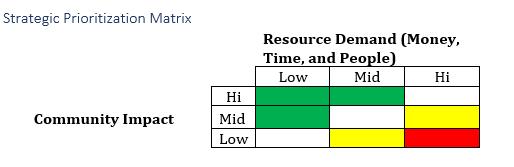
Use a priority matrix. Gather your team together with all the potential projects under consideration and weigh the resource demand against the impact on mission.
Use a priority matrix. Gather your team together with all the potential projects under consideration and weigh the resource demand against the impact on mission.
Content
Content
Content
Content
Content
Content
Content
The projects in the upper left are the winners. Less resource demand, more impact on mission. But pay extra attention to the ones on the lower right. These are frequently the holdovers that are being done because they have always been done. Or they have an overly vocal advocate. But they are resource drains and candidates for your “to-don’t” list.
The projects in the upper left are the winners. Less resource demand, more impact on mission. But pay extra attention to the ones on the lower right. These are frequently the holdovers that are being done because they have always been done. Or they have an overly vocal advocate. But they are resource drains and candidates for your “to-don’t” list.
Content
So while just saying no may not feel good in the moment, the talent in your organization will ultimately thank you for the strategic leadership, empowerment, and time to do the big things well.
So while just saying no may not feel good in the moment, the talent in your organization will ultimately thank you for the strategic leadership, empowerment, and time to do the big things well.