
ATD Blog
Making Your Way Through a Mountain of Content
Fri Mar 31 2023

Imagine you’re a sherpa—a guide helping climbers reach the top of a seemingly insurmountable mountain. You know the path—the dos and don’ts—what to focus on and what to ignore. You know the shortcuts and their dangers, too. And you lead your party of eager but inexperienced climbers through treacherous terrain, coupled with an unrelenting climate. Your goal is to reach the summit with them, making this journey worth all the trouble. You will see them celebrate their accomplishments, and you will know that your knowledge and skill of where to tread—and where not to—made all the difference.
This is often how I feel when working with a lot of technical content to design an e-learning course. As learning designers, it’s our job to build a road for our learners that leads to meaningful milestones. It may be difficult to focus on that vision when looking through pages and pages of material, but trust me, it’s possible.
In my experience leading a team through high-volume, highly technical, and dense projects, there are a few things I’ve learned about how to handle such content.
If you don’t know where you’re going, any road can take you there. —Cheshire Cat
Who is your learner?
What do they already know?
What are their expectations from this course?
What should they be able to do after this course?
These critical questions will serve as your guiding posts. Don’t rush through them in a hurry to get started. Instead, discuss with your stakeholders or project leads to fully understand the context around the training you will develop. This will equip you to make informed content decisions.
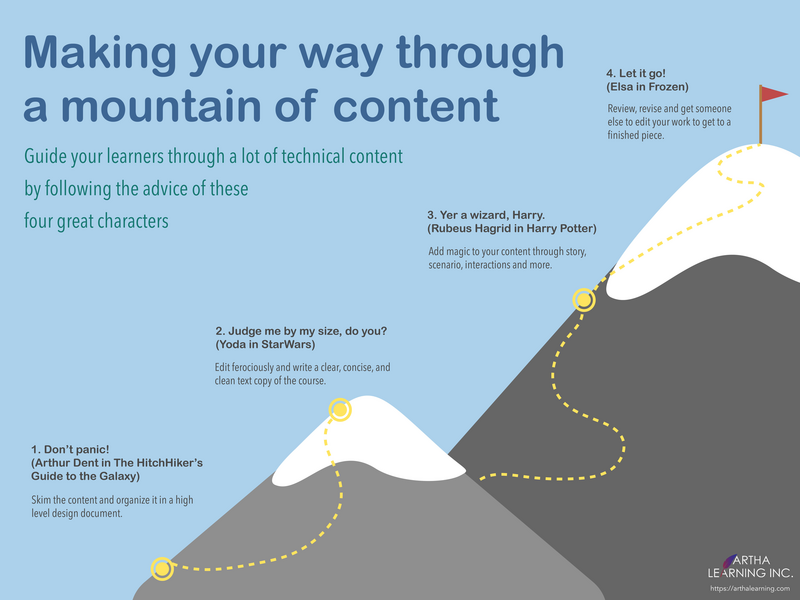
Don’t panic! —Douglas Adams
Don’t let the amount of source content get the better of you.
Start by skimming the material. Skimming is a speed-reading technique beneficial for such instructional design work. Skim through all your content by reading titles, headings, topic sentences, conclusions, diagrams, graphs, and other important items. This gives you an overall map of the material.
Speaking of maps, a mind map can be an advantageous strategy to view all the content and relations among different components. This becomes your high-level design document.
Judge me by my size, do you? —Yoda
With the high-level design as your template, it’s time to fill in the gaps with informational content.
Be cautious about over-informing. Chunk and re-sequence content so the whole course flows seamlessly with a gentle increase in complexity.
At this stage, don’t get bogged down thinking about engagement, interactivity, multimedia, etc. Instead, your goal should be to cut down any non-essential content and develop a clear, concise, and clean text copy of the course that clearly shows learners what they need to know and the performance outcomes.
Yer a wizard, Harry. —Rubeus Hagrid
Now that you have the core content, you can start thinking about how to make it more engaging and interactive.
Consider where the right infographics or a short video could replace some text content. These multimedia items add interest and variety and can greatly aid comprehension and retention of your course.
Similarly, you may find avenues for a story scenario or knowledge check to augment the learning. You must do this step after you’ve identified all the content necessary for the course—so you don’t put the cart before the horse.
Let it go! —Elsa
Go back to your course—outline, details, interactivities—and see if you can trim it further.
This is where a second pair of eyes is most useful. Being too close to your content can blind you to potential areas for revision—missing connectors or repeated material. An informed review can help you identify those and further clean up your course.
In summary, it helps to remember that as a sherpa, you can’t afford for your party to get lost. Learner attention is a scarce commodity and we need to use every bit of it intentionally.
View Courses Recommended for You