
ATD Blog
Mastering Leadership Agility for an Agile Workplace
Thu Feb 01 2024

Content
The Agile methodology for project management and software development emerged in 2001, when 17 technologists drafted the Agile Manifesto . They presented four major values:
The Agile methodology for project management and software development emerged in 2001, when 17 technologists drafted the Agile Manifesto. They presented four major values:
Content
1. Individuals and interactions over processes and tools
1. Individuals and interactions over processes and tools
Content
2. Working software over comprehensive documentation
2. Working software over comprehensive documentation
Content
3. Customer collaboration over contract negotiation
3. Customer collaboration over contract negotiation
Content
4. Responding to change over following a plan
4. Responding to change over following a plan
Content
This manifesto represented a paradigm shift and fostered a new dynamic and collaborative approach to creating the software that our businesses and world run on today.
This manifesto represented a paradigm shift and fostered a new dynamic and collaborative approach to creating the software that our businesses and world run on today.
Content
According to the Agile Alliance , a nonprofit membership group with more than 72,000 members, Agile is “about thinking through how you can understand what’s going on in the environment that you’re in today, identify what uncertainty you’re facing, and figure out how you can adapt to that as you go along.”
According to the Agile Alliance, a nonprofit membership group with more than 72,000 members, Agile is “about thinking through how you can understand what’s going on in the environment that you’re in today, identify what uncertainty you’re facing, and figure out how you can adapt to that as you go along.”
Content
When I first read that explanation over a year ago, it struck me as the perfect description of a few highly successful leaders I had recently observed.
When I first read that explanation over a year ago, it struck me as the perfect description of a few highly successful leaders I had recently observed.
Content
During pandemic chaos and while facing major business disruptors—lightning-speed change, uncertainty, complexity, technology, competition, and globalization—these leaders not only survived but excelled.
During pandemic chaos and while facing major business disruptors—lightning-speed change, uncertainty, complexity, technology, competition, and globalization—these leaders not only survived but excelled.
Content
How did they do it? After studying their behavior, habits, practices, and ways of being in the world, I soon realized they possessed a critical skill that all leaders need now—leadership agility.
How did they do it? After studying their behavior, habits, practices, and ways of being in the world, I soon realized they possessed a critical skill that all leaders need now—leadership agility.
Content
In a leadership context, agility involves making decisions and taking action when information is incomplete and outcomes are uncertain. It requires flexibility and creativity. Agile leaders can solve problems, innovate, and act, even under the most dire circumstances.
In a leadership context, agility involves making decisions and taking action when information is incomplete and outcomes are uncertain. It requires flexibility and creativity. Agile leaders can solve problems, innovate, and act, even under the most dire circumstances.
Content
Over the last year, my colleagues and I at Dion Leadership have been researching and studying leadership agility. Our findings consistently show that agility is a combination of several important competencies. It happens when leaders connect the dots among these vital skills:
Over the last year, my colleagues and I at Dion Leadership have been researching and studying leadership agility. Our findings consistently show that agility is a combination of several important competencies. It happens when leaders connect the dots among these vital skills:
Content
Flexibility
Flexibility
Content
Adaptability
Adaptability
Content
Mindfulness
Mindfulness
Content
The ability to act with incomplete information
The ability to act with incomplete information
Content
Like nearly all critical proficiencies associated with managing and leading, leadership agility is a skill that can be taught, learned, and developed. It’s up to us as talent development professionals to help our leaders understand the framework and dynamics of leadership agility and how they can approach improving or increasing their own agility.
Like nearly all critical proficiencies associated with managing and leading, leadership agility is a skill that can be taught, learned, and developed. It’s up to us as talent development professionals to help our leaders understand the framework and dynamics of leadership agility and how they can approach improving or increasing their own agility.
Content
At its core, leadership agility is about creating space in your brain so that you can respond with thoughtful, rational intent when faced with new, uncertain, complex, or quickly changing situations.
At its core, leadership agility is about creating space in your brain so that you can respond with thoughtful, rational intent when faced with new, uncertain, complex, or quickly changing situations.
Content
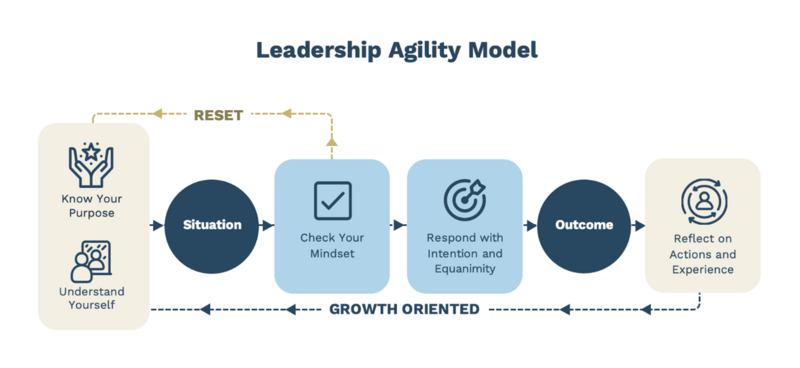
This illustration shows how a more deliberate, thoughtful response can unfold.
This illustration shows how a more deliberate, thoughtful response can unfold.
Content
The first two steps involve knowing your purpose within your larger team or organization and establishing a solid understanding of yourself. For leaders to know and understand their purpose within their organization, they must ascertain both the written and unwritten rules that guide the organization. What does it take to be successful in the organization? What does the culture encourage and discourage? When a leader understands him or herself, they are clear on what they bring to the organization. They are keenly aware of their personal style, strengths, weaknesses, drivers, and stressors.
The first two steps involve knowing your purpose within your larger team or organization and establishing a solid understanding of yourself. For leaders to know and understand their purpose within their organization, they must ascertain both the written and unwritten rules that guide the organization. What does it take to be successful in the organization? What does the culture encourage and discourage? When a leader understands him or herself, they are clear on what they bring to the organization. They are keenly aware of their personal style, strengths, weaknesses, drivers, and stressors.
Content
The next section illustrates the way a leader will react when faced with a situation requiring leadership agility. The leader must first check on their mindset. This in-the-moment analysis helps determine whether their mindset aligns with achieving a productive, effective outcome that benefits a trio of stakeholders—the leader, the project or initiative, and the organization. If their mindset is not aligned, the leader will need a reset so they can respond to the situation in a way that is thoughtful, intentional, deliberate, equanimous, and compatible with a positive result. Returning to what the leader knows about their purpose and themselves should inform this mindset shift.
The next section illustrates the way a leader will react when faced with a situation requiring leadership agility. The leader must first check on their mindset. This in-the-moment analysis helps determine whether their mindset aligns with achieving a productive, effective outcome that benefits a trio of stakeholders—the leader, the project or initiative, and the organization. If their mindset is not aligned, the leader will need a reset so they can respond to the situation in a way that is thoughtful, intentional, deliberate, equanimous, and compatible with a positive result. Returning to what the leader knows about their purpose and themselves should inform this mindset shift.
Content
The last step is reflection, closing the loop with lessons learned about the process and the leader’s behavior. Grounded in a spirit of self-awareness and growth, this reflection further refines the leader’s purpose and mindset.
The last step is reflection, closing the loop with lessons learned about the process and the leader’s behavior. Grounded in a spirit of self-awareness and growth, this reflection further refines the leader’s purpose and mindset.
Content
The model illustrates a circular flow, indicating a learning process designed to be repeated. You’ll also notice that leadership agility is primarily a reflective process.
The model illustrates a circular flow, indicating a learning process designed to be repeated. You’ll also notice that leadership agility is primarily a reflective process.
Content
Becoming a more agile leader is a learning process that takes practice and focus. It might not feel natural or comfortable at first. However, developing agility will get easier over time. And the work required to develop this crucial leadership skill will help leaders find success in a workplace that is only becoming more complex and unpredictable.
Becoming a more agile leader is a learning process that takes practice and focus. It might not feel natural or comfortable at first. However, developing agility will get easier over time. And the work required to develop this crucial leadership skill will help leaders find success in a workplace that is only becoming more complex and unpredictable.
Content
If you’d like to learn more about leadership agility, this Leadership Agility e-book is available for download. Good luck developing your leaders’ leadership agility!
If you’d like to learn more about leadership agility, this Leadership Agility e-book is available for download. Good luck developing your leaders’ leadership agility!
View Courses Recommended for You