ATD, association for talent development

ATD Blog

Measuring and Developing Executive Presence in Leaders and High Potentials

By

Mon Aug 25 2014

Measuring and Developing Executive Presence in Leaders and High Potentials
Loading...

Content

Executive presence is one of the hottest topics in talent development discussions today. You may hear from senior leaders that their high potentials are missing this “X factor,” though they struggle to define what it is. Instead, they say, “I know it when I see it.”

Executive presence is one of the hottest topics in talent development discussions today. You may hear from senior leaders that their high potentials are missing this “X factor,” though they struggle to define what it is. Instead, they say, “I know it when I see it.”

Content

This approach is frustrating for everyone, from the high potential leader to those sponsoring their career advancement to you as the professional in charge of training and development.

This approach is frustrating for everyone, from the high potential leader to those sponsoring their career advancement to you as the professional in charge of training and development.  

Content

We know from extensive research that technical and managerial skill is not enough to succeed at the highest levels. As leaders move ahead in their careers and face greater complexity and challenge, they must assert influence, galvanize people to take action, and execute a strategy by getting work done through others.

We know from extensive research that technical and managerial skill is not enough to succeed at the highest levels. As leaders move ahead in their careers and face greater complexity and challenge, they must assert influence, galvanize people to take action, and execute a strategy by getting work done through others.

Content

These qualities demonstrate readiness to take on larger leadership roles. It’s likely you notice executive presence is missing when leaders stand on a bigger stage to lead a strategic initiative, take charge of a large-scale change, or to step into a bigger enterprise role.

These qualities demonstrate readiness to take on larger leadership roles. It’s likely you notice executive presence is missing when leaders stand on a bigger stage to lead a strategic initiative, take charge of a large-scale change, or to step into a bigger enterprise role.

Content

While coaching senior leaders and partnering with talent development in global organizations, we found a common need: a cohesive approach to developing executive presence in leaders. Many organizations default to presentation skill, an ability to command the room, or look the part, but you may feel intuitively it goes much deeper. Well, it does.

While coaching senior leaders and partnering with talent development in global organizations, we found a common need: a cohesive approach to developing executive presence in leaders.  Many organizations default to presentation skill, an ability to command the room, or look the part, but you may feel intuitively it goes much deeper.  Well, it does.    

Content

Research-based approach to executive presence

Research-based approach to executive presence

Content

We set out to close the gap and define executive presence with a scientific model that translates this “X factor” into clear, understandable leadership qualities and actionable advice.

We set out to close the gap and define executive presence with a scientific model that translates this “X factor” into clear, understandable leadership qualities and actionable advice.

Content

Through extensive research into theory and literature in management, communications, psychology, and social action theory, we developed a robust model of executive presence. We validated the model with 10 independent PhD assessment experts, built a multi-rater assessment—the Bates ExPI™—and tested it with over 100 leaders in 20 global organizations.

Through extensive research into theory and literature in management, communications, psychology, and social action theory, we developed a robust model of executive presence. We validated the model with 10 independent PhD assessment experts, built a multi-rater assessment—the Bates ExPI™—and tested it with over 100 leaders in 20 global organizations.

Content

Three-dimensional executive presence model

Three-dimensional executive presence model

Content

The model speaks to the depth of qualities that leaders need to assert influence. These qualities fall into three dimensions: character, substance, and style. Within these dimensions are 15 distinct facets that contribute to a leader’s ability to mobilize people, inspire engagement, and ignite action.

The model speaks to the depth of qualities that leaders need to assert influence.  These qualities fall into three dimensions: character, substance, and style. Within these dimensions are 15 distinct facets that contribute to a leader’s ability to mobilize people, inspire engagement, and ignite action.

  • Content

    Character: person-based qualities leaders develop early in life that tend to build trust and foster goodwill

    Character: person-based qualities leaders develop early in life that tend to build trust and foster goodwill  

  • Content

    Substance: cultivated qualities of mature leadership that speak to credibility, temperament, and having a vision that inspires

    Substance: cultivated qualities of mature leadership that speak to credibility, temperament, and having a vision that inspires 

  • Content

    Style : those more overt aspects of presence, such as the way we show up, the energy and assertiveness we bring, and the way we connect and interact with others.
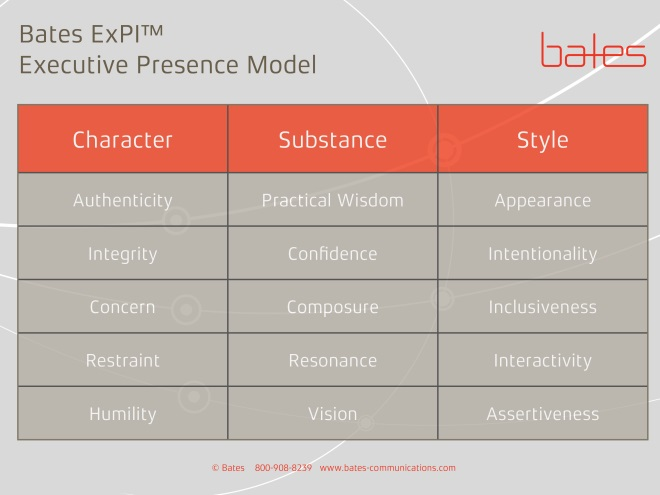
    Style: those more overt aspects of presence, such as the way we show up, the energy and assertiveness we bring, and the way we connect and interact with others. 

Content


Measuring and Developing Executive Presence in Leaders and High Potentials-622285d21171a0ded4bfca95b0ab9451d1397d685fef68d4e53487a49ae641ab

Content

Measuring executive presence

Measuring executive presence

Content

As we talked with our clients about the relevance of executive presence to training and development programs, we found a common concern.

As we talked with our clients about the relevance of executive presence to training and development programs, we found a common concern. 

Content

For example, one VP of talent management for a Fortune 500 financial services company reflected, “How do you measure things like character in leaders, and address needs when it comes to qualities like humility, integrity, and concern? Aren’t these facets deep-rooted?”

For example, one VP of talent management for a Fortune 500 financial services company reflected, “How do you measure things like character in leaders, and address needs when it comes to qualities like humility, integrity, and concern? Aren’t these facets deep-rooted?” 

Content

As many of our clients found, without a sufficient approach to measurement, attempts to build development programs around these qualities often fell flat.

As many of our clients found, without a sufficient approach to measurement, attempts to build development programs around these qualities often fell flat. 

Content

It’s important to clarify that measuring executive presence isn’t about whether the leader has these qualities. It’s about whether these qualities are showing up in the leader’s communication and interactions with key stakeholders. A tool like the ExPI measures a leader’s blind spots—the areas for improvement where there might be dissonance between the leader’s self-perception and the perception of their peers, boss, and direct reports.

It’s important to clarify that measuring executive presence isn’t about whether the leader has these qualities. It’s about whether these qualities are showing up in the leader’s communication and interactions with key stakeholders. A tool like the ExPI measures a leader’s blind spots—the areas for improvement where there might be dissonance between the leader’s self-perception and the perception of their peers, boss, and direct reports. 

Content

Multi-rater feedback offers the leader insights into how these qualities are coming through in their day-to-day leadership. The experience is often eye opening, particularly because as leaders move up in rank and influence, fewer are willing to tell them the truth about where there might be gaps. With concrete data about their EP, leaders feel energized to take action.

Multi-rater feedback offers the leader insights into how these qualities are coming through in their day-to-day leadership. The experience is often eye opening, particularly because as leaders move up in rank and influence, fewer are willing to tell them the truth about where there might be gaps. With concrete data about their EP, leaders feel energized to take action.    

Content

Tips for developing executive presence

Tips for developing executive presence 

Content

Beyond defining and measuring executive presence, what else can you do to continue on the trajectory and help leaders and high potentials develop it? Here are three quick strategies.

Beyond defining and measuring executive presence, what else can you do to continue on the trajectory and help leaders and high potentials develop it? Here are three quick strategies.

  1. Content

    Map it to your competency model and in performance reviews. We’ve found that the facets highlighted in our research on EP correlate nicely with the leadership competency models currently used in many organizations. By drawing connections between the two, you can reinforce the importance and applicability of EP to your organization’s culture and strategy.

    Map it to your competency model and in performance reviews. We’ve found that the facets highlighted in our research on EP correlate nicely with the leadership competency models currently used in many organizations. By drawing connections between the two, you can reinforce the importance and applicability of EP to your organization’s culture and strategy. 

  2. Content

    Provide business relevant context in feedback to engage leaders.It’s important to tie feedback on EP to the leader’s business context, so it establishes in their mind the practical relevance of development themes and evokes an appropriate sense of urgency to take action.

    Provide business relevant context in feedback to engage leaders.It’s important to tie feedback on EP to the leader’s business context, so it establishes in their mind the practical relevance of development themes and evokes an appropriate sense of urgency to take action.

  3. Content

    Provide reflective learning experiences. Provide leaders and high potentials with opportunities to reflect on past leadership experiences and connect the dots with their strengths and developmental themes. Through the power of recollection, leaders embark on journeys of personal discovery that lead to clarity about what defines them. When they’re able to clarify what defines them, they can demonstrate an “executive presence” that’s authentic, unique and true.

    Provide reflective learning experiences. Provide leaders and high potentials with opportunities to reflect on past leadership experiences and connect the dots with their strengths and developmental themes. Through the power of recollection, leaders embark on journeys of personal discovery that lead to clarity about what defines them. When they’re able to clarify what defines them, they can demonstrate an “executive presence” that’s authentic, unique and true. 

Content

Having a clear definition of executive presence, a way to measure it, and practical approaches to coaching and training to it are all essential steps in enabling leaders to build presence and amplify their influence. For more information on the Model of Executive Presence and ExPI, visit www.bates-communications.com/what-we-do/executive-presence-assessment .

Having a clear definition of executive presence, a way to measure it, and practical approaches to coaching and training to it are all essential steps in enabling leaders to build presence and amplify their influence. For more information on the Model of Executive Presence and ExPI, visit www.bates-communications.com/what-we-do/executive-presence-assessment.

You've Reached ATD Member-only Content

Become an ATD member to continue

Already a member?Sign In


Copyright © 2026 ATD

ASTD changed its name to ATD to meet the growing needs of a dynamic, global profession.

Terms of UsePrivacy NoticeCookie Policy