
ATD Blog
New Study Finds Training Approach Leads to 54% Increase in Learning Outcomes—And It’s Not From More Slides
Tue Apr 22 2025

Brought to you by

When employees attend training sessions, it’s not enough for them to sit passively through a presentation. What people remember and apply later depends largely on their engagement during the session. But how much does this really matter, and how can L&D teams design training that encourages participation?
To explore how different approaches to training affect outcomes, Engageli conducted the Active Learning Impact Study.
What Is Active Learning?
Active learning is a teaching approach that encourages learners to do more than just listen. Instead of absorbing information passively, learners are prompted to participate by answering questions, discussing topics with peers, working through problems, or applying new concepts to real scenarios.
For example:
In cybersecurity training, learners might work in small groups to identify phishing attempts in real emails.
In a sales workshop, they could role-play conversations with customers.
In a software onboarding session, learners might walk through real workflows and give feedback.
These small actions can make a big difference. They help people stay focused, think critically about the material, and remember what they’ve learned.
Active learning becomes more critical in online settings, where it's easy to lose focus or multitask. Without built-in opportunities to interact, learners may tune out. That’s why designing for engagement—starting from the first five minutes of a session—can lead to better outcomes.
Four Levels of Active Learning
To understand how different levels of interaction affect outcomes, Engageli tested a four-level model called the Active Learning Journey:
Level 0 – Passive: Lecture-based, with learners mainly listening.
Level 1 – Connected: Adds basic interaction like questions and polls.
Level 2 – Collaborative: Small groups work on tasks or challenges.
Level 3 – Transformative: Combines collaboration, interactive tools, and real-time application.
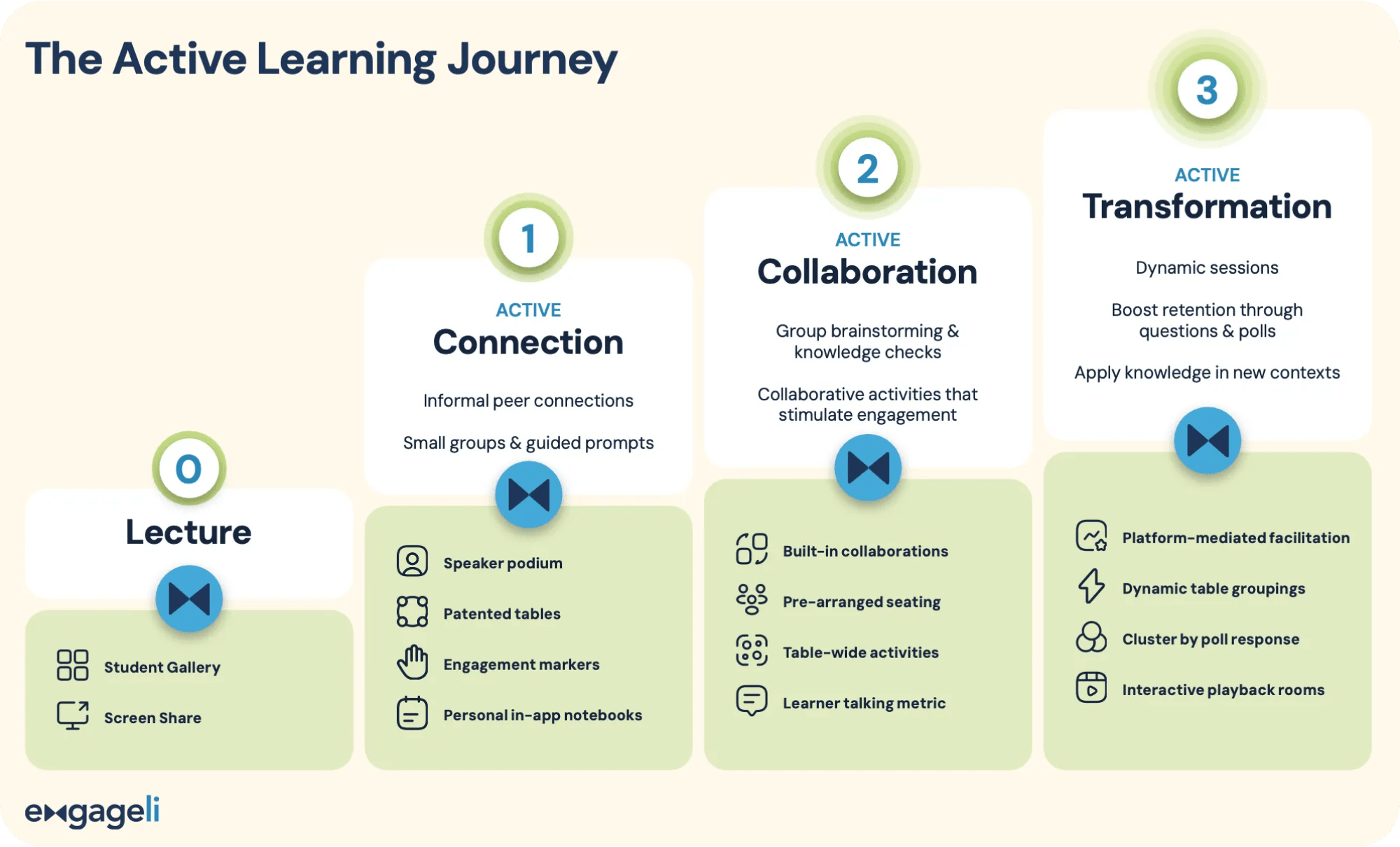
The study compared Levels 0, 1, and 3 using similarly sized groups with comparable backgrounds.
Measuring Engagement—What Changed?
To track learner engagement objectively, we measured both verbal interaction (learner talk time) and nonverbal participation (reactions, chats, polls, and collaborative whiteboard activities). The outcomes showed substantial differences:
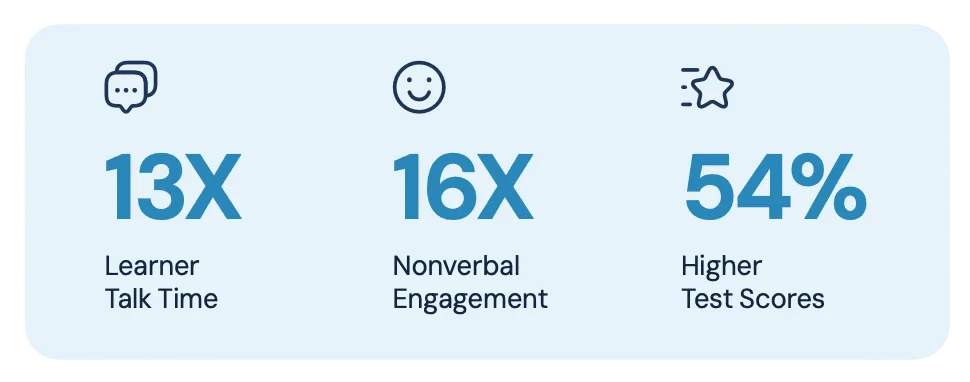
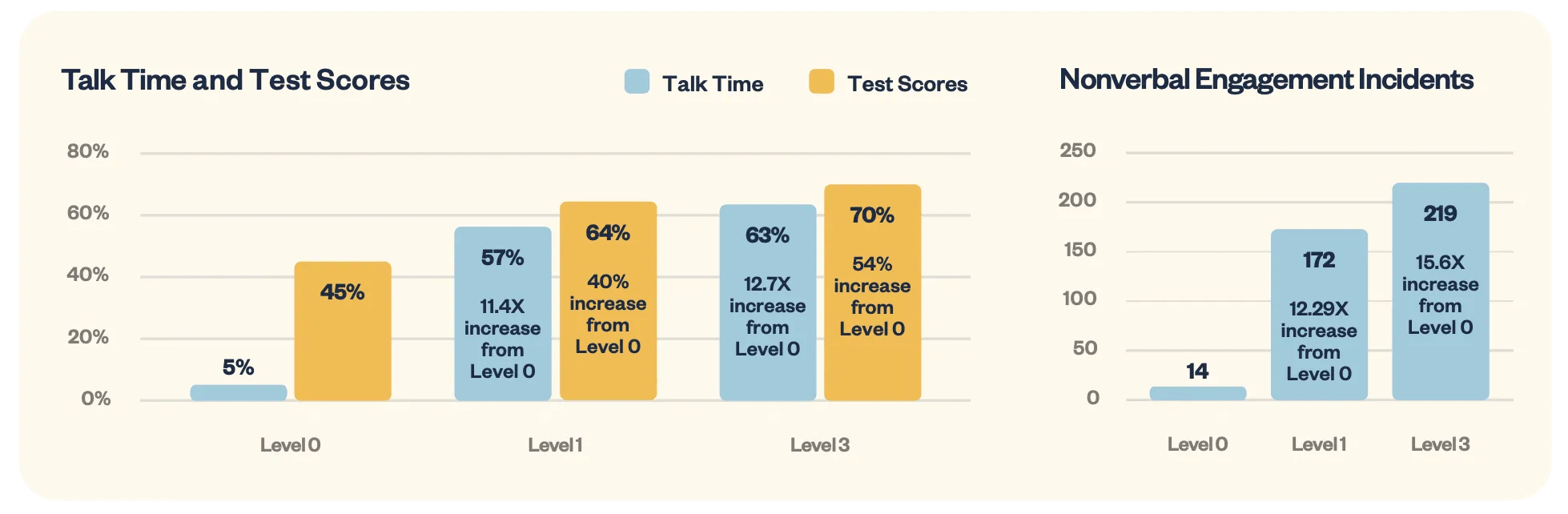
Learner talk time was 13 times higher at Level 3 than at Level 0.
Nonverbal interaction was 16 times higher at Level 3 compared to Level 0.
This shows that designing sessions with built-in opportunities for interaction—like group discussions and short polls—makes a big difference in how engaged learners are.
Did Engagement Improve Learning?
To find out whether increased participation actually led to better outcomes, learners were tested one week after their sessions. The results were clear:
At Level 0, participants scored an average of 45 percent.
At Level 1, scores improved to 64 percent.
At Level 3, scores increased further to 70 percent, representing a 54 percent improvement over passive methods.
Interestingly, even though learners in passive sessions felt like they had learned more, their test scores were significantly lower. This gap between perception and actual learning highlights the importance of measuring training effectiveness with real outcomes, not just post-session surveys.
How to Add Active Learning to Your Training
Here are some practical ways to bring active learning into your sessions, whether online or in person:
Start every session with a quick activity like a poll, chat question, or short breakout discussion.
Use checkpoints such as quizzes or knowledge checks every 10-15 minutes.
At least once a session, break learners into small groups to solve a problem or review a case study.
Ask learners to explain key concepts to a partner or the full group.
Give real-world scenarios related to the learners’ roles.
Use a mix of verbal, visual, and hands-on activities, with learners grouped by role or experience level for more relevant discussions.
Train instructors on active learning methods and provide tools that support interaction, group work, and real-time feedback.
Why Active Learning Matters Now
As more training moves online, engagement is both harder to maintain and more critical. Engageli’s study shows that even small shifts toward active participation can significantly boost learning outcomes.
With just a few simple changes—like polls, discussions, or applied scenarios—your sessions can become more effective and memorable.
To further explore the data, read the full report on Engageli’s website.
View Courses Recommended for You