ATD, association for talent development

ATD Blog

Personas: Designing Personalized, Learner-Centric Experiences

By

Wed Oct 31 2018

Personas: Designing Personalized, Learner-Centric Experiences
Loading...

Content

The persona is part of the design thinking methods toolkit and originated in the work associated with the user-centered experience. The persona tool provides an opportunity for a diverse group to quickly share ideas and research to develop a realistic description of a person. This type of tool enables talent development professionals to gain a deeper understanding of their customers, and from that perspective, they can then design learning environments to be more engaging and sustainable.

The persona is part of the design thinking methods toolkit and originated in the work associated with the user-centered experience. The persona tool provides an opportunity for a diverse group to quickly share ideas and research to develop a realistic description of a person. This type of tool enables talent development professionals to gain a deeper understanding of their customers, and from that perspective, they can then design learning environments to be more engaging and sustainable.

Content

The persona requires research and rigorous interviewing, and sometimes includes data. The LUMA Institute, in its book Innovating for People , labels a persona as “an informed summary of the mindset, needs, and goals typically held by key stakeholders.” Additionally, they call them “not preconceived stereotypes; they are archetypes borne of careful study.” Archetypes generally describe goals and observed behavior patterns and are much more specific than users.”

The persona requires research and rigorous interviewing, and sometimes includes data. The LUMA Institute, in its book Innovating for People, labels a persona as “an informed summary of the mindset, needs, and goals typically held by key stakeholders.” Additionally, they call them “not preconceived stereotypes; they are archetypes borne of careful study.” Archetypes generally describe goals and observed behavior patterns and are much more specific than users.”

Developing Personas

Content

Because one goal of a persona is to develop empathy, it is not just a general description, but also includes characteristics, feelings, needs, goals and even quotes. It’s aimed at telling a story from the person’s perspective. This information is gathered using a series of approaches and research such as interviews and observation.

Because one goal of a persona is to develop empathy, it is not just a general description, but also includes characteristics, feelings, needs, goals and even quotes. It’s aimed at telling a story from the person’s perspective. This information is gathered using a series of approaches and research such as interviews and observation.

Content

Personas use illustrations, portraits, quotes, metrics, and descriptive text (see the template below). Developing the actual persona can start anywhere, but it may be more efficient to start with what the person needs to do in the context of the purpose for the persona design. In other words, what role does the person play or what tasks does the person need to perform. For example, as talent development professionals, we typically are designing a learning experience for employees in order to enhance job performance that leads to business results.
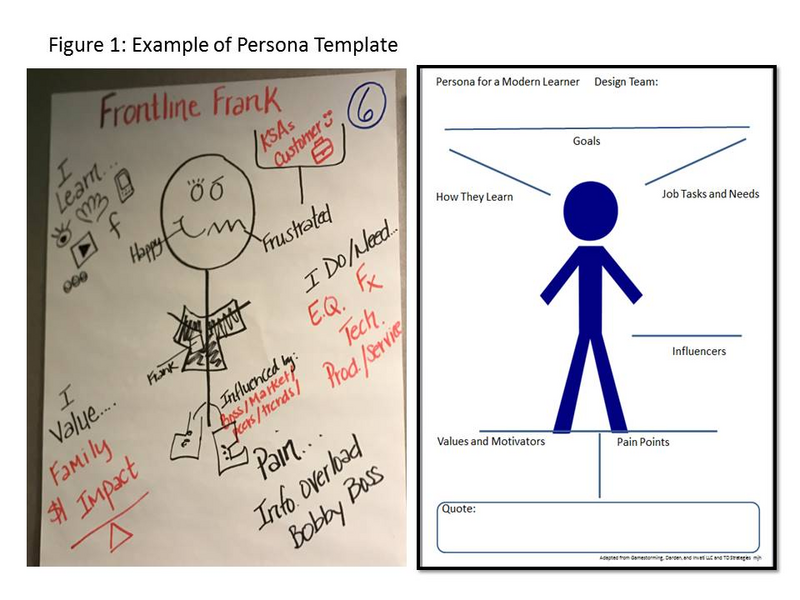
Personas use illustrations, portraits, quotes, metrics, and descriptive text (see the template below). Developing the actual persona can start anywhere, but it may be more efficient to start with what the person needs to do in the context of the purpose for the persona design. In other words, what role does the person play or what tasks does the person need to perform. For example, as talent development professionals, we typically are designing a learning experience for employees in order to enhance job performance that leads to business results.

Personas: Designing Personalized, Learner-Centric Experiences-Hall_PersonaExample.jpg

Content

Completing the persona can include information related to:

Completing the persona can include information related to:

Content

Goals:

Goals:

  • Content

    What does success look like for person?

    What does success look like for person?

  • Content

    What is the person’s end point?

    What is the person’s end point?

Content

Tasks to perform:

Tasks to perform:

  • Content

    What does the learner have to do to be successful in performing their tasks?

    What does the learner have to do to be successful in performing their tasks?

  • Content

    What skill level does the learner currently have to do the task?

    What skill level does the learner currently have to do the task?

  • Content

    What skill level is necessary?

    What skill level is necessary?

Content

Pain points:

Pain points:

  • Content

    What is getting in the way of their success?

    What is getting in the way of their success?

  • Content

    What are the challenges?

    What are the challenges?

  • Content

    What are the stumbling blocks in terms of their own skills and abilities, the resources available, other people (especially stakeholders), and even the constraints of time and space?

    What are the stumbling blocks in terms of their own skills and abilities, the resources available, other people (especially stakeholders), and even the constraints of time and space?

Content

Values and motivators:

Values and motivators:

  • Content

    What motivates the learner?

    What motivates the learner?

  • Content

    What activities or hobbies does the learner like?

    What activities or hobbies does the learner like?

Content

Learning styles:

Learning styles:

  • Content

    How does the learner like to operate: alone, in a group, or some other way?

    How does the learner like to operate: alone, in a group, or some other way?

  • Content

    Do they like to do and build things or do they like to read and think about things?

    Do they like to do and build things or do they like to read and think about things?

Content

Customarily, the name given to the persona might describe their overall personality. For instance, during a recent session to develop personas for modern Millennial learners, some of the names included ARA (Always Right Andrew), Curious Charley, Millennial Millie, and Generational Gerald. For personas related to engagement, one group had the following monikers: Shoot-from-the-Hip Sam and Helena the High Achiever.

Customarily, the name given to the persona might describe their overall personality. For instance, during a recent session to develop personas for modern Millennial learners, some of the names included ARA (Always Right Andrew), Curious Charley, Millennial Millie, and Generational Gerald. For personas related to engagement, one group had the following monikers: Shoot-from-the-Hip Sam and Helena the High Achiever.

Content

The persona is more than a fun, descriptive personality story, though. It can help align needs, goals, and pain points of the users to the products rather than those of the designers—thus, creating a better experience for the users. Indeed, the entire reason for human-centered design is to focus on the users and make design decisions around their needs.

The persona is more than a fun, descriptive personality story, though. It can help align needs, goals, and pain points of the users to the products rather than those of the designers—thus, creating a better experience for the users. Indeed, the entire reason for human-centered design is to focus on the users and make design decisions around their needs.

Content

For most scenarios, several personas are needed to cover the diversity of participant types. For example, in a learning environment, you might have different personas for:

For most scenarios, several personas are needed to cover the diversity of participant types. For example, in a learning environment, you might have different personas for:

  • Content

    the high-performing learner, the one that is self-motivated and has curiosity)

    the high-performing learner, the one that is self-motivated and has curiosity)

  • Content

    the prisoner, the employee who is sent to training but does not want to be there)

    the prisoner, the employee who is sent to training but does not want to be there)

  • Content

    the average employee, the person that knows the skills are important and is willing to try

    the average employee, the person that knows the skills are important and is willing to try

  • Content

    the vacationer, the employee that will do anything to get out of work.

    the vacationer, the employee that will do anything to get out of work.

In Summary

Content

Market-leading organizations choose personalized learning to help drive long-term performance. High-performance firms lay the foundation for long-term business success by applying personalization to drive greater engagement in learning, employee ownership of learning, and development of growth mindsets.

Market-leading organizations choose personalized learning to help drive long-term performance. High-performance firms lay the foundation for long-term business success by applying personalization to drive greater engagement in learning, employee ownership of learning, and development of growth mindsets.

Content

How do we respond to, compete with, and meet the needs of the learner in a rapidly evolving environment? It’s all about advancing performance excellence for employees in a way that meets their personal needs. This includes providing a broad range of learning experiences to engage and inspire employees—anywhere, any time, and in a variety of ways. Using personas to gain a deeper understanding of our employees can help fulfill this mission more effectively and precisely.

How do we respond to, compete with, and meet the needs of the learner in a rapidly evolving environment? It’s all about advancing performance excellence for employees in a way that meets their personal needs. This includes providing a broad range of learning experiences to engage and inspire employees—anywhere, any time, and in a variety of ways. Using personas to gain a deeper understanding of our employees can help fulfill this mission more effectively and precisely.

You've Reached ATD Member-only Content

Become an ATD member to continue

Already a member?Sign In


Copyright © 2026 ATD

ASTD changed its name to ATD to meet the growing needs of a dynamic, global profession.

Terms of UsePrivacy NoticeCookie Policy