
ATD Blog
Re-Envisioning Learning Strategy
Thu Nov 29 2018

Content
“The illiterate of the 21st century will not be those who cannot read and write, but those who cannot learn, unlearn, and relearn.” —Alvin Toffler
“The illiterate of the 21st century will not be those who cannot read and write, but those who cannot learn, unlearn, and relearn.” —Alvin Toffler
Content
As learning professionals, it’s difficult to disagree with that quote. We struggle each day with learners’ resistance to unlearning and relearning.
As learning professionals, it’s difficult to disagree with that quote. We struggle each day with learners’ resistance to unlearning and relearning.
Content
But do we ever view ourselves through the same lens?
But do we ever view ourselves through the same lens?
Content
The challenge that learning professionals face in today’s fast-paced era of technological advancement, global expansion, and disruption is putting ourselves in the position of learning, unlearning, and relearning our craft to accommodate the needs of learners.
The challenge that learning professionals face in today’s fast-paced era of technological advancement, global expansion, and disruption is putting ourselves in the position of learning, unlearning, and relearning our craft to accommodate the needs of learners.
Addressing the Industry’s Need to Adapt
Content
Outside the L&D community, several factors are impacting and reshaping the way people work together and go about their daily activities. Right now, we are emerging from an age of computer, electronics, and automation to a more connected age of the Internet, networks, and cyber physical systems. As this happens, there is a lot of disruption.
Outside the L&D community, several factors are impacting and reshaping the way people work together and go about their daily activities. Right now, we are emerging from an age of computer, electronics, and automation to a more connected age of the Internet, networks, and cyber physical systems. As this happens, there is a lot of disruption.
Content
Think of how banking has changed in recent years. You used to be able to start a loan process online, for example, then go into the bank’s environment to complete the process. But now, the environment comes to the consumer, enabling them to complete the entire loan process online while sitting in a parking lot waiting for their kid’s soccer practice to end.
Think of how banking has changed in recent years. You used to be able to start a loan process online, for example, then go into the bank’s environment to complete the process. But now, the environment comes to the consumer, enabling them to complete the entire loan process online while sitting in a parking lot waiting for their kid’s soccer practice to end.
Content
The L&D industry needs to make the same shift. Instead of learners wrapping themselves around a specific environment, we need to find a way to wrap the environment around the learner—making training available to the user where they are, when they need it.
The L&D industry needs to make the same shift. Instead of learners wrapping themselves around a specific environment, we need to find a way to wrap the environment around the learner—making training available to the user where they are, when they need it.
Content
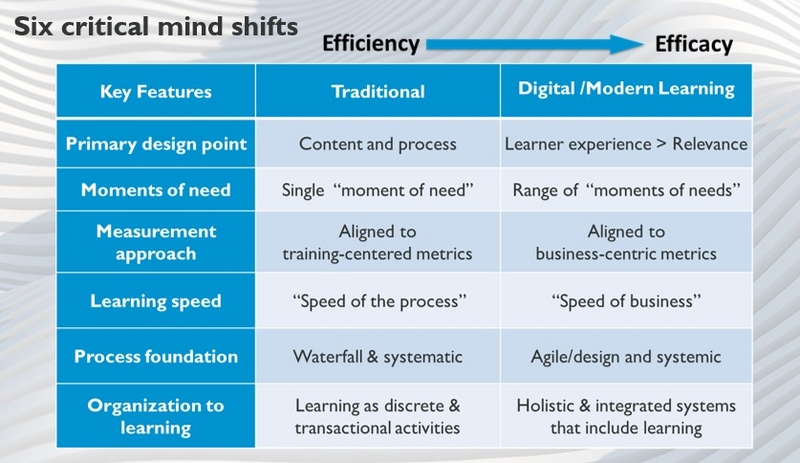
In addition, we need to move from an era of creating efficiencies to one that also creates efficacy. The chart below identifies six critical mindsets we need for this journey. For example, instead of focusing primarily on the content of learning, we need to think more about the relevance of that content and how the learner interacts with it.
In addition, we need to move from an era of creating efficiencies to one that also creates efficacy. The chart below identifies six critical mindsets we need for this journey. For example, instead of focusing primarily on the content of learning, we need to think more about the relevance of that content and how the learner interacts with it.
Content
Some L&D organizations are creating innovation centers to address these shifts and are becoming more proactive in the approach to development. In GP Strategies’ Innovation Kitchen we’re able to work through learning and technological solutions before needs arise to see what works and hone our responses before they are needed. In essence, we create solutions that don’t yet exist from scenarios that haven’t happened yet. It’s a shift in the way we think about L&D that not only increases our readiness to respond, but also creates greater value for our function in the organization.
Some L&D organizations are creating innovation centers to address these shifts and are becoming more proactive in the approach to development. In GP Strategies’ Innovation Kitchen we’re able to work through learning and technological solutions before needs arise to see what works and hone our responses before they are needed. In essence, we create solutions that don’t yet exist from scenarios that haven’t happened yet. It’s a shift in the way we think about L&D that not only increases our readiness to respond, but also creates greater value for our function in the organization.
Making the Shift
Content
We’ve amassed a lot of knowledge around learning in our industry. We know our craft. But we need to unlearn the way we respond to the changes happening around us that impact our work and relearn in a way that is more proactive to:
We’ve amassed a lot of knowledge around learning in our industry. We know our craft. But we need to unlearn the way we respond to the changes happening around us that impact our work and relearn in a way that is more proactive to:
Content
Identify industry and technological trends and signals earlier.
Identify industry and technological trends and signals earlier.
Content
Get better at determining when to shift strategies to accommodate changing trends.
Get better at determining when to shift strategies to accommodate changing trends.
Content
Transform both designer and learner mindsets in relation to greeting change.
Transform both designer and learner mindsets in relation to greeting change.
Content
Continuously adapt in order to remain relevant.
Continuously adapt in order to remain relevant.
Content
The days of having a go-to solution, such as traditional instructor-led training, that you can rely upon for decades is over. In today’s L&D industry, there is no rest for the weary. We are no longer in the business of responding to needs. We need a seat at the table so we can plan and create emerging needs. And absent of that, we need to anticipate needs, knowing that our future revolves around meeting learners in their environment.
The days of having a go-to solution, such as traditional instructor-led training, that you can rely upon for decades is over. In today’s L&D industry, there is no rest for the weary. We are no longer in the business of responding to needs. We need a seat at the table so we can plan and create emerging needs. And absent of that, we need to anticipate needs, knowing that our future revolves around meeting learners in their environment.