ATD, association for talent development

ATD Blog

Sales Onboarding: Twice as Good in Half the Time

By

Fri Apr 24 2015

Loading...
Sales Onboarding: Twice as Good in Half the Time-b208b1669105bdebbc2330aa8bc19fe50dd29bed20469fa096601e4ba7258c53

Content

Onboarding is the method by which employers bring new workers into the organization and help them acquire the necessary knowledge, skills, and behaviors to perform effectively. In the sales profession, onboarding of new hires is generally recognized as a critical activity. Given that, one might question why we typically do such a poor job of it.

Onboarding is the method by which employers bring new workers into the organization and help them acquire the necessary knowledge, skills, and behaviors to perform effectively. In the sales profession, onboarding of new hires is generally recognized as a critical activity. Given that, one might question why we typically do such a poor job of it. 

Content

\[Insert dramatic pause here.\]

\[Insert dramatic pause here.\] 

Content

Yes, that’s a blanket statement. No, I’m not a fan of generalizations. But in most organizations where I've consulted, worked in, or spoken to the training or enablement teams, ineffective onboarding was a known issue—and there was no great plan to address it. Even when there was a plan, it was typically just organized content, rather than something that would radically shorten ramp-up time or increase sales productivity of new hires.

Yes, that’s a blanket statement. No, I’m not a fan of generalizations. But in most organizations where I've consulted, worked in, or spoken to the training or enablement teams, ineffective onboarding was a known issue—and there was no great plan to address it. Even when there was a plan, it was typically just organized content, rather than something that would radically shorten ramp-up time or increase sales productivity of new hires. 

Content

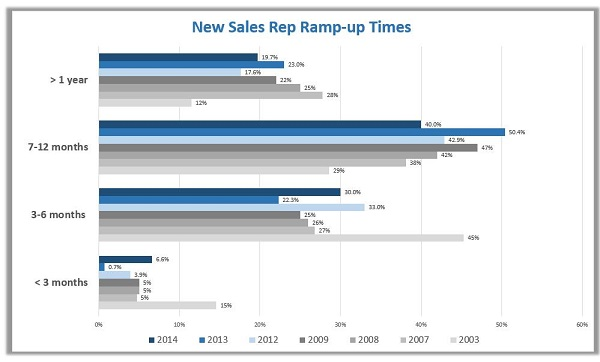
New Sales Rep Ramp-Up Times

New Sales Rep Ramp-Up Times

Content

For fun (Yes, I’m odd), I set a time limit one weekend and searched the Internet for onboarding ramp-up data. I pieced it together from various sources (which all shared some version of CSO Insights' reports), and found data for 2003, 2007-2009, and more recently for 2012-2014. The data may not be 100 percent accurate because I didn't retrieve it directly from the source, which I openly disclaim, but it was all published by others and should be "directionally" correct.

For fun (Yes, I’m odd), I set a time limit one weekend and searched the Internet for onboarding ramp-up data. I pieced it together from various sources (which all shared some version of CSO Insights' reports), and found data for 2003, 2007-2009, and more recently for 2012-2014. The data may not be 100 percent accurate because I didn't retrieve it directly from the source, which I openly disclaim, but it was all published by others and should be "directionally" correct.

Content

Whether you work with the team at CSO Insights , the wise researchers at CEB , my friends and pundits at Forrester or Aberdeen , the sharp folks at IDC , or some of my industry colleagues and friends at the analyst group SiriusDecisions , I highly recommend you consider a data-driven, fact-based approach toward managing your business—not a search-engine compilation effort like I did for my own amusement.

Whether you work with the team at CSO Insights, the wise researchers at CEB, my friends and pundits at Forrester or Aberdeen, the sharp folks at IDC, or some of my industry colleagues and friends at the analyst group SiriusDecisions, I highly recommend you consider a data-driven, fact-based approach toward managing your business—not a search-engine compilation effort like I did for my own amusement. 

Content

In any case, here’s what I found:

In any case, here’s what I found: 

Sales Onboarding: Twice as Good in Half the Time-3cc1af8c77789670e82359de687940405d95b0b535456e7caf875891b2c8df1b

Content

Source: Compiled via Internet search from sources that referred to CSO Insights’ annual surveys.

Source: Compiled via Internet search from sources that referred to CSO Insights’ annual surveys. 

Content

Here are some quick thoughts on the data.

Here are some quick thoughts on the data.

  • Content

    It takes many companies seven to 12 months to ramp-up new sales reps. Other than 2003, that’s the biggest bucket in the reported years.

    It takes many companies seven to 12 months to ramp-up new sales reps. Other than 2003, that’s the biggest bucket in the reported years.

  • Content

    I wondered about the variance from year to year in the tighter bands, and can only guess it’s due to a difference in the target demographics or respondents. I can’t say for sure or speak to the statistical significance of those comparisons or variations.

    I wondered about the variance from year to year in the tighter bands, and can only guess it’s due to a difference in the target demographics or respondents. I can’t say for sure or speak to the statistical significance of those comparisons or variations.

  • Content

    Ramp up times have generally extended over the years. There’s variance, but if you trend-line the data, it seems to be headed in the wrong direction. There could be quite a few reasons for that, though, including a more complex, competitive business environment, a shift toward a buyers’ market, or an increase in complexity of problems, opportunities, and solutions to address them. Another reason could be some year-to-year differences in research protocol or other speculative explanations. Whatever the reasons, it appears to be taking longer.

    Ramp up times have generally extended over the years. There’s variance, but if you trend-line the data, it seems to be headed in the wrong direction. There could be quite a few reasons for that, though, including a more complex, competitive business environment, a shift toward a buyers’ market, or an increase in complexity of problems, opportunities, and solutions to address them. Another reason could be some year-to-year differences in research protocol or other speculative explanations. Whatever the reasons, it appears to be taking longer.

Content

Things seemed really different in 2003, didn't they? Ah, the good ol’ days.

Things seemed really different in 2003, didn't they? Ah, the good ol’ days. 

Content

We Can Do Better

We Can Do Better

Content

Despite complex factors and some uncertainties in this reporting, I contend that we can do better. I believe this because I've helped companies do it. Here are some facts to consider to get started on a new system for onboarding:

Despite complex factors and some uncertainties in this reporting, I contend that we can do better. I believe this because I've helped companies do it. Here are some facts to consider to get started on a new system for onboarding: 

  1. Content

    Understand the importance of effective selection and hiring for sales.

    Understand the importance of effective selection and hiring for sales.

  2. Content

    Create clear definitions for the various elements of orientation and onboarding, so you’re team is clear on terms and are “speaking” the same language.

    Create clear definitions for the various elements of orientation and onboarding, so you’re team is clear on terms and are “speaking” the same language.

  3. Content

    Develop a process for how to manage things “in the beginning,” which applies to HR, IT, telecom, facilities, logins, and other logistics. The goal is to remove obstacles and distractions for new employees and do as much as possible in the pre-start logistic phases to enable reps to focus on sales performance as quickly as possible.

    Develop a process for how to manage things “in the beginning,” which applies to HR, IT, telecom, facilities, logins, and other logistics. The goal is to remove obstacles and distractions for new employees and do as much as possible in the pre-start logistic phases to enable reps to focus on sales performance as quickly as possible.

  4. Content

    Outline common onboarding mistakes and what to avoid, such as the legendary onboarding method of “go get ‘em, tiger!”

    Outline common onboarding mistakes and what to avoid, such as the legendary onboarding method of “go get ‘em, tiger!”

  5. Content

    Set the right performance milestones, which will become the foundation for how you organize your curriculum and measure success. Determine lead and lag indicators for both learning performance and sales performance.

    Set the right performance milestones, which will become the foundation for how you organize your curriculum and measure success. Determine lead and lag indicators for both learning performance and sales performance.

  6. Content

    Design content that will lead to results in the real world. A key differentiator, in my experience, is the specific way in which you chunk, sequence, and layer content and design curriculum to support the fastest-possible achievement of your pre-set performance milestones.

    Design content that will lead to results in the real world. A key differentiator, in my experience, is the specific way in which you chunk, sequence, and layer content and design curriculum to support the fastest-possible achievement of your pre-set performance milestones.

  7. Content

    Execute within the framework of an effective learning system to ensure you get the results you need.

    Execute within the framework of an effective learning system to ensure you get the results you need.

Content

Clearly, you will not be able to plug-and-play right into this system without some thought. You will need to do some work to figure out how to best apply it to your company and its sales nuances. With that said, I've helped companies both radically shorten ramp-up times, while increasing new-hire performance—often at the same time. It takes focus and real effort, as well as a different approach than I normally hear about. Here are some of the results achieved with this method:

Clearly, you will not be able to plug-and-play right into this system without some thought. You will need to do some work to figure out how to best apply it to your company and its sales nuances. With that said, I've helped companies both radically shorten ramp-up times, while increasing new-hire performance—often at the same time. It takes focus and real effort, as well as a different approach than I normally hear about. Here are some of the results achieved with this method:

  • Content

    decreased ramp-up time by 23 percent, 34 percent, 47 percent, and 52 percent (3-18 months)

    decreased ramp-up time by 23 percent, 34 percent, 47 percent, and 52 percent (3-18 months)

  • Content

    at 120 days, new reps outperformed a control group of five-year reps by 21 percent (6 months)

    at 120 days, new reps outperformed a control group of five-year reps by 21 percent (6 months)

  • Content

    increased sales/rep in the 90 days after training by 2.3/month – average increase of $183k/class or $36.6mm/year (9 months)

    increased sales/rep in the 90 days after training by 2.3/month – average increase of $183k/class or $36.6mm/year (9 months)

  • Content

    improved average profitability/new reps by 11 percent (4 months)

    improved average profitability/new reps by 11 percent (4 months)

  • Content

    improved new rep win-rate by 16 percent (6 months)

    improved new rep win-rate by 16 percent (6 months)

  • Content

    $398mm YOY revenue increase, $9.96mm net profit increase, and a 400 percent ROI (12 months). (Disclaimer: This was the result from a combination of projects, of which new sales onboarding was a part.)

    $398mm YOY revenue increase, $9.96mm net profit increase, and a 400 percent ROI (12 months). (Disclaimer: This was the result from a combination of projects, of which new sales onboarding was a part.)

You've Reached ATD Member-only Content

Become an ATD member to continue

Already a member?Sign In


Copyright © 2026 ATD

ASTD changed its name to ATD to meet the growing needs of a dynamic, global profession.

Terms of UsePrivacy NoticeCookie Policy