ATD, association for talent development

ATD Blog

Science of Learning 101: Job Performance and Expertise

By

Wed Mar 16 2016

Science of Learning 101: Job Performance and Expertise
Loading...
Science of Learning 101: Job Performance and Expertise-3fbcd58f5cb9e1f5127fbcde9babcb40a23c0d45dc44ceeb64fdeb3b127ef7cd

Content

A number of years ago, I signed up for a series of online Microsoft Excel courses. First course: A. Bad. Fit. The first 15 minutes involved fiddling with the virtual classroom audio. Then, they instructor proceeded to read every exercise from the book aloud. Next, he asked everyone, after every exercise, to read aloud to the group their answers. Not surprisingly, I logged off and immediately called the company to get my money back.

A number of years ago, I signed up for a series of online Microsoft Excel courses. First course: A. Bad. Fit. The first 15 minutes involved fiddling with the virtual classroom audio. Then, they instructor proceeded to read every exercise from the book aloud. Next, he asked everyone, after every exercise, to read aloud to the group their answers. Not surprisingly, I logged off and immediately called the company to get my money back.

Content

(Let’s face it. L&D folks can be cruel trainees.)

(Let’s face it. L&D folks can be cruel trainees.)

Content

The company was smart and offered to put me in another instructor’s class. She was an obvious expert at Microsoft Excel. More importantly, the new instructor was an expert at online instruction. After five minutes of asking about our background, experience with Excel, and our needs, we got going. In each section, she showed specific items and shortcuts we could use in our specific areas. We moved quickly over items that learners were not interested in, and spent extra time on areas of greater interest. I made sure I took every class from her.

The company was smart and offered to put me in another instructor’s class. She was an obvious expert at Microsoft Excel. More importantly, the new instructor was an expert at online instruction. After five minutes of asking about our background, experience with Excel, and our needs, we got going. In each section, she showed specific items and shortcuts we could use in our specific areas. We moved quickly over items that learners were not interested in, and spent extra time on areas of greater interest. I made sure I took every class from her.

Content

Both instructors used the same written content, but the first instructor didn’t seem nearly as capable.

Both instructors used the same written content, but the first instructor didn’t seem nearly as capable.

Growing Expertise

Content

L&D professionals often forget that we are not primarily in the content development business; instead, we are in the people development business. Our real goal is to move people toward greater expertise so they can do more for their teams and their organizations.

L&D professionals often forget that we are not primarily in the content development business; instead, we are in the people development business. Our real goal is to move people toward greater expertise so they can do more for their teams and their organizations.

Content

Here’s what L&D should really focus on: Ensuring that organizations have the expertise they need. For instance, the training company in the above example should help learners with their specific Excel needs, not teach Excel exactly as written in the instructional manuals.

Here’s what L&D should really focus on: Ensuring that organizations have the expertise they need. For instance, the training company in the above example should help learners with their specific Excel needs, not teach Excel exactly as written in the instructional manuals.

Content

To achieve this distinction, expertise really matters. Let me explain.

To achieve this distinction, expertise really matters. Let me explain.

Content

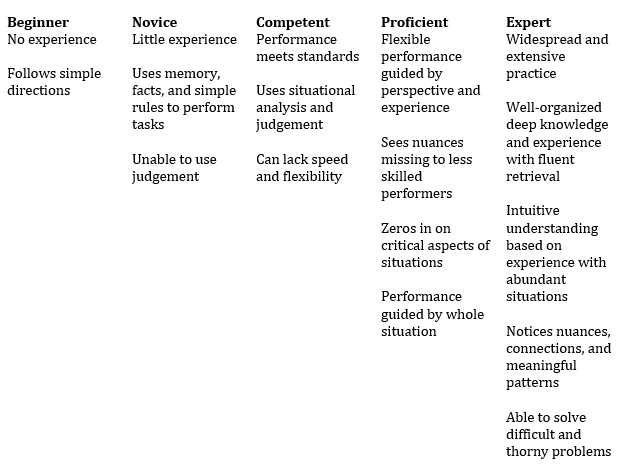
Figure 1 shows a progression of expertise—from beginner to expert, and lists some characteristics of work performance at each stage. This progression suggests distinct levels, but it’s actually a continuum, and people can be (and are) in different places with different skills

Figure 1 shows a progression of expertise—from beginner to expert, and lists some characteristics of work performance at each stage. This progression suggests distinct levels, but it’s actually a continuum, and people can be (and are) in different places with different skills

Content

Figure 1. Characteristics of Different Levels of Expertise and Impact on Job Performance Source: Patti Shank, PhD, from Make it Learnable ( www.pattishank.com ) .

Figure 1. Characteristics of Different Levels of Expertise and Impact on Job Performance Source: Patti Shank, PhD, from Make it Learnable (www.pattishank.com).

Content

For example, a graphic artist may be competent at certain design skills and expert at others. When brand new technology is introduced to the market, though, that person may revert to a beginner. They will likely gain expertise quickly because of prior knowledge, though. (See previous post on prior knowledge.)

For example, a graphic artist may be competent at certain design skills and expert at others. When brand new technology is introduced to the market, though, that person may revert to a beginner. They will likely gain expertise quickly because of prior knowledge, though. (See previous post on prior knowledge.)

Content

In essence, greater levels of expertise lead to quantitative and qualitative differences in performance. People who perform at higher levels know more and can do more. Their outcomes are very different. This is why we should care about helping people gain greater levels of expertise

In essence, greater levels of expertise lead to quantitative and qualitative differences in performance. People who perform at higher levels know more and can do more. Their outcomes are very different. This is why we should care about helping people gain greater levels of expertise

Content

Take, for example, the competent software trainer versus the expert software trainer. A competent software trainer makes it through the class materials, answers questions about the materials, handles problems people have with course content, and finishes on time. Meanwhile, an expert software trainer notices where course materials aren’t working, makes adaptations on the fly, and sends specific suggestions for changes. She helps participants apply specific segments to their own situations (through questioning techniques and other methods) and assists participants with advanced knowledge use extra content to learn even more.

Take, for example, the competent software trainer versus the expert software trainer. A competent software trainer makes it through the class materials, answers questions about the materials, handles problems people have with course content, and finishes on time. Meanwhile, an expert software trainer notices where course materials aren’t working, makes adaptations on the fly, and sends specific suggestions for changes. She helps participants apply specific segments to their own situations (through questioning techniques and other methods) and assists participants with advanced knowledge use extra content to learn even more.

Content

Similarly, think about the differences between the competent and expert supervisor, or the novice and proficient buyer. These examples should help you see why it is critical that L&D professionals work harder at developing people than developing content. Developing instructional content is important, but it doesn’t go far enough. Helping people become more expert makes all the difference in the world, both to their careers and to our organizations.

Similarly, think about the differences between the competent and expert supervisor, or the novice and proficient buyer. These examples should help you see why it is critical that L&D professionals work harder at developing people than developing content. Developing instructional content is important, but it doesn’t go far enough. Helping people become more expert makes all the difference in the world, both to their careers and to our organizations.

What Do We Know About Expertise?

Content

Expertise has been studied in depth. Here are three things L&D professionals should understand as they help others gain expertise.

Expertise has been studied in depth. Here are three things L&D professionals should understand as they help others gain expertise.

Content

#1: The hallmark of expertise is performance, which comes from a well-organized knowledge base with fluent (easy) retrieval of knowledge and skill.

#1: The hallmark of expertise is performance, which comes from a well-organized knowledge base with fluent (easy) retrieval of knowledge and skill.

Content

We call this knowledge base a “mental model” of their domain. A mental model is a mental representation of how things work. You might think of it as a concept chart of reality. Two IT experts may have different mental models of their domains because they specialize in different areas of IT. One may specialize in programming, while another specializes in databases. Parts of their mental model might overlap. That leads us to our second point.

We call this knowledge base a “mental model” of their domain. A mental model is a mental representation of how things work. You might think of it as a concept chart of reality. Two IT experts may have different mental models of their domains because they specialize in different areas of IT. One may specialize in programming, while another specializes in databases. Parts of their mental model might overlap. That leads us to our second point.

Content

#2: Expertise is very specific . We find different levels of expertise in specific types of work and different types of expertise.

#2: Expertise is very specific. We find different levels of expertise in specific types of work and different types of expertise.

Content

Consider the graphic artist who has different levels of expertise with various graphics programs. Likewise, we also have people with different types of expertise. For instance, a veterinarian may be an expert at general veterinary practice but may have an interest in certain specialty areas such as oncology (cancer) or dentistry. The vet may work at becoming more expert in those areas by taking courses, working with specialists, and so forth.

Consider the graphic artist who has different levels of expertise with various graphics programs. Likewise, we also have people with different types of expertise. For instance, a veterinarian may be an expert at general veterinary practice but may have an interest in certain specialty areas such as oncology (cancer) or dentistry. The vet may work at becoming more expert in those areas by taking courses, working with specialists, and so forth.

Content

Because modern instructional design often benefits from expertise in graphic design, usability, programming, and other areas, there are many of us who have studied topics beyond “traditional” instructional design. These are just some examples of expertise widening by level and type. In organizations, it can be extremely beneficial to organizations if we plan for how widening expertise can benefit organizational functioning.

Because modern instructional design often benefits from expertise in graphic design, usability, programming, and other areas, there are many of us who have studied topics beyond “traditional” instructional design. These are just some examples of expertise widening by level and type. In organizations, it can be extremely beneficial to organizations if we plan for how widening expertise can benefit organizational functioning.

Content

#3: Expertise takes sustained, deliberate practice in the tasks of expertise over time.

#3: Expertise takes sustained, deliberate practice in the tasks of expertise over time.

Content

It’s widely known that expert chess players invest 10,000 to 50,000 hours to reach master level. Researchers have found that it may take similar amounts of time to reach expert/master status in other fields, but cognitive science research shows that we may be able to shorten that amount of time considerably with selected training methods.

It’s widely known that expert chess players invest 10,000 to 50,000 hours to reach master level. Researchers have found that it may take similar amounts of time to reach expert/master status in other fields, but cognitive science research shows that we may be able to shorten that amount of time considerably with selected training methods.

Content

One thing that should stand out about #3 is that we tend to train and support people in our organizations in a sporadic, event-based manner. But this is not how expertise is gained. Next month we’ll examine the progress from novice to expert.

One thing that should stand out about #3 is that we tend to train and support people in our organizations in a sporadic, event-based manner. But this is not how expertise is gained. Next month we’ll examine the progress from novice to expert.

Content

In the meantime, I’d love your comments, both below or on twitter (@atdscilearn @pattishank) about the following issues.

In the meantime, I’d love your comments, both below or on twitter (@atdscilearn @pattishank) about the following issues.

  • Content

    Do you agree that L&D can do more to move people towards greater expertise so they can do more for their team and their organization?

    Do you agree that L&D can do more to move people towards greater expertise so they can do more for their team and their organization?

  • Content

    What parts of expertise-building do you think is most critical for L&D organizations?

    What parts of expertise-building do you think is most critical for L&D organizations?

  • Content

    What questions about expertise are you most interested in?

    What questions about expertise are you most interested in?

References

  • Content

    Clark, R. (2003). Building expertise: Cognitive methods for training and performance improvement (2nd ed.). Silver Spring, MD: International Society for Performance Improvement

    Clark, R. (2003). Building expertise: Cognitive methods for training and performance improvement (2nd ed.). Silver Spring, MD: International Society for Performance Improvement 

  • Content

    Ericsson, K.A. (Ed.) (1996). The road to excellence: The acquisition of expert performance in the arts and sciences, sports, and games. Lawrence Erlbaum Associates.

    Ericsson, K.A. (Ed.) (1996). The road to excellence: The acquisition of expert performance in the arts and sciences, sports, and games. Lawrence Erlbaum Associates. 

  • Content

    Foshay, W., Silber, K., Stelnicki, M. (2003). Writing training materials that work: How to train anyone to do anything. San Francisco: Pfeiffer.

    Foshay, W., Silber, K., Stelnicki, M. (2003). Writing training materials that work: How to train anyone to do anything. San Francisco: Pfeiffer.

You've Reached ATD Member-only Content

Become an ATD member to continue

Already a member?Sign In


Copyright © 2026 ATD

ASTD changed its name to ATD to meet the growing needs of a dynamic, global profession.

Terms of UsePrivacy NoticeCookie Policy