ATD Blog
Selecting the Best Sales Training Delivery Method
Wed Jan 21 2015


Content

Content

Content

Content
I f you would like more information on this topic, please download our whitepaper, Maximizing the Effectiveness of Sales Training .
If you would like more information on this topic, please download our whitepaper, Maximizing the Effectiveness of Sales Training.
Content
Content
There is an ongoing, evolving debate about the best way to deliver sales training programs. At the center of this debate is the ongoing tension among traditional instructor-led classroom training (ILT), virtual instructor-led training (VILT), and self-paced e-learning (e-learning).
Content
The truth of the matter is that all three of these delivery methods can be effective ways to help training participants understand, apply, and adopt new selling skills. The real key is in designing a program that has clear objectives, executive sponsorship, relevancy, and sustainability.
Content
It is also important to understand the advantages and limitations of each delivery method so that you can design a program the can achieve your goals, and fit within your budget.
Content
Instructor-Led Training
Content
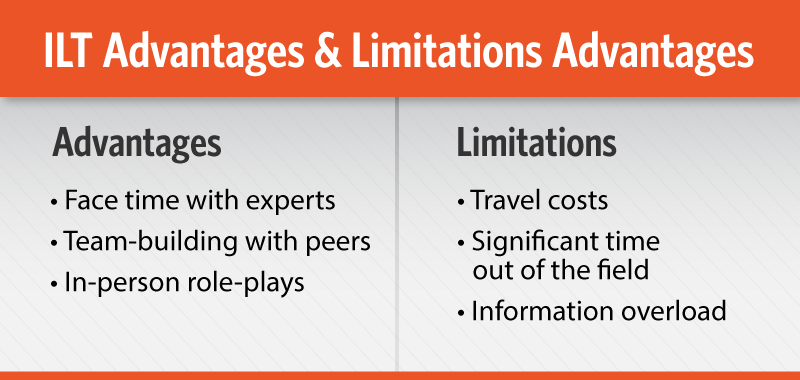
Sales organizations have traditionally trained their sales teams in-person using a multi-day training format. Training participants can glean best practices or lessons-learned from expert instructors, share experiences with peers, and participate in face-to-face role-plays.
Content
Personalizing the training experience is easy in instructor-led training (ILT). In the classroom, instructors are empowered to deviate or augment content to make the class more relevant. This can occur before the training takes place or happen on the fly based on feedback from the participants.
Content
However, physically putting sales teams in a room for an extended period of time does have a number of drawbacks. Chief among these are the impact of travel costs and classroom time on budget, employee productivity, and sales goals.
Content
Given the geographically dispersed makeup of a typical sales force, travel will almost certainly be required, which equates to both a substantial expense, as well as a decrease in the time that salespeople are out in the field actually selling.
Content
Companies will often try to work around this issue by scheduling sales training around another event, such as an annual sales meeting. Unfortunately, this is often counter-productive, as an exhausted and overwhelmed salesperson seldom makes for an ideal student.
Content
On the learning side, classroom training can be a challenge for many sales people, both in format and in impact on daily productivity. Sales people are notorious for having short attention spans and find it difficult to be taken out of the field for extended time periods, creating a negative environment for the training itself.
Content
In addition, many programs tend to cover too much content, and studies show that learners do not thrive given these aggressive “drink from the fire hose” approaches.
Content
Virtual Instructor-Led Training
Content
Virtual instructor-led training (VILT) has grown in popularity over the past several years. VILT combines many of the strengths of instructor-led training and is typically less expensive and more convenient for participants.
Content
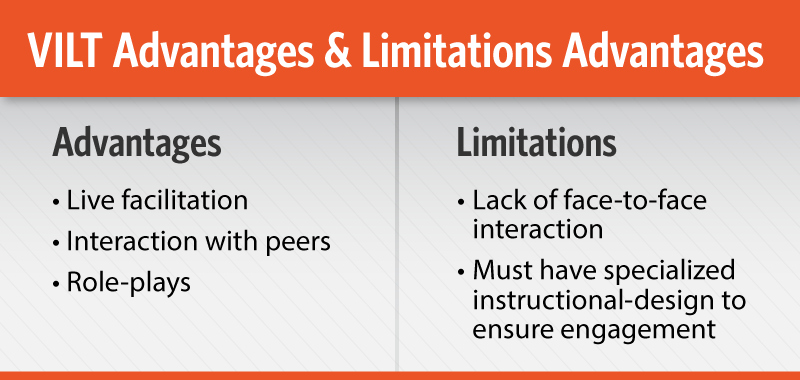
In live virtual classrooms , participants have the ability to interact with the facilitator and each other both over the telephone and using standard online interactions, such as chat, polling, white boarding, and breakout rooms, which are available in most virtual classroom training platforms.
In live virtual classrooms, participants have the ability to interact with the facilitator and each other both over the telephone and using standard online interactions, such as chat, polling, white boarding, and breakout rooms, which are available in most virtual classroom training platforms.
Content
Like a traditional classroom setting, the instructor is there to answer questions as they arise, offering students immediate clarity on content. This approach offers both two-way communication and live feedback, allowing the instructor to tailor the content based on the learners’ development needs and questions.
Content
For sales training, it is critical to keep the level of engagement and interaction high. As such, VILT class sizes should be limited to 12 to 15 participants. This is in contrast to product trainings, which are typically information-based sessions and, therefore, can accommodate a much large audience.
Content
In terms of convenience, participants can take courses from home, at the office or on the road, avoiding any break in productivity. VILT courses can be scheduled as a series of weekly or bi-weekly training sessions (typically 2 to 3 hours per session) allowing participants to remain engaged in the sales training and still attend to their day-to-day sales responsibilities..
Content
VILT also eliminates the travel burden associated with in-person training. Workers participate in courses from where they are, and there is no need to fly in or prepare accommodations for expert trainers. This, in turn, helps minimize costs.
Content
In order to maximize its effectiveness, VILT courses must be specifically designed for the unique characteristics of the virtual environment. Effectively designed VILT content offers participants frequent interaction and collaboration opportunities using chat, polling, peer discussions and role-playing exercises. This helps keep learners engaged and contributing.
Content
E-Learning
E-Learning
Content
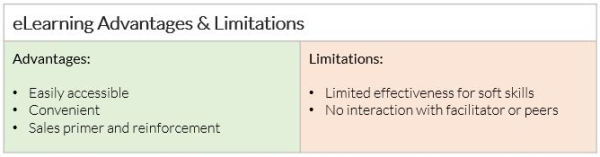
E-learning, defined here as self-paced online training, is effective for certain types of training and offers unparalleled convenience. With this style of training, workers can fit in learning when it works best for them, avoiding valuable peak sales hours during the day.
Content
While the economics and convenience of eLearning are compelling, its effectiveness for improving sales skills is questionable. Traditionally, self-paced training has been best suited topics where the content is static or data-driven, such as compliance and technical training.
Content
On the other hand, training certain soft skills like sales skills requires live instructors so that trainees can practice their new skills, receive feedback and coaching, ask questions, and interact with peers. More recently, however, e-learning has played a greater role in selling skills programs.
Content
While participant engagement and skills application are far better addressed in classrooms (live or virtual), e-learning can serve as a great sales training primer to help participants understand key skills and concepts and come to training better prepared to apply these skills.
Content
E-learning also is proving a great way to reinforce traditional training because it can be delivered as short, two- to three-minute modules that allow for on-demand access on laptops, tablets, and mobile phones.
Content
In Summary
In Summary
Content
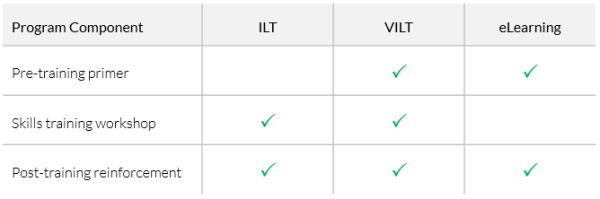
The following chart provides a summary of how the above listed training delivery methods can be used to form a blended training program that results in sustainable skills improvement.