
ATD Blog
Short Circuit Change Resistance to Power Up Adoption
Resistance does not have to derail your change initiative if you know how to recognize it early and respond with curiosity and empathy.
Thu Jun 04 2026

Organizations often struggle to stay on target with budgets, timelines, and objectives during organizational change initiatives due to change resistance, which can burden those workplaces with wasteful costs. People resist change for a variety of reasons, including fear of the unknown, fear of discomfort or of trying something difficult, fear of being wrong, fear of losing control, fear of losing status, and maybe even fear of losing their job. In addition to incurring costs and causing delays, this seemingly endless list of fears can also lead to attrition, compounding problems during times of change.
Rather than viewing change resistance as an unwanted burden or another blocker to be overcome, consider it an opportunity to learn. People who actively or passively resist change may know something you don’t know about why your change plan might not work. Or maybe they have more relevant information than you do. Or maybe they can help explain others' fears and concerns. Think of those apprehensive employees as potential canaries in the coal mine.
Imagine a change that attracts more champions and supporters rather than pushing people away. Visualize your workplace operating as a dynamic system of change, where workers can more easily adapt to keep profits and production moving. Resistance does not have to derail your change initiative if you know how to recognize it early and respond with curiosity and empathy.
Understanding and Engaging With Change Resisters
Resistance to change is an emotional and behavioral response, often deeply personal. Deeply ingrained biological systems meant to protect humans trigger this response. Paired with our unique personalities and the experiences we gain over time, resistance can become a formidable barrier to moving forward toward a “new beginning,” according to Bridges’ Transition Model. Everyone processes news of a change in their own way, in their own time. Because of that variability, different people will respond uniquely to the same change.
Responses manifest across a spectrum, ranging from hesitation to concern, to passive or even active resistance. Behavioral analysts often describe these fear-driven behaviors as fight, flight, freeze, or fawn. The range and complexity of responses can make it challenging for change leaders to know what to do. The Association for Change Management Professionals (ACMP) describes resistance as a lack of readiness, which feels like a far cry from pure defiance. Despite the variability in both internal and external responses to change, we can benefit from a few core principles and tactics that will help you, as a leader, respond in a helpful, productive way.
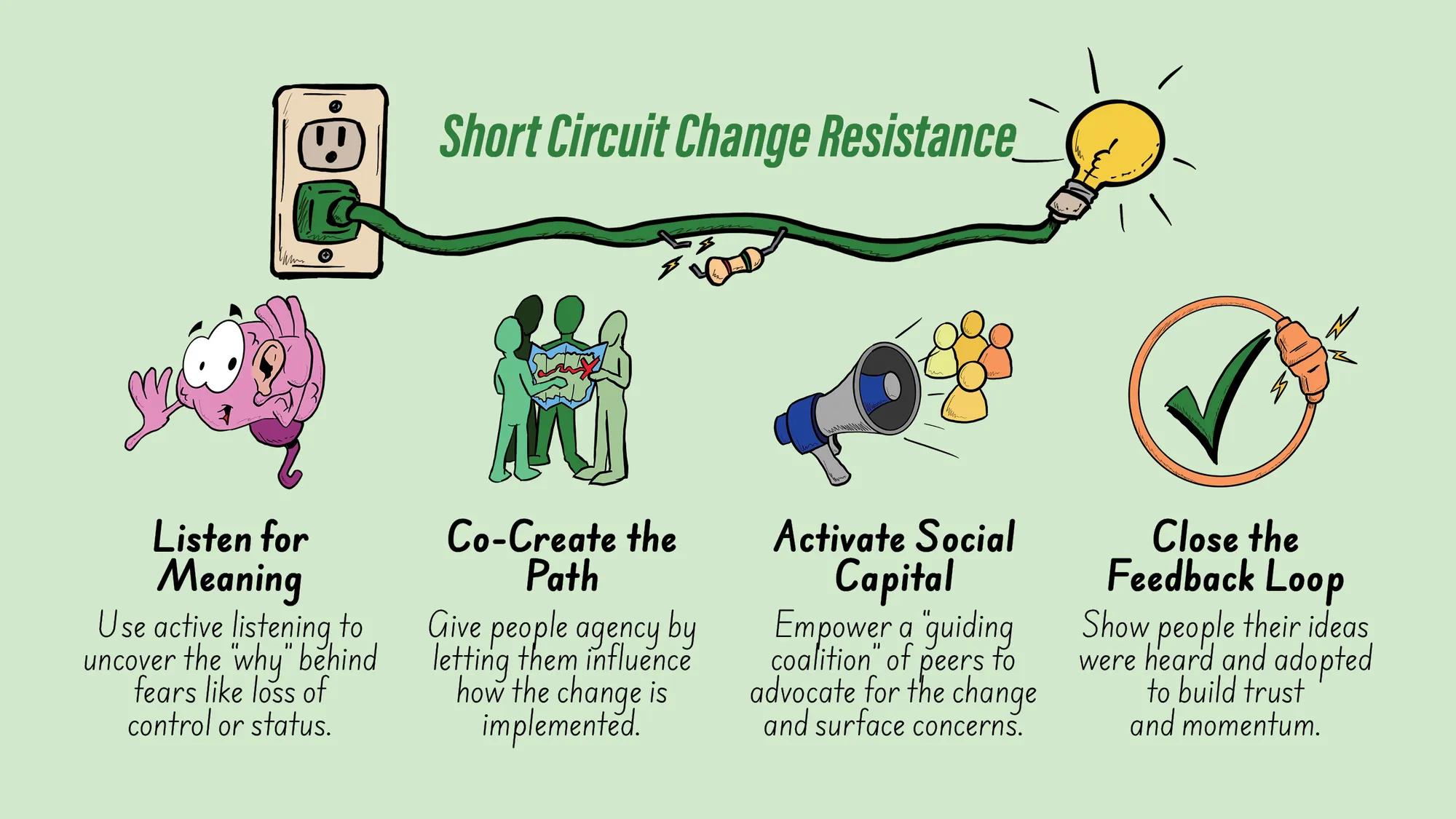
Approach Resistance With Understanding
Before you dive into action, remind yourself that most people are acting in good faith. People rarely intentionally try to sabotage your change. Usually, they attempt to make sense of the change and how it will affect them. For example, how will it affect their personal status or job security, their ways of working, or their future comfort? People may not be clear about why they must change, what exactly they should change, or the impact or severity of that change. They may not understand the urgency of the change or the risks if the organization doesn’t change. As part of your strategy, consider planning your change communications to provide clear, consistent, and constant messaging that positively impacts each of your stakeholder groups. Your communications plan should deliver the same message through a variety of channels so people have multiple ways to hear it and internalize it in their own way over time.
As you begin learning about people’s resistance to change, adopt an empathetic mindset. As Stephen Covey said, "Seek first to understand, then to be understood." Dialogic Organizational Development (OD), as researched by Marshak and Bushe, recommends conversation to build trust and understanding of cultural assumptions and unspoken mindsets. Sometimes active listening can help people air their concerns and, in doing so, help them process the change and its impact on them. Here, it’s important to be intentional about truly listening: Reflect on what you’ve heard, ask clarifying questions, and show people you’ve heard their concerns. Only then can you begin solutioning.
Co-Create With Empathy
Once you’ve understood people’s concerns, invite those who resist to join the change. Communicate the vision and offer them ways to co-create the future state. Typically, people cannot influence the underlying reason for a change or alter where leadership wants the organization to go. People can influence the details of how the change will be implemented in many ways. People may have helpful ideas about how they could adjust their processes or use of technology to enable the change. If you can give people some agency over how the change will be implemented or how they will feel about it, it can help turn them from change resisters to change advocates. Researcher Dr. Deb Orr, faculty chair at Roosevelt University in Chicago, states, “Change should not be done to people, but with people.” Showing people that you’ve heard their concerns and adopted one of their ideas sends a powerful signal not only that you’ve heard them, but that you trust them enough to try one of their ideas. When people see small wins, especially ones they’ve suggested, the motivation to adopt new behaviors, processes, or technology increases.
Leverage Social Capital
Establishing a group of peers that can help you advocate for the change and surface concerns over time can pay dividends. Depending on your organization and your change, this group could be a formal network of change champions, a central team of change concierges, or a looser affiliation of trusted leaders or subject matter experts who can wield a positive, supportive influence. John Kotter refers to this group as a “guiding coalition,” and OD and change- leadership expert Alan Landers of the Drucker School of Management calls it a planning and implementation team (PIT). Most people respond to social pressure. When applied in the right way, it can be a helpful tactic to bring people along the change journey. If at all possible, empower your change advocates to co-create solutions in real-time.
Conclusion
As a change leader, you own the responsibility of keeping an eye out for your organization’s culture so it doesn’t get corrupted by the change or by people’s resistance to it. Change leaders and change agents have a variety of supportive and productive ways to help monitor and manage people’s responses to change. Adopt an empathetic mindset. See resistance as data, not disruption. Be intentional about listening to people. Invite people to co-create the change. When people feel heard and become involved, resistance drops. Leverage trusted leaders and peers to provide support and encouragement. By being thoughtful about how you plan, execute, and monitor your change, you can accomplish your change objectives, ensure your people become active, positive participants in the change, and maintain your organizational culture as you move to your future state.
Recommended Reading
View Courses Recommended for You