
ATD Blog
Simple Drawings: Unleashing the Power of Visual Thinking
In our business communications, simple visual images, including doodles or even what some refer to as scribbles, offer numerous benefits.
Tue Apr 22 2025
Imagine you are in a social situation, discussing a new DIY garden project with a friend and asking for her feedback and ideas. She might reply, “I’m not quite seeing the concept,” so you try again to explain your project. After several rounds, you grab a napkin or a notepad and sketch it out—and she says, "Oh, I get it!” and starts sharing her insights and ideas, even taking the pencil and making changes.
How often have you heard the phrase, “A picture is worth a thousand words”? It's probably too many to count. But how many times have you doodled or drawn an idea to help others visualize or understand a concept? Probably not many. But maybe you should start!
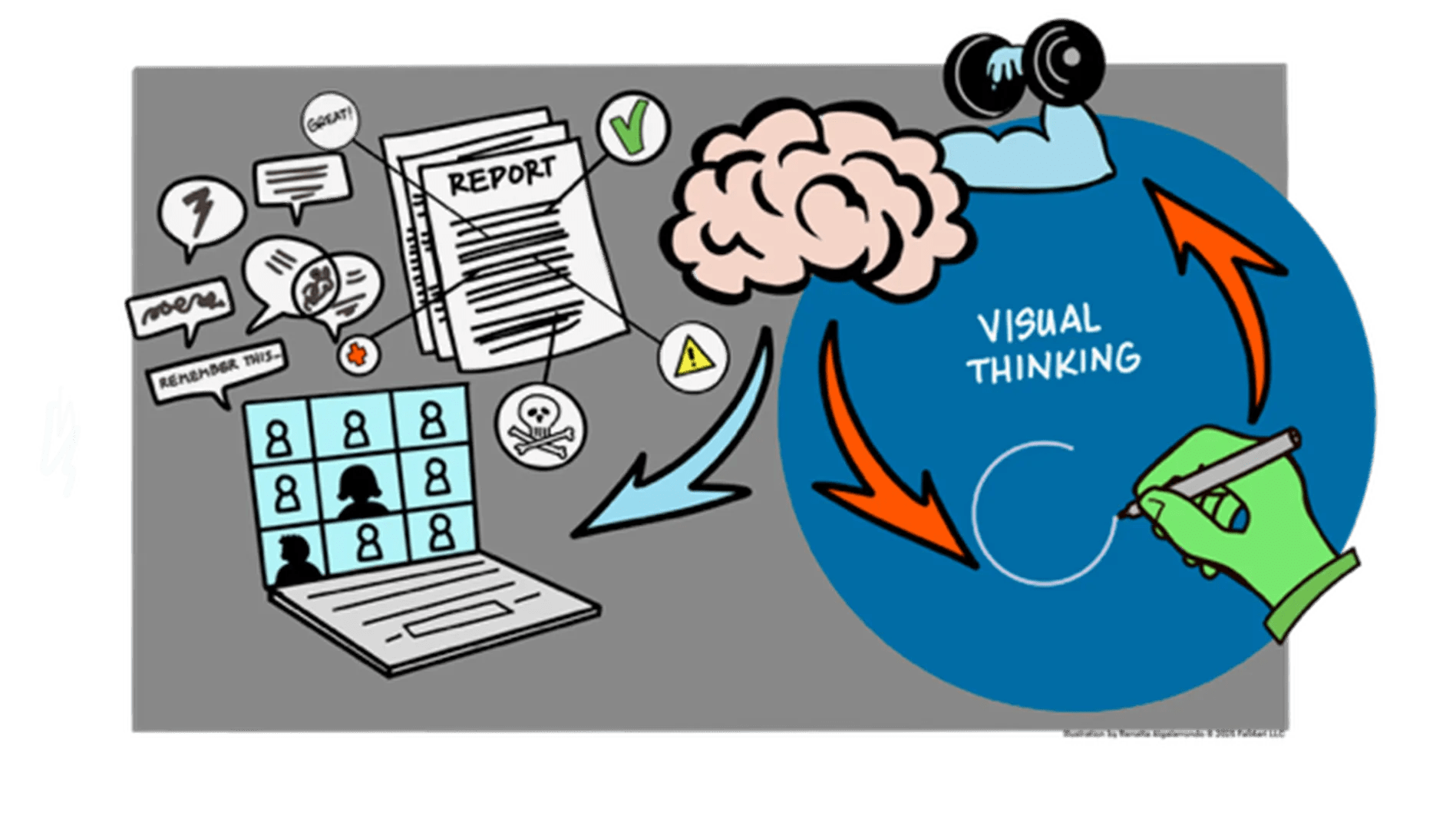
In our business communications, simple visual images, including doodles or even what some refer to as scribbles, offer numerous benefits. David Sibbet, a pioneer in using images for business communications and meeting facilitation and the author of several books, calls this “visual intelligence.” Visual intelligence enhances personal learning by engaging multiple cognitive processes, improving comprehension and retention, and making information more personally meaningful. Visuals can be used daily to document ideas while taking notes for any session, from formal meetings to informal podcasts. Visuals, such as sketch notes or infographics, can simplify complex data and concepts into easily digestible formats. They are easy to see as notes when discussing a topic in front of others. Large visuals, such as this mural of the 2024 ATD Forum Fall Lab, can g serve as a summary document for meetings or events. These visuals capture ideas and perspectives from multiple participants and serve as a memory trigger after the meeting is over.
Research from Frontiers in Psychology, by Van der Weel and Van der Meer, supports the value of simple handwriting and finger movements in improving brain connectivity patterns. Handwriting requires communication between the brain’s visual, sensory, and motor cortices. Forming letters by hand involves visualizing letters and using fine motor skills, unlike the simple, repetitious finger movements used in typing. In her blog, "To Doodle or Not to Doodle," Cathy Hutchingson states, "Doodling keeps your brain connected enough to the task at hand that it doesn’t skip off to other, more fanciful, lines of thought when the current task is boring."
To investigate why simple drawings and visuals offer numerous benefits in communicating ideas and stories, we interviewed Jessica Billiet, a thought leader in the field of learning science. Our primary question was, “How do visual pictures or drawings aid comprehension?” Billiet provided the following information:
Visuals can simplify complex information by clearly representing abstract ideas. Our brains process visuals 60,000 times faster than text, as visual processing areas in the brain are more efficient at handling large amounts of data. This speed enables people to quickly connect with the core idea, making it easier to understand and retain complex concepts. When visuals are tied to the core message, they serve as cognitive anchors, facilitating a deeper and more intuitive comprehension.
Visuals not only help with cognitive recall but also enhance emotional recall. Connecting an idea with a visual symbol creates a dual encoding pathway, both verbal and visual. This dual encoding significantly strengthens memory retention. Emotional content tied to visuals can make the information more memorable because emotions are processed in the limbic system, which plays a key role in long-term memory formation. It is a well-supported hypothesis that our brains respond to creativity, social interaction, and emotional engagement by increasing dopamine and possibly serotonin and oxytocin. Dopamine is closely linked to creative activities, so when we draw, our dopamine levels rise as we experience accomplishment or enjoy the process.
Billiet also stated that doodling engages the brain in a way that activates multiple regions, including the visual cortex and areas responsible for memory and attention. Research shows that drawing fosters stronger neural connections by integrating visual and motor processes, thereby enhancing brain activity. It also taps into creative pathways that help break down complex ideas into more accessible forms. As a form of visual engagement, simple drawing or doodling can aid in emotional processing, reinforcing ideas in a way that words alone can't.
With technology, we have become accustomed to using pictures and visuals readily available on apps. However, to gain clarity on ideas and increase the ability to make ideas sticky, what about drawing these ideas and concepts yourself? People’s first response when posed that question is that they are neither an artist nor creative. Famed sketchnoter Mike Rohde and doodler extraordinaire Sunni Brown often remind us not to confuse doodling, drawing, and art. Doodling and simple drawing are not about being an artist but about using basic lines, spacing, and color to express ideas and communicate more effectively.
So, how do we get started? One way to start is simply practicing and using basic shapes such as lines, points, triangles, circles, and squares.

These can be combined to form a myriad of symbols and shapes, such as arrows, hollow arrows, spirals, buildings, and people. Once you are comfortable drawing these shapes, you can develop a portfolio of standard shapes, icons, and symbols that you use frequently. This might include icons for collaboration, productivity, idea generation, leadership, calendars, meetings, and more, as shown here.
Start using simple drawings to create icons or banners for items in your journal or calendar. When problem-solving with colleagues, grab the poster chart and marker and draw. When attending a meeting or listening to a podcast, pick up a pencil or pen and draw to stimulate your brain.
To refine your simple drawings or doodles further, consider exploring resources such as Brown’s The Doodle Revolution and Rohde’s The Sketchnote Handbook. Dan Roam’s The Back of the Napkin is a good choice for drawing and promoting problem-solving or selling. Doug Neill’s Verbal to Visual walks you through the mechanics of sketchnoting. Use Dave Sibbett’s ideas and images in Visual Meetings or Visual Leaders to expand your repertoire. Or, for fun and to meet the recommended 15 minutes of daily laughter, visit Quick Draw to limber up those drawing muscles and have a great time.
Why not put your newfound visual thinking skills to the test in your next meeting or phone call? You might be surprised by how much more information you capture, how much you retain from the discussion with visual notes, and how much longer you remember the details!
View Courses Recommended for You