
ATD Blog
SimWord of the Day: Coach
Sun Apr 30 2006
Content
Unlike, say, in branching stories , more dynamic simulations, from interactive spreadsheets to practiceware, need live coaches. Coaches are critical members of any simulation community , and of any sim deployment, and both technology and process must be built to support them.
Unlike, say, in branching stories, more dynamic simulations, from interactive spreadsheets to practiceware, need live coaches. Coaches are critical members of any simulation community, and of any sim deployment, and both technology and process must be built to support them.
Content
Coaches can be co-located or remote, synchronous or asynchronous.
Coaches can be co-located or remote, synchronous or asynchronous.
Content
At least three factors drive the need for coaches
At least three factors drive the need for coaches
Content
The divergence of the learning (increase need for coaching)
The divergence of the learning (increase need for coaching)
Content
The importance that the learning actually occurs (increase need)
The importance that the learning actually occurs (increase need)
Content
How well designed the sim is (decrease need)
How well designed the sim is (decrease need)
Content
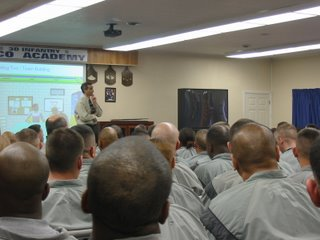
SimuLearn has two master-level coaches, Graham Courtney and Tom Parkinson (Tom seen here with an US Army group). Their mantra is: "Our role is 99% to motivate. Let the simulation do the teaching." This is really hard for so many people with training backgrounds, who are, by necessity, control freaks.
SimuLearn has two master-level coaches, Graham Courtney and Tom Parkinson (Tom seen here with an US Army group). Their mantra is: "Our role is 99% to motivate. Let the simulation do the teaching." This is really hard for so many people with training backgrounds, who are, by necessity, control freaks.
Content
Coaches can give specific assignments, break students into teams, ask students to redo, or skip ahead. They can run facilitated group sessions. They can sometimes explain parts of the simulation. They can make issues more specific (many of our coaches review 360 data before students begin taking the simulations). They can do live After Action Reviews or review uploaded or submitted AAR data hours or days later. And they can still grade.
Coaches can give specific assignments, break students into teams, ask students to redo, or skip ahead. They can run facilitated group sessions. They can sometimes explain parts of the simulation. They can make issues more specific (many of our coaches review 360 data before students begin taking the simulations). They can do live After Action Reviews or review uploaded or submitted AAR data hours or days later. And they can still grade.
Content
Preparing coaches requires a facilitator's guide and even a train the trainer program, all typically part of the simulation deliverable.
Preparing coaches requires a facilitator's guide and even a train the trainer program, all typically part of the simulation deliverable.
Content
This role, from being a traditional instructor to be a coach, has often been talked about. But simulations provide a transition strategy for instructors to leverage many of their traditional skills to increase their own value considerably to end-learners.
This role, from being a traditional instructor to be a coach, has often been talked about. But simulations provide a transition strategy for instructors to leverage many of their traditional skills to increase their own value considerably to end-learners.