
ATD Blog
Strategic Storytelling for Sales Managers
Published Tue Apr 22 2014

Content
CEOs and entrepreneurs are beginning to recognize that a virtual sales force not only cuts down on costs, but also can add a competitive advantage. By the end of the decade, nearly one billion people across the globe will be mobile workers who tend to use social media to keep in touch.
Content
Guess what? Social media is really a technical version of storytelling. As organizations become more geographically distributed and competition increases, sales managers need to find new ways communicate with their sales force and customers. Storytelling is a very powerful way to do this, and if used properly, it will help differentiate your products and services from the rest.
Content
Understanding business storytelling
Content
Storytelling is well-recognized by professionals from a variety of disciplines, such as historians, literary critics, filmmakers, cognitive psychologists, lawyers, neurologists, physicians, economists, and, yes, professional storytellers. As F. Scott Fitzgerald said, “Draw your chair up to edge of the precipice, and I’ll tell you a story.”
Content
Stories create a communication bridge to connect the left and right sides of the brain, by touching the rational elements of our customers (and team members), as well as their emotional aims and objectives. Storytelling in the corporate environment is generally used in marketing and product development. This technique can be used in other areas to improve results. One of the best places to use storytelling is sales management to engage a sales team or customers.
Content
Strategic storytelling for sales management is the art of telling a story that will engage listeners by providing a link between facts and emotions. The storyline must make sense during the beginning, middle, and end, with actions made by a memorable character. That character must achieve a goal through a sequence of events that engage the listeners and create emotional experiences for them.
Content
Starting with the message is a key difference between strategic storytelling and the informal storytelling that occurs every day in organizations. In strategic storytelling, the message comes first, and you identify and develop stories around it.
Content
In a business environment, consider these elements when crafting a strategic story:
Content
What purpose do you want to achieve with that story?
Content
Who is involved (the characters)?
Content
What’s the time frame (past, present, or future)?
Content
Who should tell the story?
Content
Finding strategic stories
Content
As a sales manager, where do we start looking for stories? The majority of our stories regarding the sales processes will come from events or relationships. The reason for crafting a good story from a past experience is to make conclusions to improve the impact of the events in the future. In some stories, relationships and their outcomes can be the main propose of what is being told, while in others, the relationships will be a peripheral element to the story.
Content
Three other areas are good “golden rules” to help find and create strategic stories.
Content
The story is based on a lesson learned.
Content
The story can be used in a sales business context.
Content
The story must search for better performance.
Content
Lessons learned
Lessons learned
Content
As a manager, you know that your sales professionals will learn from procedures and policies, if they are translated to a lesson that can be learned. People use lists all the time, but can’t always remember what’s on that list. Only a narrative can integrate the items into a logical process, enabling the person to remember that information.
Content
Sales context. In order to create a credible, realistic, and tangible impact, sales managers should use the storytelling to focus the story on specific actions to achieve success. This will provide engagement, emotion, logic, and authenticity in the manager’s communications with the sales staff. The story must make a point about sales, customer service, business improvement, innovation, leadership, communication, teamwork, productivity, or other topics related to the workplace.
Content
Better performance. The best stories are those that are based on real-life moments. The manager must be able to remember the sequence of events and the relationships in colorful detail. Doug Stevenson, author of Theatre Business Stories explains it this way: “I call these events “Polaroid memories,” because you can clearly see them in your mind’s eye. When you recall the event or relationship; the time, place, and specific details such as how it sounded, looked, and felt come back easily and vividly.”
Content
We all know that the business environment and the market are full of challenges, competition, and obstacles. Sales representatives need us to remind them that the sale can be made, even with the barriers, objections, and tactics used by our customers. A story will enable them to enhance performance and achieve positive outcomes because it provides ways to remember actions to overcome difficult situations.
Content
Bottom line
Bottom line
Content
Stories are useful conduits for reinforcing your business priorities and values, because they will help sales representatives to better understand what corporate values mean in terms of behavior. By telling stories we can explain how to approach a customer, how to apply the sales methodology learned in the corporate university, and how to be successful in this beautiful science of selling.

Content
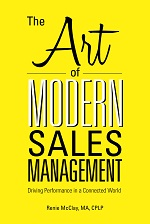
This post is based on content explored in the new ASTD Press release, The Art of Modern Sales Management , which covers everything you need to know to be a top sales manager!
This post is based on content explored in the new ASTD Press release, The Art of Modern Sales Management, which covers everything you need to know to be a top sales manager!
Content
Sales management has changed dramatically in the past decade. With increasing globalization and many companies adding more virtual workers, the task of managing these diverse sales teams has become increasingly complicated. In a connected and evolving world it is hard to offer a definitive guide, but this book strives to sketch out a blueprint for managing performance in a changing sales landscape.
Content
Each chapter is written by a sales professional and thought leader, many with experience as both a salesperson and as a sales manager. Learn from their experience and utilize the action plans at the end of each chapter to grow into a better leader for your team, whether they are down the hall or across the world.