
ATD Blog
Sustainable High Performance Requires Gender Collaboration
Mon Dec 17 2018

Content
In her bestseller Lean In , Sheryl Sandberg, Facebook COO, encouraged women to take a seat at the conference table as participants rather than sit around the outside as observers. Great advice, except for one historical impediment: Women find sitting at the table, surrounded by men, to be a risky undertaking because they are very often ignored, talked down to, harassed, and made to feel they don't belong.
In her bestseller Lean In, Sheryl Sandberg, Facebook COO, encouraged women to take a seat at the conference table as participants rather than sit around the outside as observers. Great advice, except for one historical impediment: Women find sitting at the table, surrounded by men, to be a risky undertaking because they are very often ignored, talked down to, harassed, and made to feel they don't belong.
Content
Certainly, women are entitled to be respected for what they bring to the table—but it is not solely up to them to change the seating arrangements. The surest way to achieve gender collaboration is for men to create a place where women feel welcome, and to ensure women are taken seriously when they come to the table.
Certainly, women are entitled to be respected for what they bring to the table—but it is not solely up to them to change the seating arrangements. The surest way to achieve gender collaboration is for men to create a place where women feel welcome, and to ensure women are taken seriously when they come to the table.
Content
What follows are several ways to establish learning forums, where leaders of all genders gather to discuss, discover, and determine the best way to create a culture where female leadership is celebrated, female achievements are recognized, and female core values and underlying assumptions are shared and affirmed.
What follows are several ways to establish learning forums, where leaders of all genders gather to discuss, discover, and determine the best way to create a culture where female leadership is celebrated, female achievements are recognized, and female core values and underlying assumptions are shared and affirmed.
Content
The challenge facing leaders in today's information-rich workplace is to make present decisions with the greatest knowledge of their future success, organize to carry out these decisions, measure the results, and make changes to ensure better outcomes. This is best accomplished by adhering to the following tenets of a high-performance culture:
The challenge facing leaders in today's information-rich workplace is to make present decisions with the greatest knowledge of their future success, organize to carry out these decisions, measure the results, and make changes to ensure better outcomes. This is best accomplished by adhering to the following tenets of a high-performance culture:
Content
Risk stimulates creative thinking and builds confidence.
Risk stimulates creative thinking and builds confidence.
Content
Leaders reach across boundaries to seek and share new information.
Leaders reach across boundaries to seek and share new information.
Content
Change is the natural way to sustain high performance.
Change is the natural way to sustain high performance.
Content
Critical thinking generates new ways to use old resources.
Critical thinking generates new ways to use old resources.
Content
Failure is used as a learning tool when it occurs.
Failure is used as a learning tool when it occurs.
Content
New learning opportunities and creative processes are the norm.
New learning opportunities and creative processes are the norm.
Content
Rather than trickle down from the top as it once did, information instead streams in through a variety of portals. The value of one tiny bit of information cannot be assessed until it has been pooled with other pieces and examined openly. Leaders of all genders must to set aside their cultural biases and join forces to make decisions.
Rather than trickle down from the top as it once did, information instead streams in through a variety of portals. The value of one tiny bit of information cannot be assessed until it has been pooled with other pieces and examined openly. Leaders of all genders must to set aside their cultural biases and join forces to make decisions.
Content
In a workplace where leadership is gender-balanced, failure is viewed as the basis for learning and one of the critical factors leading to success. Successful leaders understand the risk involved in any given situation and strive to minimize the chances of failure by seeking feedback from their peers both before and after making a decision.
In a workplace where leadership is gender-balanced, failure is viewed as the basis for learning and one of the critical factors leading to success. Successful leaders understand the risk involved in any given situation and strive to minimize the chances of failure by seeking feedback from their peers both before and after making a decision.
Content
The key to pooling knowledge and then moving it to the point where it can do the most good is to gather the right balance of people and pose the right questions. Gender-balanced discussions become especially critical in situations where no one person has the complete picture. Additionally, they point out the need to explore the deeper meaning of a situation whenever the people involved do not agree on what they see.
The key to pooling knowledge and then moving it to the point where it can do the most good is to gather the right balance of people and pose the right questions. Gender-balanced discussions become especially critical in situations where no one person has the complete picture. Additionally, they point out the need to explore the deeper meaning of a situation whenever the people involved do not agree on what they see.
Content
Anytime leaders start to argue over who is right, it should serve as a warning signal that some critical piece of information is missing. It should also trigger the same question in everyone’s mind: How might the missing information impact what I do?
Anytime leaders start to argue over who is right, it should serve as a warning signal that some critical piece of information is missing. It should also trigger the same question in everyone’s mind: How might the missing information impact what I do?
Content
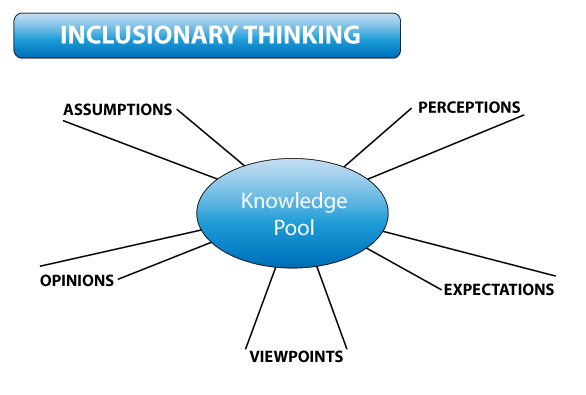
The Inclusionary Thinking model depicted in the image and expanded below shows what a knowledge pool looks like and how it is formed. Here is a list of sample questions by category to help get the process started:
The Inclusionary Thinking model depicted in the image and expanded below shows what a knowledge pool looks like and how it is formed. Here is a list of sample questions by category to help get the process started:
Content
Assumptions
Assumptions
Content
What conclusions have people brought with them?
What conclusions have people brought with them?
Content
What do they actually know?
What do they actually know?
Content
What information is missing?
What information is missing?
Content
What are the major agreements and differences?
What are the major agreements and differences?
Content
Opinions
Opinions
Content
What do people think should happen?
What do people think should happen?
Content
Who has taken a stand and who is open to change?
Who has taken a stand and who is open to change?
Content
Are people proactive, reactive, or inactive?
Are people proactive, reactive, or inactive?
Content
How were their opinions formed and by whom?
How were their opinions formed and by whom?
Content
Perceptions
Perceptions
Content
What do people think has happened?
What do people think has happened?
Content
What information has gotten through?
What information has gotten through?
Content
What needs correcting or modifying?
What needs correcting or modifying?
Content
Who is up to date and who is not?
Who is up to date and who is not?
Content
Expectations
Expectations
Content
What are the anticipated outcomes?
What are the anticipated outcomes?
Content
What information sources are people using?
What information sources are people using?
Content
Which expectations are viewed as positive?
Which expectations are viewed as positive?
Content
Which expectations are perceived as negative?
Which expectations are perceived as negative?
Content
Viewpoints
Viewpoints
Content
What do people see from their position?
What do people see from their position?
Content
What individual views are represented?
What individual views are represented?
Content
What facts are true and which are being twisted?
What facts are true and which are being twisted?
Content
Whose views are blocked and by what or whom?
Whose views are blocked and by what or whom?
A Gender-Balanced Process Model
Content
The purpose of the React—Respond—Reflect process model is to encourage more listening and less speaking during meetings and face-to-face interactions. Participants should keep in mind that they will be more effective and expend less energy by being quick to listen, slow to speak, and slow to anger.
The purpose of the React—Respond—Reflect process model is to encourage more listening and less speaking during meetings and face-to-face interactions. Participants should keep in mind that they will be more effective and expend less energy by being quick to listen, slow to speak, and slow to anger.
Content
React: Suppress first impressions or impulses. The temptation to react when a thought enters your mind is natural, but it should be held in check so as to encourage the speaker to continue without interruption. Expressing your own feelings and thoughts prematurely shifts the focus away from the speaker and discourages rather than encourages a more thorough exploration of the issue.
React: Suppress first impressions or impulses. The temptation to react when a thought enters your mind is natural, but it should be held in check so as to encourage the speaker to continue without interruption. Expressing your own feelings and thoughts prematurely shifts the focus away from the speaker and discourages rather than encourages a more thorough exploration of the issue.
Content
Respond: Answer positively or affirmatively. The appropriate time to respond will become obvious once the speaker has expressed what is foremost on their mind. A positive response not only acknowledges that you have heard what has been said, it also encourages the speaker to respond more openly to your questions and concerns.
Respond: Answer positively or affirmatively. The appropriate time to respond will become obvious once the speaker has expressed what is foremost on their mind. A positive response not only acknowledges that you have heard what has been said, it also encourages the speaker to respond more openly to your questions and concerns.
Content
Reflect: Suggest alternatives or resolutions. The opportunity to reflect on alternative outcomes and explore optional solutions will eventually surface when critical judgment is suspended and the dialogue is freely flowing between all participants. At this point you can hold up the mirror so everyone can see the situation through multiple eyes.
Reflect: Suggest alternatives or resolutions. The opportunity to reflect on alternative outcomes and explore optional solutions will eventually surface when critical judgment is suspended and the dialogue is freely flowing between all participants. At this point you can hold up the mirror so everyone can see the situation through multiple eyes.
Content
The prosperity of every organization depends upon how its leaders respond to failure, treat mistakes, service customers, handle complaints, create ideas, manage growth, and view success. Although men and women may bring differing perspectives to the table, to be effective they must respect each other and work together to maintain a culture where collaboration matters and performance counts.
The prosperity of every organization depends upon how its leaders respond to failure, treat mistakes, service customers, handle complaints, create ideas, manage growth, and view success. Although men and women may bring differing perspectives to the table, to be effective they must respect each other and work together to maintain a culture where collaboration matters and performance counts.
View Courses Recommended for You