
ATD Blog
TD, Leadership, and Worthy Results
Mon May 25 2020

Content
Where should talent development and leadership focus? Effective TD and performance improvement requires aligning any development with closing gaps in organizational performance and external impact. For example, what if you developed a performance process improvement program that met all the learning objectives and was highly received, only to find out that instead of a human workplace performance problem, it was product safety concerns evaporating the sales?
Content
Deming, Juran, and Rummler each noted that most performance problems were not at the worker level but above with the organization (and beyond). Some organizational effectiveness problems stem from the disconnect with external clients and our shared society, but most TD interventions are at the workplace. Some training and development add to the entire value chain, but most performance improvement initiatives are left dwelling in the depths of operations because they’re not connected to all organizational needs and requirements. We rarely properly measure their value added, so they remain organizational artifacts. And costs.
Wholes verses parts
Content
Looking at the whole before attending to the parts is generally more effective. As with trying to be personally healthy, TD usually starts from the here and-now and assumes good things will happen by our work, such as detox diets, jogging, or other vitamin supplements. But are these single-issue interventions enough?
Content
For sustainable health, we are better to first get a full health exam. Based on the vital signs and other tests, we have a total view of our health and well-being. From that total view, we can better select those interventions, that along with others, will help us become fit and healthy and live longer.
Content
The same holistic approach is important to deliver worthy performance improvement and accomplishments. Start from the outside-in—the total organization and its realities—rather than the usual and initially more comfortable (and conventional) inside-out approach by fixing things in the workplace. Why look at the total organization? To survive and thrive, your company must add measurable value to all stakeholders. As Peter Drucker advised us, “Revenue comes from outside the organizations: inside there are only costs.” Anything we use, do, produce, and deliver must add value outside the organization. If what we do in performance improvement doesn’t add value inside and outside the organization, it will be a cost.
Content
Concepts and tools exist to do and deliver the holistic results. The Organizational Elements Model (see Figure 1) that is suggested in my human resources development book Mega Thinking and Planning (2011), offers three levels of results:
Content
mega: external clients/societal contributions
Content
macro: organizational contributions
Content
micro: individual and small-group contributions.
Content
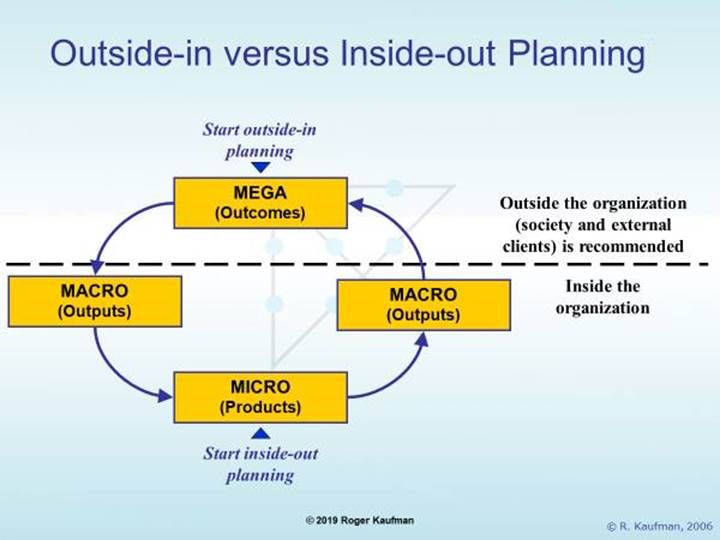
If we start planning from the outside-in versus inside-out (see Figure 1), we will have more sustainable and worthy success. We don’t, however, abandon the workplace; we align it with the whole organization and what the organization delivers. But are we empowered to look outside-in as our leaders tend to have an inside-out orientation?
What is a leader’s role?
Content
Leaders tend to set the directions and policies. Let’s look at leadership types and how each leadership orientation can help or inhibit us.
Content
Leaders can influence us to be fix-and-repair specialists or they can empower us to question what we do and deliver that may lead to better individual and organizational success.
Content
There are at least two types of leaders. The traditional leaders (and there are variations of them_),_ get others to do things cheaper, faster, and better. They build on the here-and-now and bring it toward success. They look at from within their organizations out to shareholder value. They are inside-out leaders.
Content
Then there are the outside-in (or inversion_) leaders_ who stand things on their heads, create something new, and work to bring it to the point conventional leaders can take the new orientation on to the next steps. Outside-in leaders ask questions (as can you) such as, “If my organization is the solution, what’s the problem?” Outside-in leaders look at things from outside an organization—with societal good in primary focus—then move inside. Inside-out-thinking versus outside-in thinking (Figure 1).
Content
Figure 1. Outside-in versus Inside-out Planning Leadership, and TD Activities

Content
Source: Kaufman (2006, 2011)
Content
The outside-in leader as well as TD professionals best use the three levels of results and two levels of processes and resources: The Organizational Elements Model (Kaufman, 2000, 2006, 2011) of:
Content
MEGA: Primary client and beneficiary is society and tomorrow’s child
Content
MACRO: Primary client and beneficiary is the organization itself
Content
MICRO: Primary client and beneficiary are individuals and small groups
Content
PROCESSES: The programs, projects, and activities used to get results
Content
INPUTS: The human, physical, and financial resources available.
Content
These levels, for best practice, should be linked and aligned. As a TD professional, you can do the same; be your own leader. Even if the organizational norm is inside-out, you may also take an outside-in view and offer, perhaps an exercise in informed consent, a different path toward success that your leaders can consider. After all, if an intervention fails, it is usually the practitioner is blamed even if all project objectives were met.
Content
We must have both types of leaders and related operational performance professionals. For example, Thomas Edison created the lightbulb using direct current. He did not set out to make better candles or kerosene lamps. Nikola Tesla created alternating current that rendered Edison’s energy approach outdated but allowed the lightbulb to become universal. We had to have it all as prologue, but Tesla stood the supplying of energy on its head—he inverted the logic of the day—and created something new and useful and took an outside-in perspective. J. P. Morgan took it all over and created General Electric and conventional leadership took it from there. It was a bit of an ugly transition from an outside-in leader to a conventional one to make it all operational, effective, and efficient.
Content
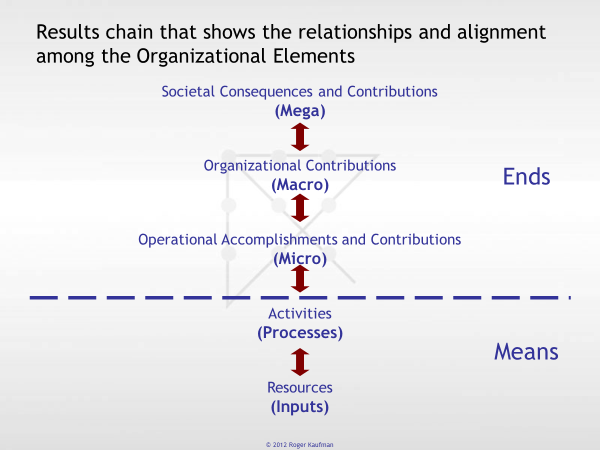
Figure 2 is the value chain for inside-out and outside-in TD and leadership direction. Inside-out starts at inputs and attempts to work its way up to mega. Outside-in starts at mega and aligns all the elements to define and deliver worthy results.
Content
Figure 2.Inside-Out Versus Outside-In Value Chain

Content
Using the Organizational Elements Model (mega, macro, micro, process, inputs) employs a planning hierarchy, and the linking of all of levels to define and deliver worthy results. In appropriate practice, the outside-in and inside out approaches are integrated. Why not use both?
Content
What can we do to optimize both kinds of leaders and human performance specialists? We could get education to transition back from teaching people what to think to teaching people how to think. We could reward leaders and TD professionals who leave our shared world a better place intellectually and socially and not just financially.
Content
Will we shift to become conventional leaders and performance improvers as well as outside-in leaders and practitioners? Will we keep getting better at doing that which should not be done at all? Or, will we also think outside the box, add measurable intellectual and social value, and develop and value outside-in leaders and professionals who will help us become the only ones who do what we do?
Content
Our individual and collective futures depend on our choices.
References
Content
Addison, R., C. Haig, and L. Kearny. 2009. Performance Architecture: The Art and Science of Improving Organizations. San Francisco: Wiley & Songs.
Content
Kaufman, R. 2000. Mega Planning: Practical Tools for Organizational Success . Thousand Oaks, CA: Sage Publications.
Kaufman, R. 2000. Mega Planning: Practical Tools for Organizational Success. Thousand Oaks, CA: Sage Publications.
Content
Kaufman, R. 2006. Change, Choices, and Consequences: A Guide to Mega Thinking and Planning. Amherst, MA: HRD Press.
Content
Kaufman, R. 2011. A Manager’s Pocket Guide to Strategic Thinking and Planning. Amherst, MA: HRD Press.
Content
Kaufman, R. 2019. “Alignment and Success: Applying the Hierarchy of Planning and the Needs Assessment Hierarchy,” Performance Improvement Journal. Vol. 59, No. 7. Pp.24–28. August.
Content
Kaufman, R. 2019. “Outside In and Inside Out Planning,” PerformanceXpress. Silver Spring, MD: ISPI.