
ATD Blog
The Hitchhiker’s Guide to Design Thinking
Wed Jan 06 2021

Content
The term “agility” has been increasingly tossed around as a vital component for organizations, teams, and individuals. Yet misconceptions abound about what it means. At its broadest, agility is the ability to be responsive to change—change in competitive environments and customer needs as well as change in workplace learning and performance.
The term “agility” has been increasingly tossed around as a vital component for organizations, teams, and individuals. Yet misconceptions abound about what it means. At its broadest, agility is the ability to be responsive to change—change in competitive environments and customer needs as well as change in workplace learning and performance.
Content
As an organizational capability, agility represents a virtuous cycle. It enables an organization and its workforce to be innovative, to think critically, and to continuously learn and improve. In return, these elements reinforce an organization to be agile. In the training and development space, agility emerges through the adoption of an agile design and development approach, such as design thinking.
As an organizational capability, agility represents a virtuous cycle. It enables an organization and its workforce to be innovative, to think critically, and to continuously learn and improve. In return, these elements reinforce an organization to be agile. In the training and development space, agility emerges through the adoption of an agile design and development approach, such as design thinking.
Content
Design thinking is a methodology that puts human needs at the center of design decisions. The design challenge at hand is reframed in human-centric ways. Designers work to find multiple solutions in brainstorming sessions, using prototyping and testing to ensure the best learner solutions.
Design thinking is a methodology that puts human needs at the center of design decisions. The design challenge at hand is reframed in human-centric ways. Designers work to find multiple solutions in brainstorming sessions, using prototyping and testing to ensure the best learner solutions.
Content
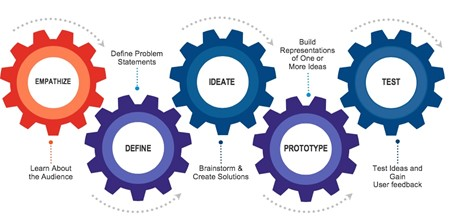
The iterative design thinking process consists of five stages:
The iterative design thinking process consists of five stages:
Content
Empathize
Empathize
Content
Define
Define
Content
Ideate
Ideate
Content
Prototype
Prototype
Content
Test
Test
Prepare Your Workshop
Content
The design thinking workshop will cover the process’s first three stages. To prepare, you need stakeholder buy-in and aligned expectations for the entire transformational project. A great alignment tool is an intent clarity map. Three questions will shine a light on any potential risks while at the same time focus all conversations around a common goal:
The design thinking workshop will cover the process’s first three stages. To prepare, you need stakeholder buy-in and aligned expectations for the entire transformational project. A great alignment tool is an intent clarity map. Three questions will shine a light on any potential risks while at the same time focus all conversations around a common goal:
Content
What are you hoping to achieve?
What are you hoping to achieve?
Content
Why are we doing this now?
Why are we doing this now?
Content
What are the consequences of not doing this?
What are the consequences of not doing this?
Content
Throughout a design thinking workshop, it is best to have two skilled and open-minded facilitators with design backgrounds. The lead-facilitator focuses on the session flow and keeps conversations on track. The co-facilitator takes notes, asks additional questions for clarification, and keeps track of time. Both facilitators always need to be able to think on their feet. Design-thinking workshops often take unexpected turns, especially once the group starts to empathize with learners or make deeper dives into problem statements. Instead of uncovering training-related issues, organizational issues often come to light. This, in turn, can lead to heated conversations.
Throughout a design thinking workshop, it is best to have two skilled and open-minded facilitators with design backgrounds. The lead-facilitator focuses on the session flow and keeps conversations on track. The co-facilitator takes notes, asks additional questions for clarification, and keeps track of time. Both facilitators always need to be able to think on their feet. Design-thinking workshops often take unexpected turns, especially once the group starts to empathize with learners or make deeper dives into problem statements. Instead of uncovering training-related issues, organizational issues often come to light. This, in turn, can lead to heated conversations.
Content
Empathize
Empathize
Content
In the empathize stage, we need to put aside our own assumptions about the learner and the design challenge at hand and instead gain insights into our users. The most common way of achieving this goal is the creation of learner personas. During this brainstorming exercise, the group envisions the typical learner based on observations and, where possible, data.
In the empathize stage, we need to put aside our own assumptions about the learner and the design challenge at hand and instead gain insights into our users. The most common way of achieving this goal is the creation of learner personas. During this brainstorming exercise, the group envisions the typical learner based on observations and, where possible, data.
Content
Define
Define
Content
In the define stage, we leverage all the information we have gathered in the first stage and organize and interpret it. This allows the team to define the design challenge’s core problem. At this point, we define an actionable and meaningful problem statement that needs to be solved. This design challenge will guide us and kickstart the ideation process rather than just define learning objectives.
In the define stage, we leverage all the information we have gathered in the first stage and organize and interpret it. This allows the team to define the design challenge’s core problem. At this point, we define an actionable and meaningful problem statement that needs to be solved. This design challenge will guide us and kickstart the ideation process rather than just define learning objectives.
Content
Ideation
Ideation
Content
Before diving into the ideation stage, it is helpful to share recent trends and developments in the industry as well as time-tested and proven methodologies, such as the Five Moments of Needs or the AGES model. These methodologies get participants thinking outside the box. If participants are not in the right environment, generating ideas can be a daunting task. They will benefit from stepping back. The ideation stage is about looking at every possible angle for the defined problem statement. It is about pushing boundaries and effective collaboration. The goal is to be bold and curious, challenge common beliefs, and explore each other’s ideas.
Before diving into the ideation stage, it is helpful to share recent trends and developments in the industry as well as time-tested and proven methodologies, such as the Five Moments of Needs or the AGES model. These methodologies get participants thinking outside the box. If participants are not in the right environment, generating ideas can be a daunting task. They will benefit from stepping back. The ideation stage is about looking at every possible angle for the defined problem statement. It is about pushing boundaries and effective collaboration. The goal is to be bold and curious, challenge common beliefs, and explore each other’s ideas.
Content
Prototype
Prototype
Content
In the prototype stage, the design team produces several inexpensive, scaled-down versions of the solution. The goal is to investigate which solution best solves the design challenge at hand. It is recommended to share prototypes within the team and, if possible, a wider audience. During this experimental phase, designers accept, improve, and re-examine or reject solutions based on the learners’ experience.
In the prototype stage, the design team produces several inexpensive, scaled-down versions of the solution. The goal is to investigate which solution best solves the design challenge at hand. It is recommended to share prototypes within the team and, if possible, a wider audience. During this experimental phase, designers accept, improve, and re-examine or reject solutions based on the learners’ experience.
Content
Test
Test
Content
It’s most important to remember that, even though testing is the last step in the process, it is iterative, which means results from the test phase are used to redefine problems and inform the understanding of learners. Rigorous testing should be done by the designer and other evaluators to ensure the solution meets the learners’ needs. As a result, designers may have to go back to the drawing board and come up with a different solution.
It’s most important to remember that, even though testing is the last step in the process, it is iterative, which means results from the test phase are used to redefine problems and inform the understanding of learners. Rigorous testing should be done by the designer and other evaluators to ensure the solution meets the learners’ needs. As a result, designers may have to go back to the drawing board and come up with a different solution.
Considerations to Keep in Mind
Content
An agile approach is only appropriate when one or more of these three conditions exists:
An agile approach is only appropriate when one or more of these three conditions exists:
Content
1. A High Degree of Uncertainty : The content is not stable or documented. The performance context is not well-defined. The initiative’s goals, budget, and timeline are evolving. Stakeholders are unsure of or cannot agree on the requirements of the final product.
1. A High Degree of Uncertainty: The content is not stable or documented. The performance context is not well-defined. The initiative’s goals, budget, and timeline are evolving. Stakeholders are unsure of or cannot agree on the requirements of the final product.
Content
2. A High Degree of Complexity : The content and performance context are complex and challenging to learn. There are many subject matter experts and stakeholders who require an evolutionary feedback process.
2. A High Degree of Complexity: The content and performance context are complex and challenging to learn. There are many subject matter experts and stakeholders who require an evolutionary feedback process.
Content
3. Uniqueness or Novelty : The solution is unique and includes new learning technology, emerging content, or new performance content.
3. Uniqueness or Novelty: The solution is unique and includes new learning technology, emerging content, or new performance content.
Want to Learn More?
Content
Join me during ATD Techknowledge 2021 for the session The Hitchhiker’s Guide to Design Thinking and Agile. You will learn how to effectively and efficiently run a design thinking workshop from the planning stages through to the post-workshop follow-up and deliverables.
Join me during ATD Techknowledge 2021 for the session The Hitchhiker’s Guide to Design Thinking and Agile. You will learn how to effectively and efficiently run a design thinking workshop from the planning stages through to the post-workshop follow-up and deliverables.