
ATD Blog
The Power of Having a Team of Leaders
Tue Feb 11 2014

Content
For 20 years, Stewart Liff rode the subway to work in New York City. Every day, while he was sitting in a subway car, there would be two people standing in front of him discussing their work situations. While the two people, job roles, and companies would differ each day, the conversations were generally the same.
For 20 years, Stewart Liff rode the subway to work in New York City. Every day, while he was sitting in a subway car, there would be two people standing in front of him discussing their work situations. While the two people, job roles, and companies would differ each day, the conversations were generally the same.
Content
They would constantly complain to each other about the way they were treated by their managers. They moaned and groaned about a lack of communication, something their boss said or did not say to them, disparate treatment, a perceived lack of opportunities, and so on. To a large extent, it didn’t seem to matter what they were complaining about, because the core issue always seemed to be their relationship with their boss.
They would constantly complain to each other about the way they were treated by their managers. They moaned and groaned about a lack of communication, something their boss said or did not say to them, disparate treatment, a perceived lack of opportunities, and so on. To a large extent, it didn’t seem to matter what they were complaining about, because the core issue always seemed to be their relationship with their boss.
Content
Authors Marcus Buckingham and Curt Coffman write in their book, First Break All the Rules: What The Worlds’ Greatest Managers Do Differently , “that people don’t leave jobs, they leave managers. If employees don’t get along with their managers, don’t like them or don’t respect them, they will leave a company despite a high salary or great benefits. A bad manager is a big factor in employee performance. A good manager, no matter the salary, will inspire loyalty.”
Authors Marcus Buckingham and Curt Coffman write in their book, First Break All the Rules: What The Worlds’ Greatest Managers Do Differently, “that people don’t leave jobs, they leave managers. If employees don’t get along with their managers, don’t like them or don’t respect them, they will leave a company despite a high salary or great benefits. A bad manager is a big factor in employee performance. A good manager, no matter the salary, will inspire loyalty.”
Content
Likewise, in a recent Engagement Study commissioned by Randstad , 53 percent of the employees felt that they could do a better job than their manager.
Likewise, in a recent Engagement Study commissioned by Randstad, 53 percent of the employees felt that they could do a better job than their manager.
Content
According to Leigh Branham, in The 7 Hidden Reasons Employees Leave, the results of 19,000 exit interviews conducted by the Saratoga Institute indicate that the top reasons employees cite when leaving a job is either disagreement with or disapproval of their immediate supervisor. A natural conclusion to draw from this and other highly consistent data is that the way supervisors deal with their employees is what most drives morale, retention and more importantly performance.
According to Leigh Branham, in The 7 Hidden Reasons Employees Leave, the results of 19,000 exit interviews conducted by the Saratoga Institute indicate that the top reasons employees cite when leaving a job is either disagreement with or disapproval of their immediate supervisor. A natural conclusion to draw from this and other highly consistent data is that the way supervisors deal with their employees is what most drives morale, retention and more importantly performance.
Content
Joel Garfinkle, in his Talent Management article “ Why Employees Leave Their Managers ,” listed five of the most common mistakes managers make when dealing with their teams:
Joel Garfinkle, in his Talent Management article “Why Employees Leave Their Managers,” listed five of the most common mistakes managers make when dealing with their teams:
Content
Not challenging employees
Not challenging employees
Content
Not providing feedback
Not providing feedback
Content
Avoiding dirty work
Avoiding dirty work
Content
Being unapproachable
Being unapproachable
Content
Believing authority flows from a title.
Believing authority flows from a title.
Content
Others also have identified different mistakes to avoid, but most of them come down to the same basic conclusion: the best way approach to address this huge problem is to change the way that people manage. This has resulted in millions if not billions of dollars being spent on training and in many cases retraining supervisors around the world.
Others also have identified different mistakes to avoid, but most of them come down to the same basic conclusion: the best way approach to address this huge problem is to change the way that people manage. This has resulted in millions if not billions of dollars being spent on training and in many cases retraining supervisors around the world.
Content
A different management model
A different management model
Content
Given the fact that the organizations have been struggling to address this issue for decades, without the success they crave, perhaps training is not the only answer. Maybe it is time to take a fresh approach to way that work is conducted. What if you could create a team of leaders where everyone in the team took a leadership role and there was no real need for a manager, other than in an advisory capacity?
Given the fact that the organizations have been struggling to address this issue for decades, without the success they crave, perhaps training is not the only answer. Maybe it is time to take a fresh approach to way that work is conducted. What if you could create a team of leaders where everyone in the team took a leadership role and there was no real need for a manager, other than in an advisory capacity?
Content
The idea here is that organizations with the traditional top-down, manager-to-employee work structure, struggle with the inherent nature of this design. From the managers’s perspective, there is pressure to perform, frequent demands on their time, problem employees to address and unions to deal with. Moreover, they are required to make all of the key decisions and the weight of the world seemingly rests on their shoulders.
The idea here is that organizations with the traditional top-down, manager-to-employee work structure, struggle with the inherent nature of this design. From the managers’s perspective, there is pressure to perform, frequent demands on their time, problem employees to address and unions to deal with. Moreover, they are required to make all of the key decisions and the weight of the world seemingly rests on their shoulders.
Content
From the employees’ point of view, they face stringent performance demands, often feel like they are a cog in the wheel and replaceable, are expected to do what they are told, and have little autonomy, authority or room to be creative. Their satisfaction often depends on less-than-effective supervisors resulting in most of them not being fully engaged.
From the employees’ point of view, they face stringent performance demands, often feel like they are a cog in the wheel and replaceable, are expected to do what they are told, and have little autonomy, authority or room to be creative. Their satisfaction often depends on less-than-effective supervisors resulting in most of them not being fully engaged.
Content
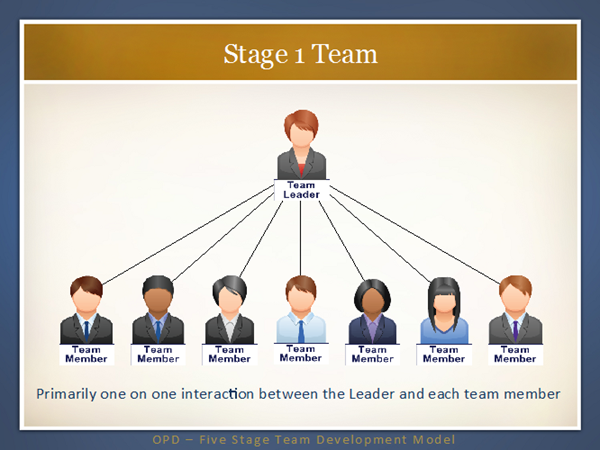
Below is an illustration of what a typical work unit looks like, which we refer to as a Stage 1 Team.
Below is an illustration of what a typical work unit looks like, which we refer to as a Stage 1 Team.
Content
With a team of leaders, knowledge is spread throughout the team, which does all of the planning, scheduling, performance management and accountability, including dealing with problem employees. Meanwhile, the supervisor moves on to focus on higher-level activities, although he still remains available as an advisor to the team.
With a team of leaders, knowledge is spread throughout the team, which does all of the planning, scheduling, performance management and accountability, including dealing with problem employees. Meanwhile, the supervisor moves on to focus on higher-level activities, although he still remains available as an advisor to the team.
Content
This takes away the traditional argument that the supervisor is to blame for the employees’ problems at work. Instead it shifts the responsibility and decision-making to each team member, resulting in everyone become more engaged, involved and motivated. As a result, the main issue is no longer, “what did management do or not do to me?” Instead, it becomes, “how can we deliver outstanding performance?”
This takes away the traditional argument that the supervisor is to blame for the employees’ problems at work. Instead it shifts the responsibility and decision-making to each team member, resulting in everyone become more engaged, involved and motivated. As a result, the main issue is no longer, “what did management do or not do to me?” Instead, it becomes, “how can we deliver outstanding performance?”
Content
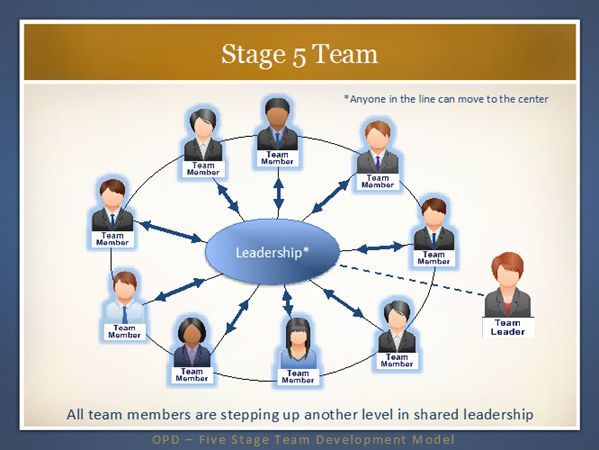
Below is a depiction of a team leaders; in other words, a team that is at Stage 5 and manages itself.
Below is a depiction of a team leaders; in other words, a team that is at Stage 5 and manages itself.
Content
As you can see, this is a very different model than the one that has been used for thousands of years. The team no longer has a supervisor at the top that makes all of the key decisions, while the employees are merely workers who follow his lead.
As you can see, this is a very different model than the one that has been used for thousands of years. The team no longer has a supervisor at the top that makes all of the key decisions, while the employees are merely workers who follow his lead.
Content
Instead, it is a true team that revolves around all of its members and one in which everyone takes ownership and accountability for its results. This model, which other organizations have successfully adopted, can provide you with energy, capability and results that all strive for but few achieve.
Instead, it is a true team that revolves around all of its members and one in which everyone takes ownership and accountability for its results. This model, which other organizations have successfully adopted, can provide you with energy, capability and results that all strive for but few achieve.
Content
Obviously, transitioning to teams of leaders is not an easy thing to do. Otherwise, everyone would do it. It requires expertise, careful planning and appropriate tools, as well as time, energy, and some patience to make such a shift. However, for organizations that want to reinvent themselves and move to this approach, the payoff can be quite significant.
Obviously, transitioning to teams of leaders is not an easy thing to do. Otherwise, everyone would do it. It requires expertise, careful planning and appropriate tools, as well as time, energy, and some patience to make such a shift. However, for organizations that want to reinvent themselves and move to this approach, the payoff can be quite significant.
Content
Case in point
Case in point
Content
One company found that when their employees began working together in teams of leaders, amazing things began to happen. They quickly saw that people are much better at reducing waste when they work as a team rather than as individuals. They began to meet as a group, shared ideas, exchanged best practices and identified the paths that were not worth pursuing.
One company found that when their employees began working together in teams of leaders, amazing things began to happen. They quickly saw that people are much better at reducing waste when they work as a team rather than as individuals. They began to meet as a group, shared ideas, exchanged best practices and identified the paths that were not worth pursuing.
Content
As they developed as a team, they began to focus on analyzing their business processes. They categorized the work accordingly and where necessary, made adjustments along the way. During their analyses, they discovered that the best way to reduce expenditures was during those steps in the process when something was handed off.
As they developed as a team, they began to focus on analyzing their business processes. They categorized the work accordingly and where necessary, made adjustments along the way. During their analyses, they discovered that the best way to reduce expenditures was during those steps in the process when something was handed off.
Content
Over a five year period, the teams saved this company about $500 million, with savings of $100-$150 million for the first few years. In addition, the systemic changes identified during their reviews provided them with a distinct advantage over the competition. Finally, by taking such an approach, the employees became much more engaged, committed and knowledgeable about their work, while becoming a team of leaders. The organization got these results because they got exactly what they designed.
Over a five year period, the teams saved this company about $500 million, with savings of $100-$150 million for the first few years. In addition, the systemic changes identified during their reviews provided them with a distinct advantage over the competition. Finally, by taking such an approach, the employees became much more engaged, committed and knowledgeable about their work, while becoming a team of leaders. The organization got these results because they got exactly what they designed.
Content
Creating a team of leaders
Creating a team of leaders
Content
The principle we use in creating a team of leaders is that teams are “perfectly designed to get the results that they get.” That means that to create a team of leaders, everything must be designed with this end in mind. The best way to do this is to take the following steps:
The principle we use in creating a team of leaders is that teams are “perfectly designed to get the results that they get.” That means that to create a team of leaders, everything must be designed with this end in mind. The best way to do this is to take the following steps:
Content
Connect your teams around a sense of purpose.
Connect your teams around a sense of purpose.
Content
Use the Five-Stage Team Development Model, which describes how to evolve from a traditional team to a team of leaders (we described the first and last stages above), as the framework for your transition
Use the Five-Stage Team Development Model, which describes how to evolve from a traditional team to a team of leaders (we described the first and last stages above), as the framework for your transition
Content
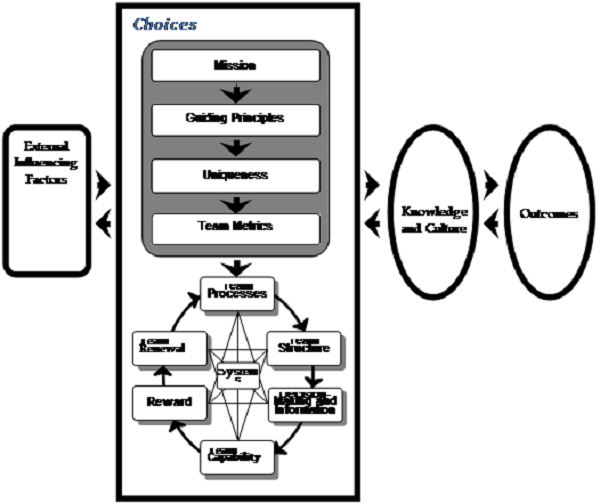
Use the OSD Model for Teams, as shown below, to properly design and integrate your team’s mission, values, and systems, so that you reach the right outcomes. To do this properly requires an environmental scan, process mapping and a culture analysis. A series of tools are used to accomplish each analysis. (See Figure 1 below.)
Use the OSD Model for Teams, as shown below, to properly design and integrate your team’s mission, values, and systems, so that you reach the right outcomes. To do this properly requires an environmental scan, process mapping and a culture analysis. A series of tools are used to accomplish each analysis. (See Figure 1 below.)
Content
Design and implement your team’s processes (onboarding, offboarding, performance management) to ultimately support a Stage Five team.
Design and implement your team’s processes (onboarding, offboarding, performance management) to ultimately support a Stage Five team.
Content
Develop and install a Team Value Creation Tool that allows members to understand and appreciate the significance of what they contribute each day.
Develop and install a Team Value Creation Tool that allows members to understand and appreciate the significance of what they contribute each day.
Content
Capture, manage, and diffuse the knowledge required by each team member
Capture, manage, and diffuse the knowledge required by each team member
Content
Design your team’s space using Visual Performance Management principles, so that its physical plant is tightly aligned with all other design elements
Design your team’s space using Visual Performance Management principles, so that its physical plant is tightly aligned with all other design elements
Content
Use a series of team startup tools to pave the way for the transition, such as identifying how the team will move from stage to stage, how it will communicate, what everyone’s role will be, how decisions will be made, what the expected performance will be, and so forth.
Use a series of team startup tools to pave the way for the transition, such as identifying how the team will move from stage to stage, how it will communicate, what everyone’s role will be, how decisions will be made, what the expected performance will be, and so forth.
Content
Figure 1: OSD Model for Teams
Figure 1: OSD Model for Teams
Content
Having a team of leaders can provide your organization with an enormous competitive advantage. You will get this by having a culture whereby each team member/leader uses her full potential and collectively they leverage the creativity and desire that everyone has to make a difference in the workplace and with their customers and partners. Members of these teams of leaders have a great sense of meaning in what and why they do what they do and that translates into results. Perhaps it is time for you to consider such an approach.
Having a team of leaders can provide your organization with an enormous competitive advantage. You will get this by having a culture whereby each team member/leader uses her full potential and collectively they leverage the creativity and desire that everyone has to make a difference in the workplace and with their customers and partners. Members of these teams of leaders have a great sense of meaning in what and why they do what they do and that translates into results. Perhaps it is time for you to consider such an approach.
Content
This post is based on the forthcoming book, A Team of Leaders: Empowering Every Member to Take Ownership, Demonstrate Initiative, and Deliver Results , AMACOM Books, March 2014.
This post is based on the forthcoming book, A Team of Leaders: Empowering Every Member to Take Ownership, Demonstrate Initiative, and Deliver Results, AMACOM Books, March 2014.