
ATD Blog
The Table of Diversity: Maximizing Impact Using a Chemistry-Inspired Framework
Content
By expanding the definition of diversity and incorporating intersectionality, leaders stay true to DEI’s roots of creating workplaces and communities where everyone thrives.
By expanding the definition of diversity and incorporating intersectionality, leaders stay true to DEI’s roots of creating workplaces and communities where everyone thrives.
Thu May 01 2025
Content
Think back to your high school chemistry class. One of the first lessons and the foundation of the entire subject was the Periodic Table of Elements.
Think back to your high school chemistry class. One of the first lessons and the foundation of the entire subject was the Periodic Table of Elements.
Content
Remember learning about the different elements and their properties? Hydrogen, for example, is one atomic unit and is the lightest, simplest, and most abundant chemical element. While most elements belong neatly in a group based on their similarities, hydrogen is an outlier. It is most similar to lithium and sodium, so it hangs out with the alkali metals in Group 1.
Remember learning about the different elements and their properties? Hydrogen, for example, is one atomic unit and is the lightest, simplest, and most abundant chemical element. While most elements belong neatly in a group based on their similarities, hydrogen is an outlier. It is most similar to lithium and sodium, so it hangs out with the alkali metals in Group 1.
Content
Each element on the Periodic Table of Elements told a story. Students learned what each element is composed of, the environment they exist best in, and how they ultimately show up in the world. It was one of the most overwhelming yet satisfying lessons to learn.
Each element on the Periodic Table of Elements told a story. Students learned what each element is composed of, the environment they exist best in, and how they ultimately show up in the world. It was one of the most overwhelming yet satisfying lessons to learn.
Content
But it didn’t stop there! The next lesson focused on compounds—the unique combination of elements that creates a new entity. In many instances, the compound is just as important as its individual elements. Water (H 2 O), for example, is just as important as its parts—hydrogen and oxygen.
But it didn’t stop there! The next lesson focused on compounds—the unique combination of elements that creates a new entity. In many instances, the compound is just as important as its individual elements. Water (H2O), for example, is just as important as its parts—hydrogen and oxygen.
Content
The Periodic Table of Elements serves as the basis for every chemistry class, experiment, and objective.
The Periodic Table of Elements serves as the basis for every chemistry class, experiment, and objective.
Content
What if we thought about diversity the same way?
What if we thought about diversity the same way?
Content
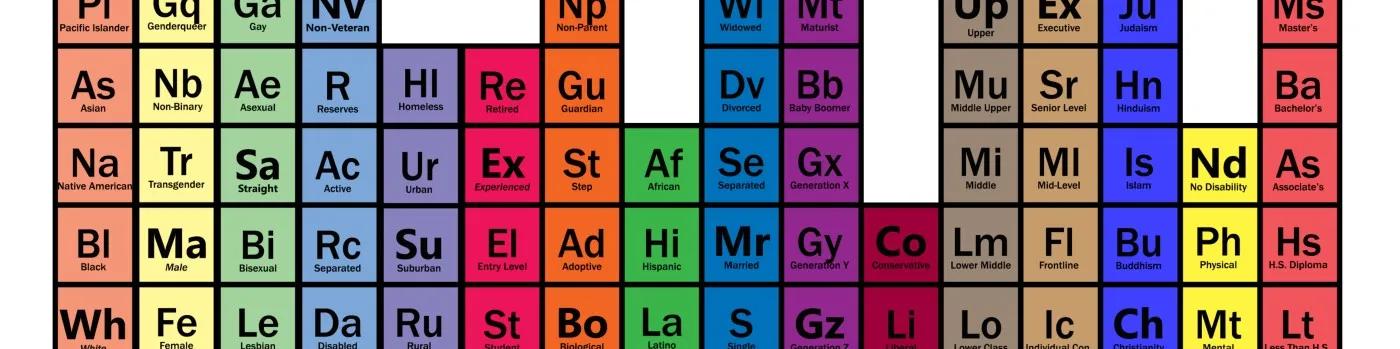
The Table of Diversity is a tool that is similar to the Periodic Table of Elements, but instead of naming chemical elements, it names diversity elements. It challenges people to think about diversity in a new way and create a culture and environment that truly is inclusive and equitable and promotes belonging.
The Table of Diversity is a tool that is similar to the Periodic Table of Elements, but instead of naming chemical elements, it names diversity elements. It challenges people to think about diversity in a new way and create a culture and environment that truly is inclusive and equitable and promotes belonging.
Content
If leaders believe in the transformative power of diversity, equity, and inclusion, the Table of Diversity can increase overall impact.
If leaders believe in the transformative power of diversity, equity, and inclusion, the Table of Diversity can increase overall impact.
Expand Your Definition of Diversity—The Science of DEI
Content
How do you define diversity? Think about yourself and the people around you. What aspects of identity come to mind? If you thought about race, gender identity, and sexual orientation, you’re in good company, but there’s more to diversity than the common demographics most people think about.
How do you define diversity? Think about yourself and the people around you. What aspects of identity come to mind? If you thought about race, gender identity, and sexual orientation, you’re in good company, but there’s more to diversity than the common demographics most people think about.
Content
The Table of Diversity expands our definition of diversity to include other diversity elements like caregiver status, education level, justice impacted status, and even personality type. This expanded view of diversity deepens our understanding of ourselves, each other, and the world around us, leading to workplace cultures that feel personalized, colleagues who understand our unique needs, and organizations that make us feel like our contributions are meaningful. This creates an environment where everyone can thrive.
The Table of Diversity expands our definition of diversity to include other diversity elements like caregiver status, education level, justice impacted status, and even personality type. This expanded view of diversity deepens our understanding of ourselves, each other, and the world around us, leading to workplace cultures that feel personalized, colleagues who understand our unique needs, and organizations that make us feel like our contributions are meaningful. This creates an environment where everyone can thrive.
Content
In addition to seeing ourselves and each other more fully, expanding how we think about diversity allows everyone to authentically participate in the process of inclusion and equity. The Table of Diversity is made up of inherent and acquired traits. Inherent traits are those we are born with and acquired traits are those we acquire or experience over time. These elements cut across race, gender identity, and sexual orientation. These shared experiences mean that people can better relate to one another, sharing both marginalizing experiences and empowering experiences.
In addition to seeing ourselves and each other more fully, expanding how we think about diversity allows everyone to authentically participate in the process of inclusion and equity. The Table of Diversity is made up of inherent and acquired traits. Inherent traits are those we are born with and acquired traits are those we acquire or experience over time. These elements cut across race, gender identity, and sexual orientation. These shared experiences mean that people can better relate to one another, sharing both marginalizing experiences and empowering experiences.
Content
One example of this is with caregivers. Caregiving is an identity and experience that affects people across all backgrounds and life stages, yet everyone experiences it differently. Caring for aging parents, caring for disabled relatives, caring for young children, going through the IVF process, adopting or fostering a child are all examples that require different things from the caregiver. These responsibilities can create challenges and obstacles that are not recognized as part of the employee experience but can affect how people show up.
One example of this is with caregivers. Caregiving is an identity and experience that affects people across all backgrounds and life stages, yet everyone experiences it differently. Caring for aging parents, caring for disabled relatives, caring for young children, going through the IVF process, adopting or fostering a child are all examples that require different things from the caregiver. These responsibilities can create challenges and obstacles that are not recognized as part of the employee experience but can affect how people show up.
Content
During the COVID-19 pandemic, a library system recognized that an overwhelming number of their employees lived in multigenerational households. They adjusted their benefits package to include family members outside of the traditional nuclear family such as grandparents, aunts, and cousins. They also extended additional mental health support to everyone included under their benefits.
During the COVID-19 pandemic, a library system recognized that an overwhelming number of their employees lived in multigenerational households. They adjusted their benefits package to include family members outside of the traditional nuclear family such as grandparents, aunts, and cousins. They also extended additional mental health support to everyone included under their benefits.
Content
Exercise : Compare your organization’s employee experience for people who give birth to the experience and benefits for people who adopt, foster, go through IVF, or care for an aging parent or relative. Where are the similarities? Where are the differences? What’s the impact?
Exercise: Compare your organization’s employee experience for people who give birth to the experience and benefits for people who adopt, foster, go through IVF, or care for an aging parent or relative. Where are the similarities? Where are the differences? What’s the impact?
Content
The Table of Diversity challenges leaders to consider the full human experience and include groups of people who are often overlooked, such as people who were incarcerated.
The Table of Diversity challenges leaders to consider the full human experience and include groups of people who are often overlooked, such as people who were incarcerated.
Content
In a recent report from fwd.us , 50 percent of American adults know someone who is now or has previously been incarcerated. That’s a staggering number, yet very few DEI programs recognize this group of people in their efforts. Not only does incarceration affect the person directly imprisoned, but it affects others in the organization, including a partner who may be dependent on their income and emotional support. It affects children who may be missing a present and active parent.
In a recent report from fwd.us, 50 percent of American adults know someone who is now or has previously been incarcerated. That’s a staggering number, yet very few DEI programs recognize this group of people in their efforts. Not only does incarceration affect the person directly imprisoned, but it affects others in the organization, including a partner who may be dependent on their income and emotional support. It affects children who may be missing a present and active parent.
Content
Researchers have found that people who have been incarcerated experienced trauma at a level similar to people who have gone to war. Children who had a parent incarcerated are more likely to experience mental and physical health challenges as adults.
Researchers have found that people who have been incarcerated experienced trauma at a level similar to people who have gone to war. Children who had a parent incarcerated are more likely to experience mental and physical health challenges as adults.
Content
Reentering society after incarceration, finding a rewarding job, rebuilding relationships, learning new societal norms, and healing from the trauma is a journey often overlooked, but is the reality for many people. DEI, and people processes in general, need a stronger focus on elements of diversity such as this.
Reentering society after incarceration, finding a rewarding job, rebuilding relationships, learning new societal norms, and healing from the trauma is a journey often overlooked, but is the reality for many people. DEI, and people processes in general, need a stronger focus on elements of diversity such as this.
Content
Exercise : Think about your training programs, are there phrases, exercises, or scenarios that could, unintentionally, alienate or be a trigger for someone with lived experiences of incarceration? What about your organization’s unspoken cultural norms? Are there aspects of culture that may need to be taught to someone who is reentering society?
Exercise: Think about your training programs, are there phrases, exercises, or scenarios that could, unintentionally, alienate or be a trigger for someone with lived experiences of incarceration? What about your organization’s unspoken cultural norms? Are there aspects of culture that may need to be taught to someone who is reentering society?
Incorporating Intersectionality—Your Diversity Formula
Content
Just as compounds are essential to chemistry, intersectionality is vital to diversity! Intersectionality is the unique combination of two or more diversity elements and their experience in the world. This unique combination of elements is your diversity formula.
Just as compounds are essential to chemistry, intersectionality is vital to diversity! Intersectionality is the unique combination of two or more diversity elements and their experience in the world. This unique combination of elements is your diversity formula.
Content
People are not just one aspect of their identity nor does one aspect of their identity define their entire life. When we place people’s identity in silos, we overlook the complexity and nuance of their lived experiences, as well as the ways in which their identities shape how they engage in the workplace. Failing to see the entire person can lead to talent development professionals crafting solutions that are ineffective and may erode trust, as people feel misunderstood or overlooked.
People are not just one aspect of their identity nor does one aspect of their identity define their entire life. When we place people’s identity in silos, we overlook the complexity and nuance of their lived experiences, as well as the ways in which their identities shape how they engage in the workplace. Failing to see the entire person can lead to talent development professionals crafting solutions that are ineffective and may erode trust, as people feel misunderstood or overlooked.
Content
Consider someone who is caring for an aging parent while living in a rural area. Their access to resources may be limited—whether it’s access to healthcare facilities, support services, or even professional development opportunities. They might spend long hours commuting to access essential services for their family member or may have to take on additional caregiving tasks due to a lack of local support. How are leaders equipped to keep this person engaged and feeling supported? What if this person is also a parent? What if this person is single and doesn’t have a significant other to share caregiving responsibilities? What if this person has an invisible disability, such as diabetes, that requires additional attention and care?
Consider someone who is caring for an aging parent while living in a rural area. Their access to resources may be limited—whether it’s access to healthcare facilities, support services, or even professional development opportunities. They might spend long hours commuting to access essential services for their family member or may have to take on additional caregiving tasks due to a lack of local support. How are leaders equipped to keep this person engaged and feeling supported? What if this person is also a parent? What if this person is single and doesn’t have a significant other to share caregiving responsibilities? What if this person has an invisible disability, such as diabetes, that requires additional attention and care?
Content
Addressing any one of these identities and their challenges is important, but true engagement and support come from recognizing the full scope of their life experiences. The Table of Diversity helps leaders keep this front of mind by encouraging a deeper understanding of the unique journeys that shape individual needs.
Addressing any one of these identities and their challenges is important, but true engagement and support come from recognizing the full scope of their life experiences. The Table of Diversity helps leaders keep this front of mind by encouraging a deeper understanding of the unique journeys that shape individual needs.
Content
Reflection : How can your talent development programs be adapted to recognize and support employees who are balancing multiple responsibilities in a way that is cohesive and comprehensive?
Reflection: How can your talent development programs be adapted to recognize and support employees who are balancing multiple responsibilities in a way that is cohesive and comprehensive?
Content
How might one’s experience shift based on their unique intersections? For example, what are the differences in experience for a caregiver who is married versus single? Living in a rural area versus a suburban area? Low socioeconomic versus high socioeconomic? What unique challenges could each subgroup of caregivers experience?
How might one’s experience shift based on their unique intersections? For example, what are the differences in experience for a caregiver who is married versus single? Living in a rural area versus a suburban area? Low socioeconomic versus high socioeconomic? What unique challenges could each subgroup of caregivers experience?
Intersectionality in Action
Content
What does intersectionality look like in action? First, it means recognizing the experiences people have based on their unique combination of identities. Many of these identities and experiences accompany people to their job and either help them contribute more effectively or interrupts their zone of genius. Recognizing the entire human experience means going beyond a one-size-fits-all approach to recognize how different backgrounds, responsibilities, and challenges shape the way people engage at work. When people feel supported in ways that reflect their lives, they are more productive and innovative.
What does intersectionality look like in action? First, it means recognizing the experiences people have based on their unique combination of identities. Many of these identities and experiences accompany people to their job and either help them contribute more effectively or interrupts their zone of genius. Recognizing the entire human experience means going beyond a one-size-fits-all approach to recognize how different backgrounds, responsibilities, and challenges shape the way people engage at work. When people feel supported in ways that reflect their lives, they are more productive and innovative.
Content
For example, women going through menopause are silently experiencing one of the biggest physical, mental, and emotional changes of their lives. Menopause is a life experience that occurs at the intersection of gender and age. Women at this stage experience memory lapses, sleep disturbances, and mood changes that can potentially lead to their performance being affected. How can leaders be better prepared to accommodate these challenges as they arise and prevent any negative effects on performance?
For example, women going through menopause are silently experiencing one of the biggest physical, mental, and emotional changes of their lives. Menopause is a life experience that occurs at the intersection of gender and age. Women at this stage experience memory lapses, sleep disturbances, and mood changes that can potentially lead to their performance being affected. How can leaders be better prepared to accommodate these challenges as they arise and prevent any negative effects on performance?
Content
Second, understanding the impact of these life experiences is crucial for creating systems of support that allow people to thrive. Systems refers to the policies, processes, and norms that shape an organization’s culture and operations. When leaders create thoughtful rules and guidelines for these systems, their team members succeed.
Second, understanding the impact of these life experiences is crucial for creating systems of support that allow people to thrive. Systems refers to the policies, processes, and norms that shape an organization’s culture and operations. When leaders create thoughtful rules and guidelines for these systems, their team members succeed.
Content
Think about the way performance is measured and reviewed. Leaders typically prioritize being a team player or going above and beyond as measures of good performance. This type of subjective feedback can be unhelpful to neurotypical people and create unnecessary barriers for neurodivergent people. Providing clear and actionable feedback, instead of vague language reduces the risk of it being misinterpreted. Talent development professionals have an opportunity to equip leaders with the knowledge and skills to assess performance in a way that recognizes different work styles, communication preferences, and strengths.
Think about the way performance is measured and reviewed. Leaders typically prioritize being a team player or going above and beyond as measures of good performance. This type of subjective feedback can be unhelpful to neurotypical people and create unnecessary barriers for neurodivergent people. Providing clear and actionable feedback, instead of vague language reduces the risk of it being misinterpreted. Talent development professionals have an opportunity to equip leaders with the knowledge and skills to assess performance in a way that recognizes different work styles, communication preferences, and strengths.
Content
Exercise: How does your organization proactively equip leaders to meet their team’s diverse needs during the performance review process? How can the performance review system be improved so leaders get the support they need to be successful?
Exercise: How does your organization proactively equip leaders to meet their team’s diverse needs during the performance review process? How can the performance review system be improved so leaders get the support they need to be successful?
How Do You Get There?
Content
Most people look outward and around them to better understand the world. The DEI journey requires leaders to first look inward. This part of the journey is personal and encompasses life both within the workplace and beyond. DEI is a way of life. The journey of self-discovery and exploration is a solid foundation for truly valuing others.
Most people look outward and around them to better understand the world. The DEI journey requires leaders to first look inward. This part of the journey is personal and encompasses life both within the workplace and beyond. DEI is a way of life. The journey of self-discovery and exploration is a solid foundation for truly valuing others.
Content
By reflecting on their individual identity, experiences, and perspectives, leaders begin to understand what it means to belong and what it feels like to be included.
By reflecting on their individual identity, experiences, and perspectives, leaders begin to understand what it means to belong and what it feels like to be included.
Content
Exercise : Which diversity elements or intersections have shaped you the most? In what ways? When?
Exercise: Which diversity elements or intersections have shaped you the most? In what ways? When?
Content
The next part of the journey requires intentionally relating to others. This is the process of learning and unlearning. Unlearning the harmful and outdated preconceived notions built and solidified over time and learning the true culture through a spectrum of experiences and representation.
The next part of the journey requires intentionally relating to others. This is the process of learning and unlearning. Unlearning the harmful and outdated preconceived notions built and solidified over time and learning the true culture through a spectrum of experiences and representation.
Content
This is the phase of the journey people spend the most time in, but often come up short. The learning is surface level and focused on the current version of that culture’s food, dress, language, and music. To be meaningful, there must be an understanding of that group’s evolution through time. For example, exploring the world before the Americans with Disabilities Act or the Individuals with Disabilities Education Act or Section 504 of the Rehabilitation Act of 1973. Life before each of these shifts toward inclusion was harsh for people with disabilities. Knowledge at this level guides leaders into the third phase of the journey, taking meaningful action.
This is the phase of the journey people spend the most time in, but often come up short. The learning is surface level and focused on the current version of that culture’s food, dress, language, and music. To be meaningful, there must be an understanding of that group’s evolution through time. For example, exploring the world before the Americans with Disabilities Act or the Individuals with Disabilities Education Act or Section 504 of the Rehabilitation Act of 1973. Life before each of these shifts toward inclusion was harsh for people with disabilities. Knowledge at this level guides leaders into the third phase of the journey, taking meaningful action.
Content
Exercise : Choose a diversity element or intersection outside your own.
Exercise: Choose a diversity element or intersection outside your own.
Content
What do you know about the culture of this group?
What do you know about the culture of this group?
Content
How did you learn about this group?
How did you learn about this group?
Content
What do you need to unlearn?
What do you need to unlearn?
Content
How can you gain a more accurate understanding?
How can you gain a more accurate understanding?
Content
True inclusion starts here as leaders learn what others need to feel included.
True inclusion starts here as leaders learn what others need to feel included.
Content
Translating this learning of ourselves and each other into meaningful action is where the magic happens.
Translating this learning of ourselves and each other into meaningful action is where the magic happens.
For Talent Development Professionals
Content
The learning and development experience is filled with opportunities for exploration and transformation through the Table of Diversity lens. For example:
The learning and development experience is filled with opportunities for exploration and transformation through the Table of Diversity lens. For example:
Content
C reate learning experiences that incorporate a variety of senses for people with various neurodiversities. Utilize videos, text, and audio to convey similar messages so people can choose the method that works best for them.
Create learning experiences that incorporate a variety of senses for people with various neurodiversities. Utilize videos, text, and audio to convey similar messages so people can choose the method that works best for them.
Content
R econsider career pathways that require advanced education, unless pay sufficiently covers the cost or the full cost is reimbursed.
Reconsider career pathways that require advanced education, unless pay sufficiently covers the cost or the full cost is reimbursed.
Content
Improve your employee experience by considering the impact of incarceration in the employee’s day-to-day life. This is also a great time to analyze the experience of veterans and their families!
Improve your employee experience by considering the impact of incarceration in the employee’s day-to-day life. This is also a great time to analyze the experience of veterans and their families!
Content
If your organization has a leadership development program that is focused on one specific group of people—women, people of color, millennials or Gen Z—make space for their intersections!
If your organization has a leadership development program that is focused on one specific group of people—women, people of color, millennials or Gen Z—make space for their intersections!
Content
Exercise : What other moments in your talent development process could you expand the impact and consider the intersections of identity?
Exercise: What other moments in your talent development process could you expand the impact and consider the intersections of identity?
Content
The Table of Diversity introduces a fundamental shift in how people see themselves and each other. By expanding the definition of diversity and incorporating intersectionality, leaders stay true to DEI’s roots of creating workplaces and communities where everyone thrives.
The Table of Diversity introduces a fundamental shift in how people see themselves and each other. By expanding the definition of diversity and incorporating intersectionality, leaders stay true to DEI’s roots of creating workplaces and communities where everyone thrives.