ATD, association for talent development

ATD Blog

TK CONNECT: Reflections in a Virtual Collaborative Space

By

Thu Jun 25 2020

TK CONNECT: Reflections in a Virtual Collaborative Space
Loading...

Content

When I stepped into the content manager role for learning technologies and sciences at the Association for Talent Development, I was so impressed to learn that the TechKnowledge (TK) conference was undergoing a massive transformation. Part of reimagining this conference included the vision of a year-round campaign to provide community, resources, and content to TK attendees.

When I stepped into the content manager role for learning technologies and sciences at the Association for Talent Development, I was so impressed to learn that the TechKnowledge (TK) conference was undergoing a massive transformation. Part of reimagining this conference included the vision of a year-round campaign to provide community, resources, and content to TK attendees.

Content

Last Friday we launched our inaugural TK CONNECT event, a virtual session devoted to bringing the TK community together to reconnect. When envisioning the purpose of this event, we saw value in providing an exclusive space for TK attendees to come together, reflect on learnings they’d put into practice, and troubleshoot with peers and other practitioners who can spark ideas and offer solutions. What had they implemented? What was working? What wasn’t working? Where were they getting stuck?

Last Friday we launched our inaugural TK CONNECT event, a virtual session devoted to bringing the TK community together to reconnect. When envisioning the purpose of this event, we saw value in providing an exclusive space for TK attendees to come together, reflect on learnings they’d put into practice, and troubleshoot with peers and other practitioners who can spark ideas and offer solutions. What had they implemented? What was working? What wasn’t working? Where were they getting stuck?

Content

It was a no-brainer to bring in Jake Gittleson, TK’s 2020 Program Advisory Committee chair who serves as a senior learning solutions expert at McKinsey and Company. He specializes in guiding his clients through problem solving processes to find learning solutions and was gracious enough to volunteer his time to help facilitate this session. He suggested we use Miro, a collaborative whiteboard tool, to facilitate interaction and discussions with a virtual group. I had never used Miro, and it was exciting to set up this event knowing that I was experimenting and that many participants would likely be new to the tool as well.

It was a no-brainer to bring in Jake Gittleson, TK’s 2020 Program Advisory Committee chair who serves as a senior learning solutions expert at McKinsey and Company. He specializes in guiding his clients through problem solving processes to find learning solutions and was gracious enough to volunteer his time to help facilitate this session. He suggested we use Miro, a collaborative whiteboard tool, to facilitate interaction and discussions with a virtual group. I had never used Miro, and it was exciting to set up this event knowing that I was experimenting and that many participants would likely be new to the tool as well.

Breaking the Ice With a New Tool

Content

Participants were introduced to Miro through screenshare in WebEx. The session was set up to occur through Miro, so after a mini demonstration of the toolbar features, we provided attendees with the link to join the collaborative board. They were able to interact with the platform in an icebreaker activity. Participants began exploring the tool by sharing their superhero power, a professional strength, via text, sticky notes, a pen, or the “icon finder” app plug-in to insert images.

Participants were introduced to Miro through screenshare in WebEx. The session was set up to occur through Miro, so after a mini demonstration of the toolbar features, we provided attendees with the link to join the collaborative board. They were able to interact with the platform in an icebreaker activity. Participants began exploring the tool by sharing their superhero power, a professional strength, via text, sticky notes, a pen, or the “icon finder” app plug-in to insert images.

Content

It was a productive time to get familiar with some of the basic features we would ask them to use later in the session. Allyson Lewis, a participant, says, “This is the type of learning that I want. It was kind of awkward at first and no one knew what they were doing with the tool. And that was OK. It was a great pace for me to learn about a new tool I didn’t know existed, and I got the hang of it very quickly.”

It was a productive time to get familiar with some of the basic features we would ask them to use later in the session. Allyson Lewis, a participant, says, “This is the type of learning that I want. It was kind of awkward at first and no one knew what they were doing with the tool. And that was OK. It was a great pace for me to learn about a new tool I didn’t know existed, and I got the hang of it very quickly.”

Rose, Bud, Thorn

Content

In looking for a framework to facilitate a session that might require problem solving, we settled on two exercises: Rose, Bud, Thorn (RBT) and Affinity Clustering. These are common design thinking methods used by teams or groups to conduct collaborative problem solving and serve well as reflection tools to identify accomplishments, opportunities, and pain points. The group was given 10 to 15 minutes to reflect independently and share examples of what is working (rose), what is not working (thorns), and what are areas of opportunity yet to be explored (bud). The timeframe Jake asked participants to consider was between TK ending (in early February) and the present. They used color-coded sticky notes to differentiate their roses, buds, and thorns.

In looking for a framework to facilitate a session that might require problem solving, we settled on two exercises: Rose, Bud, Thorn (RBT) and Affinity Clustering. These are common design thinking methods used by teams or groups to conduct collaborative problem solving and serve well as reflection tools to identify accomplishments, opportunities, and pain points. The group was given 10 to 15 minutes to reflect independently and share examples of what is working (rose), what is not working (thorns), and what are areas of opportunity yet to be explored (bud). The timeframe Jake asked participants to consider was between TK ending (in early February) and the present. They used color-coded sticky notes to differentiate their roses, buds, and thorns.

Content

We set up the following sample questions for participants to ask themselves during the brainstorming process.

We set up the following sample questions for participants to ask themselves during the brainstorming process.

Content

Rose:

Rose:

  • Content

    What successes (big or small) have you achieved?

    What successes (big or small) have you achieved?

  • Content

    What have you been able to implement?

    What have you been able to implement?

  • Content

    What have you been able to innovate in the tools you’ve been stuck with?

    What have you been able to innovate in the tools you’ve been stuck with?

  • Content

    What have you created?

    What have you created?

  • Content

    Who have you supported?

    Who have you supported?

Content

Bud:

Bud:

  • Content

    What is something that is a possible accelerator?

    What is something that is a possible accelerator?

  • Content

    What is something new on your radar?

    What is something new on your radar?

  • Content

    What is something you haven’t explored yet?

    What is something you haven’t explored yet?

  • Content

    What opportunities need nurturing?

    What opportunities need nurturing?

Content

Thorn:

Thorn:

  • Content

    What are some limitations?

    What are some limitations?

  • Content

    Where are you getting stuck?

    Where are you getting stuck?

  • Content

    What isn’t working?

    What isn’t working?

  • Content

    What are pain points in the process?

    What are pain points in the process?

TK CONNECT: Reflections in a Virtual Collaborative Space-TK Connect Common Themes.png

Finding Common Themes

Content

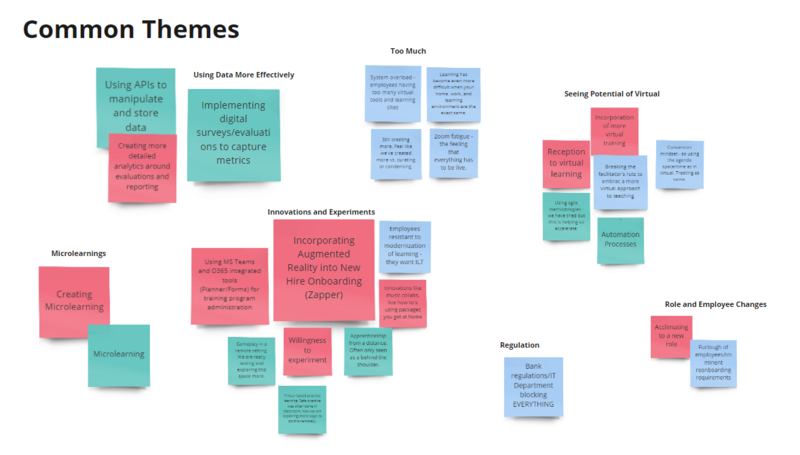
Once participants contributed their RBT, the group was directed to read one another’s responses and look for common themes. We used a blank space next to the board that had divided the rose, bud, and thorn responses to regroup and cluster based on similarities (affinity clustering). During this process several large themes emerged and were broken into smaller themes as the activity continued. For example, one big theme identified as virtual and new was later broken down into three different clusters: innovations and experiments, seeing potential of virtual, and too much.

Once participants contributed their RBT, the group was directed to read one another’s responses and look for common themes. We used a blank space next to the board that had divided the rose, bud, and thorn responses to regroup and cluster based on similarities (affinity clustering). During this process several large themes emerged and were broken into smaller themes as the activity continued. For example, one big theme identified as virtual and new was later broken down into three different clusters: innovations and experiments, seeing potential of virtual, and too much.

Content

Depending on time, groups could choose to devote more time to regrouping and organizing themes and characteristics, dive deeper on challenges and how to reframe them, or synthesize the findings to prioritize next steps or where to focus efforts first.

Depending on time, groups could choose to devote more time to regrouping and organizing themes and characteristics, dive deeper on challenges and how to reframe them, or synthesize the findings to prioritize next steps or where to focus efforts first.

Content

An interesting conversation involved the use of augmented reality (AR). One participant requested support with implementing AR or VR (virtual reality) into the workplace, and another shared her recent success with AR. After participating in the TK ScavengAR Hunt, she shared she had an aha moment to reinvent her onboarding program. She dumped the click-through content and replaced by using a simple design with Zappar scan codes. They placed Zappar codes along the manufacturing line, and new hires learned about various equipment and functions by solving clues to get to the next location.
An interesting conversation involved the use of augmented reality (AR). One participant requested support with implementing AR or VR (virtual reality) into the workplace, and another shared her recent success with AR. After participating in the TK ScavengAR Hunt, she shared she had an aha moment to reinvent her onboarding program. She dumped the click-through content and replaced by using a simple design with Zappar scan codes. They placed Zappar codes along the manufacturing line, and new hires learned about various equipment and functions by solving clues to get to the next location.

TK CONNECT: Reflections in a Virtual Collaborative Space-TK Connect One Tiny Action.png

One Tiny Action

Content

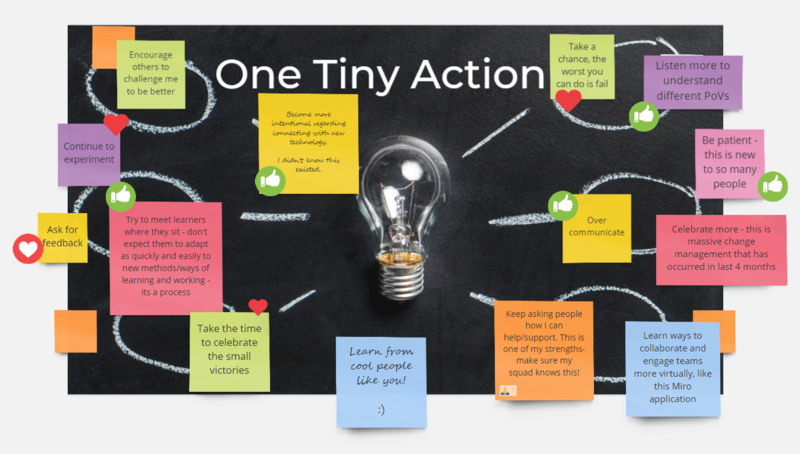
We wrapped the session by asking participants to share one tiny action (OTA) they could implement right away. The group’s takeaways and action steps were, for the most part, not technology related. Instead, they were filled with interpersonal skills. Some of the OTAs shared were:

We wrapped the session by asking participants to share one tiny action (OTA) they could implement right away. The group’s takeaways and action steps were, for the most part, not technology related. Instead, they were filled with interpersonal skills. Some of the OTAs shared were:

  • Content

    Listen more to understand different point of views

    Listen more to understand different point of views

  • Content

    Be patient

    Be patient

  • Content

    Overcommunicate

    Overcommunicate

  • Content

    Keep asking people how to help or support them

    Keep asking people how to help or support them

  • Content

    Continue to experiment

    Continue to experiment

  • Content

    Encourage others to challenge me

    Encourage others to challenge me

  • Content

    Ask for feedback

    Ask for feedback

  • Content

    Meet learners where they sit. Don’t expect rapid change. Learning is a process

    Meet learners where they sit. Don’t expect rapid change. Learning is a process

  • Content

    Take time to celebrate the small victories

    Take time to celebrate the small victories

  • Content

    Take a chance; the worst you can do is fail

    Take a chance; the worst you can do is fail

  • Content

    Learn ways to collaborate and engage teams virtually, like this Miro application

    Learn ways to collaborate and engage teams virtually, like this Miro application

Content

Khadija Moore commented, “I liked the Miro engagement and what others shared in the one tiny action workspace. I put some thumbs up icons by quite a few sticky notes \[with ideas\] I felt \[were\] timely!” Fittingly, this group committed to themselves and each other to prioritize skills and mindsets that would nurture their communities as we continue working through the massive change the world is experiencing. I look forward to reconnecting with TK attendees again soon to celebrate their continued successes in navigating a disruptive year.

Khadija Moore commented, “I liked the Miro engagement and what others shared in the one tiny action workspace. I put some thumbs up icons by quite a few sticky notes \[with ideas\] I felt \[were\] timely!” Fittingly, this group committed to themselves and each other to prioritize skills and mindsets that would nurture their communities as we continue working through the massive change the world is experiencing. I look forward to reconnecting with TK attendees again soon to celebrate their continued successes in navigating a disruptive year.

Content

As Coretta Scott King said, “The greatness of a community is most accurately measured by the compassionate actions of its members.”

As Coretta Scott King said, “The greatness of a community is most accurately measured by the compassionate actions of its members.”

Content

Please reach out to me directly at [email protected] if you’re interested in learning more about TechKnowledge or additional details on this content.

Please reach out to me directly at [email protected] if you’re interested in learning more about TechKnowledge or additional details on this content.

You've Reached ATD Member-only Content

Become an ATD member to continue

Already a member?Sign In


Copyright © 2026 ATD

ASTD changed its name to ATD to meet the growing needs of a dynamic, global profession.

Terms of UsePrivacy NoticeCookie Policy