
ATD Blog
Transform Any Team of Experts Into an Expert Team: Part 1
Thu Jan 18 2018

Content
The global and technological nature of markets has caused organizations to increasingly struggle with staying competitive. To achieve this, they need to work more effectively, efficiently, or innovatively in carrying out complex cognitive work.
The global and technological nature of markets has caused organizations to increasingly struggle with staying competitive. To achieve this, they need to work more effectively, efficiently, or innovatively in carrying out complex cognitive work.
Content
To accomplish complex work successfully, organizations rely on interdisciplinary and cross-functional high performing teams, explains research in a 2001 Academy of Management Journal article . Examples of such teams can be found in all kinds of industries, such as healthcare, product innovation, or education.
To accomplish complex work successfully, organizations rely on interdisciplinary and cross-functional high performing teams, explains research in a 2001 Academy of Management Journal article. Examples of such teams can be found in all kinds of industries, such as healthcare, product innovation, or education.
Content
But a team of experts isn’t the same thing as an expert team just as a football team of superstars isn’t necessarily a super team. The question is: What does it take to ensure that a team of experts isn’t just ordinary? As Delise and colleagues point out in their 2010 Performance Improvement Quarterly article , there’s a serious lack of understanding of what the most effective strategy is to support these oh so needed teams in enhancing their performance.
But a team of experts isn’t the same thing as an expert team just as a football team of superstars isn’t necessarily a super team. The question is: What does it take to ensure that a team of experts isn’t just ordinary? As Delise and colleagues point out in their 2010 Performance Improvement Quarterly article, there’s a serious lack of understanding of what the most effective strategy is to support these oh so needed teams in enhancing their performance.
Content
There are many aspects to be considered, and this blog attempts to tease some of them out. Particularly, it discusses the theoretical background of the matter, while a follow-up blog will provide concrete examples that you can use as a just-in-time performance support tool.
There are many aspects to be considered, and this blog attempts to tease some of them out. Particularly, it discusses the theoretical background of the matter, while a follow-up blog will provide concrete examples that you can use as a just-in-time performance support tool.
Content
Let’s start by discussing what we mean by an “expert team.”
Let’s start by discussing what we mean by an “expert team.”
What Is an Expert Team?
Content
According to S. Tancig in Interdisciplinary Description of Complex Systems, an expert team is a “group of interdependent team members with a high level of task-related expertise and the mastering of team processes.”
According to S. Tancig in Interdisciplinary Description of Complex Systems, an expert team is a “group of interdependent team members with a high level of task-related expertise and the mastering of team processes.”
Content
The idea of an expert team is that, first the skills or expertise of each individual team member can be leveraged in order to reach a common goal, such as a task or a project, which then typically contributes to a higher-order goal like “staying ahead of the competition.” However, as Burke and co-authors point out in a 2004 article in Quality & Safety Health Care , even when you put the best people together (and usually that’s not even the case as teams generally consist of members with a variety of expertise levels), individual “experts don’t necessarily make an expert team.”
The idea of an expert team is that, first the skills or expertise of each individual team member can be leveraged in order to reach a common goal, such as a task or a project, which then typically contributes to a higher-order goal like “staying ahead of the competition.” However, as Burke and co-authors point out in a 2004 article in Quality & Safety Health Care, even when you put the best people together (and usually that’s not even the case as teams generally consist of members with a variety of expertise levels), individual “experts don’t necessarily make an expert team.”
Content
Research from Joe Fransen and colleagues focuses on learning teams. (However, in the light of this blog it’s worthwhile to discuss their research because through their explanation of the differences between learning teams and work teams, we can get some good insights on what constitutes an expert team. The authors explain that work teams are effective when they “successfully use their distributed expertise to effectively and efficiently perform as a team to successfully complete a given task.” Although in work teams, learning may occur as a by-product of collaboration, the quality of the product is the primary goal. They also add that team effectiveness in a workplace context isn’t only expressed by the quality of the product but also by aspects such as “speed, performance, accuracy, and inventiveness, as well as attitudinal and behavioural indicators.” Compared to learning teams, effective (or expert) work teams are thus defined in a broader sense—both in terms of quality of the outcomes in relation to organisational standards as well as satisfaction of individual team members’ needs.
Research from Joe Fransen and colleagues focuses on learning teams. (However, in the light of this blog it’s worthwhile to discuss their research because through their explanation of the differences between learning teams and work teams, we can get some good insights on what constitutes an expert team. The authors explain that work teams are effective when they “successfully use their distributed expertise to effectively and efficiently perform as a team to successfully complete a given task.” Although in work teams, learning may occur as a by-product of collaboration, the quality of the product is the primary goal. They also add that team effectiveness in a workplace context isn’t only expressed by the quality of the product but also by aspects such as “speed, performance, accuracy, and inventiveness, as well as attitudinal and behavioural indicators.” Compared to learning teams, effective (or expert) work teams are thus defined in a broader sense—both in terms of quality of the outcomes in relation to organisational standards as well as satisfaction of individual team members’ needs.
Content
In order to develop as an expert team, you need more than a group of expert individuals. This is often visible in soccer, where team owners buy lots of top players for astronomical salaries, but the side doesn’t function as an effective team.
In order to develop as an expert team, you need more than a group of expert individuals. This is often visible in soccer, where team owners buy lots of top players for astronomical salaries, but the side doesn’t function as an effective team.
Content
So, what do you need to support a team of experts to develop into an expert team?
So, what do you need to support a team of experts to develop into an expert team?
How to Turn Any Team Into an Expert Team
Content
Although individual task-work competencies and skills are the foundation of expert team performance, they aren’t sufficient, explains the Quality & Safety Health Care article. Burke and co-authors add that you also need to look at teamwork competencies and skills. Teams must, first, have the competencies to “enable them to communicate and coordinate with team members and, second, must carry out complex tasks that require smooth integration of each team members’ competencies,” notes Delise and colleagues. In order to achieve this, teams need necessary information about one another’s competencies and need to build mutual trust. This doesn’t just happen overnight, it takes time to develop as an expert team.
Although individual task-work competencies and skills are the foundation of expert team performance, they aren’t sufficient, explains the Quality & Safety Health Care article. Burke and co-authors add that you also need to look at teamwork competencies and skills. Teams must, first, have the competencies to “enable them to communicate and coordinate with team members and, second, must carry out complex tasks that require smooth integration of each team members’ competencies,” notes Delise and colleagues. In order to achieve this, teams need necessary information about one another’s competencies and need to build mutual trust. This doesn’t just happen overnight, it takes time to develop as an expert team.
Content
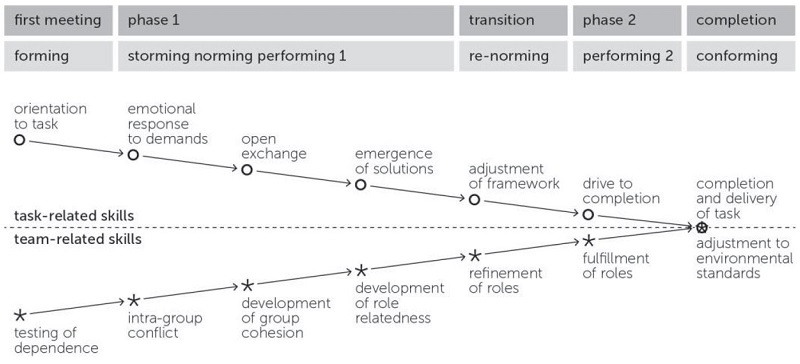
Fortunately, research from Fransen, Weinberger, and Kirschner presents various models of team development. The Team Evolution and Maturation (TEAM) model from Morgan, Salas, and Glickman nicely combines various existing theories into a general and useful team development model (see Figure 1). While this model describes a set of developmental stages for teams, teams don’t necessarily need to go through all stages. It depends, for example, on past experiences of the team and its members. The figure also illustrates that the optimum level of performance (hence, when the level of ‘expert team’ has been achieved) is reached when the two paths converge.
Fortunately, research from Fransen, Weinberger, and Kirschner presents various models of team development. The Team Evolution and Maturation (TEAM) model from Morgan, Salas, and Glickman nicely combines various existing theories into a general and useful team development model (see Figure 1). While this model describes a set of developmental stages for teams, teams don’t necessarily need to go through all stages. It depends, for example, on past experiences of the team and its members. The figure also illustrates that the optimum level of performance (hence, when the level of ‘expert team’ has been achieved) is reached when the two paths converge.
Content
Figure I. Essentials of the TEAM Model
Figure I. Essentials of the TEAM Model
Content
Source: Team Effectiveness and Team Development in CSCL, Fransen et. al
Source: Team Effectiveness and Team Development in CSCL, Fransen et. al
Content
Next, when developing teams into expert teams, we also need to take various variables that influence work teams’ effectiveness into account. Fransen and colleagues discuss the Big Five in Teamwork from Salas and colleagues, which is based on a meta-analysis of research on team effectiveness in organizational settings. The table below explains the five factors and their three supporting and coordinating mechanisms briefly.
Next, when developing teams into expert teams, we also need to take various variables that influence work teams’ effectiveness into account. Fransen and colleagues discuss the Big Five in Teamwork from Salas and colleagues, which is based on a meta-analysis of research on team effectiveness in organizational settings. The table below explains the five factors and their three supporting and coordinating mechanisms briefly.
Content
Table 1: Big Five Factors
Table 1: Big Five Factors
Content | Content |
Content Factors Factors | Content Brief Explanation Brief Explanation |
Content Team Orientation Team Orientation | Content This refers to a preference to work with others and a tendency to enhance individual performance through coordination of one’s actions with other members while performing group tasks. It facilitates decision-making, cooperation, and coordination, which in turns contributes to increases team performance. This refers to a preference to work with others and a tendency to enhance individual performance through coordination of one’s actions with other members while performing group tasks. It facilitates decision-making, cooperation, and coordination, which in turns contributes to increases team performance. |
Content Team Leadership Team Leadership | Content The effects of team leadership depend on the type of team and/or task. Overall, teams prefer democratic leadership. When groups work with distributed leadership, emergent leadership is important. This refers to a shift in leadership depending on the stage that the team is in. The effects of team leadership depend on the type of team and/or task. Overall, teams prefer democratic leadership. When groups work with distributed leadership, emergent leadership is important. This refers to a shift in leadership depending on the stage that the team is in. |
Content Mutual Performance Monitoring Mutual Performance Monitoring | Content This factor refers to team members keeping track of one another’s work while carrying out one’s own work to ensure that all is running as expected. The more complex a task, the more important mutual performance monitoring will be. It requires a shared understanding of task and team responsibilities. This factor refers to team members keeping track of one another’s work while carrying out one’s own work to ensure that all is running as expected. The more complex a task, the more important mutual performance monitoring will be. It requires a shared understanding of task and team responsibilities. |
Content Back-Up Behavior Back-Up Behavior | Content This is the ability to anticipate other team members’ needs through accurate knowledge of their responsibilities and also to shift the workload mong members to achieve balance during periods of high pressure. It is strongly related to shared mental models and mutual performance monitoring. It can be provided through feedback, assisting a team member, or completing a sub task for a team member. This is the ability to anticipate other team members’ needs through accurate knowledge of their responsibilities and also to shift the workload mong members to achieve balance during periods of high pressure. It is strongly related to shared mental models and mutual performance monitoring. It can be provided through feedback, assisting a team member, or completing a sub task for a team member. |
Content Adaptability Adaptability | Content This refers to the ability of a person or group to adjust strategies through back-up behaviour and reallocation of intrateam resources. It can also refer to change a course of action in response to changing conditions. Adaptability requires both mutual performance monitoring and shared mental models. This refers to the ability of a person or group to adjust strategies through back-up behaviour and reallocation of intrateam resources. It can also refer to change a course of action in response to changing conditions. Adaptability requires both mutual performance monitoring and shared mental models. |
Content Supporting and Coordinating Mechanisms Supporting and Coordinating Mechanisms | |
Content Shared Mental Models Shared Mental Models | Content This refers to both team-related and task-related mental models. The first is about awareness of the team functioning and expected behaviours, the second is about information on the materials and strategies needed to successfully carry out the mutual task. The accuracy of the mental models is more critical than the similarity of the models. High-quality planning in the early stages of the team work is required. This refers to both team-related and task-related mental models. The first is about awareness of the team functioning and expected behaviours, the second is about information on the materials and strategies needed to successfully carry out the mutual task. The accuracy of the mental models is more critical than the similarity of the models. High-quality planning in the early stages of the team work is required. |
Content Mutual Trust Mutual Trust | Content This implies the shared perception that each team member will perform particular actions important to all members and will protect the rights and interests of team members. Trust is a multidimensional construct and it seems to develop through stages building upon each other. This implies the shared perception that each team member will perform particular actions important to all members and will protect the rights and interests of team members. Trust is a multidimensional construct and it seems to develop through stages building upon each other. |
Content Closed-Loop Communication Closed-Loop Communication | Content This is the ability to exchange clear, concise information, acknowledge the receipt of that information, and confirm its correct understanding. This type of communication facilitates teams in updating their shared mental models engaging in activities regarding task execution, monitoring the process, and adapting to changing conditions. This is the ability to exchange clear, concise information, acknowledge the receipt of that information, and confirm its correct understanding. This type of communication facilitates teams in updating their shared mental models engaging in activities regarding task execution, monitoring the process, and adapting to changing conditions. |
Content Source: Small Group Research, Salas et al. Source: Small Group Research, Salas et al. |
Content
It’s obvious that the factors that influence team effectiveness involve very complex constructs, which is something to keep in mind when you’re involved in developing expert teams.
It’s obvious that the factors that influence team effectiveness involve very complex constructs, which is something to keep in mind when you’re involved in developing expert teams.
Content
What we’ve learned so far is that in order to develop expert teams, you need to take the development stages into account and also be aware of all the variables that influence team effectiveness. However, this still doesn’t tell us what exactly we need to do to support teams to get to an “expert” level. In other words, what kind of interventions or support do we need to provide?
What we’ve learned so far is that in order to develop expert teams, you need to take the development stages into account and also be aware of all the variables that influence team effectiveness. However, this still doesn’t tell us what exactly we need to do to support teams to get to an “expert” level. In other words, what kind of interventions or support do we need to provide?
Content
Delise and colleagues conducted a meta-analysis, comparing 23 studies (which is a small sample size and, therefore, all results need to be interpreted with caution) on the effects of learning and performance interventions on team outcomes. They call it “team training,” which refers to any “planned effort designed to improve team performance by assisting individuals in the acquisition of new information, skills, and attitudes essential to effective performance in a team environment.”
Delise and colleagues conducted a meta-analysis, comparing 23 studies (which is a small sample size and, therefore, all results need to be interpreted with caution) on the effects of learning and performance interventions on team outcomes. They call it “team training,” which refers to any “planned effort designed to improve team performance by assisting individuals in the acquisition of new information, skills, and attitudes essential to effective performance in a team environment.”
Content
Overall, their findings suggest that well-planned and well-implemented learning experiences are highly associated with team effectiveness and that they’re effective in general for all kinds of teams in all kinds of contexts. In addition, there were no differences in effectiveness across lab and field studies. Results also indicated that these structured learning experiences are as effective for existing teams as for ad hoc teams, which are teams that are put together for a specific, temporary purpose.
Overall, their findings suggest that well-planned and well-implemented learning experiences are highly associated with team effectiveness and that they’re effective in general for all kinds of teams in all kinds of contexts. In addition, there were no differences in effectiveness across lab and field studies. Results also indicated that these structured learning experiences are as effective for existing teams as for ad hoc teams, which are teams that are put together for a specific, temporary purpose.
Content
Unfortunately, the sample size of this meta study was too small to examine one potentially important moderator variable: the method of the learning intervention (the how ).
Unfortunately, the sample size of this meta study was too small to examine one potentially important moderator variable: the method of the learning intervention (the how).
Content
Because all authors agree that just waiting for something magical to happen in order to achieve expert level in teams won’t do the trick, it’s worthwhile to tease out what type of learning and performance interventions help to develop expert teams. This is exactly what we’ll do in our next blog.
Because all authors agree that just waiting for something magical to happen in order to achieve expert level in teams won’t do the trick, it’s worthwhile to tease out what type of learning and performance interventions help to develop expert teams. This is exactly what we’ll do in our next blog.
Further Reading
Content
Burke, C.S., Salas, E., Wilson-Donnelly, K., & Priest, H., (2004). How to turn a team of experts into an expert medical team: guidance from the aviation and military communities . Quality & Safety Health Care, 13 , i96-i104.
Burke, C.S., Salas, E., Wilson-Donnelly, K., & Priest, H., (2004). How to turn a team of experts into an expert medical team: guidance from the aviation and military communities. Quality & Safety Health Care, 13, i96-i104.
Content
Delise, L.A., Gorman, A., Brooks, A.M., Rentsch, J.R., & Steele-Johnson, D., (2010). The effects of team training on team outcomes: A meta-analysis. Performance Improvement Quarterly, 22 , 53-80.
Delise, L.A., Gorman, A., Brooks, A.M., Rentsch, J.R., & Steele-Johnson, D., (2010). The effects of team training on team outcomes: A meta-analysis. Performance Improvement Quarterly, 22, 53-80.
Content
Fransen, J., Weinberger, A., & Kirschner, P.A., (2013). Team effectiveness and team development in CSCL. Educational Psychologist, 48 , 9-24.
Fransen, J., Weinberger, A., & Kirschner, P.A., (2013). Team effectiveness and team development in CSCL. Educational Psychologist, 48, 9-24.
Content
Lovelace, K., Shapiro, D.L., & Weingart, L.R., (2001). Maximizing cross-functional new product teams’ innovativeness and constraint adherence: A conflict communications perspective. Academy of Management Journal, 44 , 779-793.
Lovelace, K., Shapiro, D.L., & Weingart, L.R., (2001). Maximizing cross-functional new product teams’ innovativeness and constraint adherence: A conflict communications perspective. Academy of Management Journal, 44, 779-793.
Content
Morgan, B.B., Salas, E., & Glickman, A.S., (1993). An analysis of team evolution and maturation . The Journal of General Psychology, 120 , 277-291.
Morgan, B.B., Salas, E., & Glickman, A.S., (1993). An analysis of team evolution and maturation. The Journal of General Psychology, 120, 277-291.
Content
Salas, E., Sims, D.E., & Burke, C.S., (2005). Is there a “Big Five” in teamwork? Small Group Research, 36 , 555-599.
Salas, E., Sims, D.E., & Burke, C.S., (2005). Is there a “Big Five” in teamwork? Small Group Research, 36, 555-599.
Content
Shibley, I.A., (2006). Interdisciplinary team teaching. Negotiating pedagogical differences. College Teaching, 54 , 271-271.
Shibley, I.A., (2006). Interdisciplinary team teaching. Negotiating pedagogical differences. College Teaching, 54, 271-271.
Content
Tancig, S., (2009). Expert team decision-making and problem-solving: development and learning . Interdisciplinary Description of Complex Systems, 7 , 106-116.
Tancig, S., (2009). Expert team decision-making and problem-solving: development and learning. Interdisciplinary Description of Complex Systems, 7, 106-116.