
ATD Blog
Unlocking Innovation: A Guide to Other Transaction Authorities (OTAs) for Federal Agencies
Fri Aug 09 2024

Content
The federal government is constantly seeking innovative solutions to complex challenges, from modernizing defense systems to improving public health outcomes. While traditional procurement methods are essential, they can sometimes be cumbersome and time-consuming. Enter Other Transaction Authorities (OTAs), a flexible and agile contracting tool that allows agencies to partner with non-traditional contractors and accelerate the development and deployment of cutting-edge technologies.
The federal government is constantly seeking innovative solutions to complex challenges, from modernizing defense systems to improving public health outcomes. While traditional procurement methods are essential, they can sometimes be cumbersome and time-consuming. Enter Other Transaction Authorities (OTAs), a flexible and agile contracting tool that allows agencies to partner with non-traditional contractors and accelerate the development and deployment of cutting-edge technologies.
What Are OTAs?
Content
OTAs are a special type of statutory authority that enable federal agencies to enter into agreements with small businesses, research institutions, universities, and commercial companies that may not generally do business with the government. Unlike traditional procurement contracts, OTAs are not bound by the strict regulations of the Federal Acquisition Regulation (FAR), FAR supplements, and Competition in Contracting Act (CICA). This flexibility allows agencies to tailor agreements to specific project needs, fostering a more collaborative and results-oriented approach.
OTAs are a special type of statutory authority that enable federal agencies to enter into agreements with small businesses, research institutions, universities, and commercial companies that may not generally do business with the government. Unlike traditional procurement contracts, OTAs are not bound by the strict regulations of the Federal Acquisition Regulation (FAR), FAR supplements, and Competition in Contracting Act (CICA). This flexibility allows agencies to tailor agreements to specific project needs, fostering a more collaborative and results-oriented approach.
Key Advantages of OTAs
Content
Flexibility: OTAs offer greater flexibility in terms of contract structure, intellectual property rights, and other terms and conditions. This allows agencies to tailor agreements to the unique needs of each project.
Flexibility: OTAs offer greater flexibility in terms of contract structure, intellectual property rights, and other terms and conditions. This allows agencies to tailor agreements to the unique needs of each project.
Content
Collaboration: OTAs encourage collaboration between government agencies, non-traditional contractors, and other stakeholders. This can lead to the development of more creative and effective solutions.
Collaboration: OTAs encourage collaboration between government agencies, non-traditional contractors, and other stakeholders. This can lead to the development of more creative and effective solutions.
Content
Access to Innovation: OTAs provide agencies with access to a wider range of innovative technologies and capabilities, often from companies that do not typically work with the government.
Access to Innovation: OTAs provide agencies with access to a wider range of innovative technologies and capabilities, often from companies that do not typically work with the government.
Which Agencies Have OTA Authority?
Content
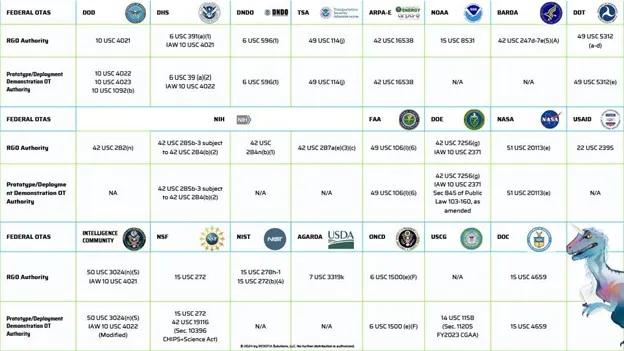
Several federal agencies have been granted OTA authority by Congress. The Department of Defense (DoD) is the most prominent user of OTAs, with authority to use them for research, prototyping, and production projects. Other agencies with OTA authority include the Department of Homeland Security, the Department of Health and Human Services, and the Department of Energy. A detailed breakdown of federal agencies with OTA authority can be found in the graphic below.
Several federal agencies have been granted OTA authority by Congress. The Department of Defense (DoD) is the most prominent user of OTAs, with authority to use them for research, prototyping, and production projects. Other agencies with OTA authority include the Department of Homeland Security, the Department of Health and Human Services, and the Department of Energy. A detailed breakdown of federal agencies with OTA authority can be found in the graphic below.
Understanding the Different OTA Statutes
Content
Each OTA statute has its own specific requirements and limitations. For example, the DoD's OTA authority is divided into these types:
Each OTA statute has its own specific requirements and limitations. For example, the DoD's OTA authority is divided into these types:
Content
Research OTs:
Research OTs:
Content
Used for basic, applied, and advanced research projects.
Used for basic, applied, and advanced research projects.
Content
Prototype, Demonstration/Deployment/Production OTs:
Prototype, Demonstration/Deployment/Production OTs:
Content
Used to develop prototypes of new technologies. In some statutes, this authority may also allow to produce limited quantities of a prototype or use it for operation testing and evaluation.
Used to develop prototypes of new technologies. In some statutes, this authority may also allow to produce limited quantities of a prototype or use it for operation testing and evaluation.
Content
It's essential for federal agencies to understand the specific requirements of each OTA statute to ensure compliance and maximize the benefits of this powerful tool.
It's essential for federal agencies to understand the specific requirements of each OTA statute to ensure compliance and maximize the benefits of this powerful tool.
How to Leverage OTAs Effectively
Content
To leverage OTAs effectively, federal agencies should consider the following best practices:
To leverage OTAs effectively, federal agencies should consider the following best practices:
Content
Early Engagement: Engage with potential industry partners early in the acquisition process to identify innovative solutions and tailor OTAs to specific project needs.
Early Engagement: Engage with potential industry partners early in the acquisition process to identify innovative solutions and tailor OTAs to specific project needs.
Content
Clearly Defined Objectives: Clearly define project objectives, milestones, and deliverables to ensure that all parties are on the same page and working toward the same goals.
Clearly Defined Objectives: Clearly define project objectives, milestones, and deliverables to ensure that all parties are on the same page and working toward the same goals.
Content
Streamlined Processes: Develop streamlined processes for OTA solicitation, evaluation, and award to minimize delays and maximize efficiency.
Streamlined Processes: Develop streamlined processes for OTA solicitation, evaluation, and award to minimize delays and maximize efficiency.
Content
Performance-Based Metrics: Use performance-based metrics to track progress and evaluate the success of OTA projects.
Performance-Based Metrics: Use performance-based metrics to track progress and evaluate the success of OTA projects.
Content
Collaboration and Communication: Foster a collaborative environment and maintain open communication with all stakeholders throughout the OTA process.
Collaboration and Communication: Foster a collaborative environment and maintain open communication with all stakeholders throughout the OTA process.
Content
By following these best practices, federal agencies can leverage OTAs to accelerate innovation, access cutting-edge technologies, and achieve their mission objectives.
By following these best practices, federal agencies can leverage OTAs to accelerate innovation, access cutting-edge technologies, and achieve their mission objectives.
The Future of OTAs
Content
As the pace of technological change continues to accelerate, OTAs will continue to play a vital role in federal acquisition. By providing a flexible and agile contracting tool, OTAs can help agencies stay ahead of the curve and deliver the innovative solutions needed to address the challenges of the 21st century and beyond.
As the pace of technological change continues to accelerate, OTAs will continue to play a vital role in federal acquisition. By providing a flexible and agile contracting tool, OTAs can help agencies stay ahead of the curve and deliver the innovative solutions needed to address the challenges of the 21st century and beyond.

Content
View Courses Recommended for You