
ATD Blog
Virtual Events: Engaged Participants vs. Disengaged Attendees
Thu Sep 17 2015

Content
Participants in online meetings, webinars, and virtual training events want and need them to be great experiences. But what do great experiences look like? The business buzzword answer is that it’s all about participant engagement—and for once the buzzword is on track.
Participants in online meetings, webinars, and virtual training events want and need them to be great experiences. But what do great experiences look like? The business buzzword answer is that it’s all about participant engagement—and for once the buzzword is on track.
Content
A great online meeting engages all participants, while still achieving the meeting’s objectives. A great webinar that gets information to stick engages participants as much as possible with a large audience. And a great training event engages learners so that they retain knowledge, gain new skills, and see the desired behavior changes and performance improvements.
A great online meeting engages all participants, while still achieving the meeting’s objectives. A great webinar that gets information to stick engages participants as much as possible with a large audience. And a great training event engages learners so that they retain knowledge, gain new skills, and see the desired behavior changes and performance improvements.
Content
Engagement in live online events looks essentially the same no matter what the context: meeting, webinar, or training event. Here’s a breakdown of the clear difference between an engaged “participant” and a disengaged “attendee”:
Engagement in live online events looks essentially the same no matter what the context: meeting, webinar, or training event. Here’s a breakdown of the clear difference between an engaged “participant” and a disengaged “attendee”:
Content
Engaged Participants:
Engaged Participants:
Content
Focused and attentive
Focused and attentive
Content
Active
Active
Content
Enthusiastic and eager
Enthusiastic and eager
Content
Spontaneous
Spontaneous
Content
Curious and inquisitive
Curious and inquisitive
Content
Ask questions
Ask questions
Content
Willing
Willing
Content
Disengaged Attendee:
Disengaged Attendee:
Content
Uninterested
Uninterested
Content
Passive
Passive
Content
Bored and frustrated
Bored and frustrated
Content
Reactive
Reactive
Content
Indifferent
Indifferent
Content
Goes through the motions
Goes through the motions
Content
Resistant
Resistant
Content
Put another way, meeting facilitators need to stop running their online meetings like a typical marketing webinar, where they read PowerPoint slides to a large, mostly passive audience, only allowing for a few questions if there’s time at the end. It doesn’t work.
Put another way, meeting facilitators need to stop running their online meetings like a typical marketing webinar, where they read PowerPoint slides to a large, mostly passive audience, only allowing for a few questions if there’s time at the end. It doesn’t work.
Content
Likewise, webinar facilitators need to stop assuming their webinars can serve as robust training programs. Such events have large audiences and don’t allow for collaboration, hands-on or other realistic practice, expert coaching, and so on—the interactions needed for robust training to take place. Facilitators are setting participants up for disappointment and failure if they expect anything more than knowledge-level learning from large-audience webinar events.
Likewise, webinar facilitators need to stop assuming their webinars can serve as robust training programs. Such events have large audiences and don’t allow for collaboration, hands-on or other realistic practice, expert coaching, and so on—the interactions needed for robust training to take place. Facilitators are setting participants up for disappointment and failure if they expect anything more than knowledge-level learning from large-audience webinar events.
Content
And if training event facilitators are expecting rich learning outcomes—changed behavior and improved performance—they need to design live online training in a way that enables such results. Some basic guidelines for more effective results includes:
And if training event facilitators are expecting rich learning outcomes—changed behavior and improved performance—they need to design live online training in a way that enables such results. Some basic guidelines for more effective results includes:
Content
limit the participants to a reasonable number (a maximum of 16 to 20)
limit the participants to a reasonable number (a maximum of 16 to 20)
Content
break out the audience into even smaller group activities
break out the audience into even smaller group activities
Content
engage via audio, chat, and whiteboarding.
engage via audio, chat, and whiteboarding.
Content
In other words, facilitators and designers need to think of the event in the same way as any other in-person training event.
In other words, facilitators and designers need to think of the event in the same way as any other in-person training event.
Content
Well-designed online activities—aligned with and in support of the event’s goals—are critical to maximizing engagement. They provide structure and purpose to interaction and collaboration, and keep facilitators from becoming captive to the features of the live online platform tool.
Well-designed online activities—aligned with and in support of the event’s goals—are critical to maximizing engagement. They provide structure and purpose to interaction and collaboration, and keep facilitators from becoming captive to the features of the live online platform tool.
Content
For instance, facilitators need to avoid using a poll just to break up what is otherwise a lecture-driven webinar or randomly asking a question in chat in the middle of an online training event. Otherwise, they are simply falling victim to “shiny object syndrome”—the “Ooooh! Aaah! That feature is nifty. I’ll use it!” response. Facilitators should not use a tool for the sake of using it. Rather, they should use it in support of the goals of the meeting, webinar, or training event.
For instance, facilitators need to avoid using a poll just to break up what is otherwise a lecture-driven webinar or randomly asking a question in chat in the middle of an online training event. Otherwise, they are simply falling victim to “shiny object syndrome”—the “Ooooh! Aaah! That feature is nifty. I’ll use it!” response. Facilitators should not use a tool for the sake of using it. Rather, they should use it in support of the goals of the meeting, webinar, or training event.
Content
Here are some general types of activities for use in live online events.
Here are some general types of activities for use in live online events.
Warm-Ups and Welcomes
Content
As with in-person meetings or classroom training events, participants need to prepare before they use the available tools. Welcome and warm-up activities are perfect for starting an online meeting, webinar, or training event. They ensure an on-time start, open the session with a purpose beyond asking participants to sit and listen, and help set the stage for interaction and collaboration. In addition, they function as early technical checks. What’s more, they help ensure successful communication process among the participants, the producer, and the facilitator once the event starts and content-focused activities need to begin. After all, teaching participants how to use the chat feature only distracts all involved when reviewing the meeting agenda or the training objectives.
As with in-person meetings or classroom training events, participants need to prepare before they use the available tools. Welcome and warm-up activities are perfect for starting an online meeting, webinar, or training event. They ensure an on-time start, open the session with a purpose beyond asking participants to sit and listen, and help set the stage for interaction and collaboration. In addition, they function as early technical checks. What’s more, they help ensure successful communication process among the participants, the producer, and the facilitator once the event starts and content-focused activities need to begin. After all, teaching participants how to use the chat feature only distracts all involved when reviewing the meeting agenda or the training objectives.
Ice Breakers
Content
After a Warm-Up/Welcome activity, ice breakers are vital to creating an environment in which participants feel at ease enough to share opinions, ask questions, and learn something new. Because the online tools are still new for many people (even after a solid welcome or warm-up activity), participants need an additional way to connect with others who may be remotely connected and geographically dispersed. Ice breakers in an online event ensure that the participants are truly comfortable, engaged, and ready to interact. And ice breakers are especially import¬ant for anyone who joined the program late; they now have a second chance to learn some of the tools and get involved.
After a Warm-Up/Welcome activity, ice breakers are vital to creating an environment in which participants feel at ease enough to share opinions, ask questions, and learn something new. Because the online tools are still new for many people (even after a solid welcome or warm-up activity), participants need an additional way to connect with others who may be remotely connected and geographically dispersed. Ice breakers in an online event ensure that the participants are truly comfortable, engaged, and ready to interact. And ice breakers are especially import¬ant for anyone who joined the program late; they now have a second chance to learn some of the tools and get involved.
Content-Centered Activities
Content
Whether you are facilitating an internal or external virtual meeting, a large-audience webinar, or a more intensive virtual training event, great activities are a key to interactivity and engagement. The goal is to convey information in a way that will stick or practicing new skills, such activities can be the most memorable and impactful segment of the event. They should also be the centerpiece of the meeting’s agenda or the webinar’s or virtual training’s instructional design.
Whether you are facilitating an internal or external virtual meeting, a large-audience webinar, or a more intensive virtual training event, great activities are a key to interactivity and engagement. The goal is to convey information in a way that will stick or practicing new skills, such activities can be the most memorable and impactful segment of the event. They should also be the centerpiece of the meeting’s agenda or the webinar’s or virtual training’s instructional design.
Closers
Content
One of the biggest mistakes made in an online event is failing to leave enough time to properly bring the session to a close with a memorable wrap-up activity. Planning a closing activity for the online event will leave a lasting impression, one that ensures that the time spent in the event was well worth it. Closing activities engage participants to contribute their own thoughts and ideas on how they’ll take the knowledge and skills learned in the online event into their own environments.
One of the biggest mistakes made in an online event is failing to leave enough time to properly bring the session to a close with a memorable wrap-up activity. Planning a closing activity for the online event will leave a lasting impression, one that ensures that the time spent in the event was well worth it. Closing activities engage participants to contribute their own thoughts and ideas on how they’ll take the knowledge and skills learned in the online event into their own environments.
Celebrations
Content
Recognizing important milestones, or celebrating holidays and birthdays provide themed opportunities to throw “virtual celebrations.” Such activities can inspire online participants and make them feel honored to have been part of building and maintaining a virtual team. Enjoy, create, and celebrate!
Recognizing important milestones, or celebrating holidays and birthdays provide themed opportunities to throw “virtual celebrations.” Such activities can inspire online participants and make them feel honored to have been part of building and maintaining a virtual team. Enjoy, create, and celebrate!
Content
**
**
Content
**
**
Content
Editor’s Note: This post is adapted from the new book by Kassy LaBorie and Tom Stone, Interact and Engage! 50+ Activities for Virtual Training, Meetings, and Webinars . Check it out for more examples of activities that have proven to increase engagement and results, as well as additional virtual classroom, meeting, and webinar tips. Click here for a free chapter of this book.
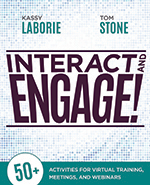
Editor’s Note: This post is adapted from the new book by Kassy LaBorie and Tom Stone, Interact and Engage! 50+ Activities for Virtual Training, Meetings, and Webinars. Check it out for more examples of activities that have proven to increase engagement and results, as well as additional virtual classroom, meeting, and webinar tips. Click here for a free chapter of this book.
Content