
ATD Blog
What to Review Before Purchasing AI HR Software: 6 Key Challenges
Content
Here are six AI challenges to review before choosing HR software and shares steps and vendor questions to support safer decisions.
Here are six AI challenges to review before choosing HR software and shares steps and vendor questions to support safer decisions.
Tue Mar 17 2026

Brought to you by

Content
According to recent HR technology trends data , more than half of HR professionals already use AI features, with adoption strongest among large organizations managing complex workflows. Buyers increasingly expect AI capabilities to expand, and many view them as a deciding factor in new software investments.
According to recent HR technology trends data, more than half of HR professionals already use AI features, with adoption strongest among large organizations managing complex workflows. Buyers increasingly expect AI capabilities to expand, and many view them as a deciding factor in new software investments.
Content
AI can support efficiency and decision‑making, but it also introduces challenges tied to skills, fairness, privacy, data quality, and cost. The article outlines six AI challenges to review before choosing HR software and shares steps and vendor questions to support safer decisions.
AI can support efficiency and decision‑making, but it also introduces challenges tied to skills, fairness, privacy, data quality, and cost. The article outlines six AI challenges to review before choosing HR software and shares steps and vendor questions to support safer decisions.
1. AI Literacy and Adoption Readiness
Content
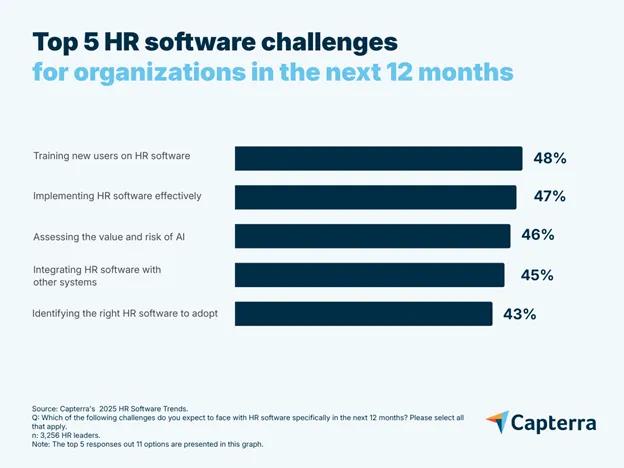
Having sufficient AI skills on staff is the biggest HR software challenge. Without strong AI literacy, teams may misunderstand model outputs, rely too heavily on automated recommendations, or configure workflows that affect candidates or employees. Teams need enough fluency to know when to trust AI, when to override it, and how to monitor it over time.
Having sufficient AI skills on staff is the biggest HR software challenge. Without strong AI literacy, teams may misunderstand model outputs, rely too heavily on automated recommendations, or configure workflows that affect candidates or employees. Teams need enough fluency to know when to trust AI, when to override it, and how to monitor it over time.
Content
Solutions include:
Solutions include:
Content
Offer training on AI basics, feature‑level usage, and ethics.
Offer training on AI basics, feature‑level usage, and ethics.
Content
Create guidelines that define when human review is required.
Create guidelines that define when human review is required.
Content
Assign data owners to oversee how AI tools interact with HR datasets.
Assign data owners to oversee how AI tools interact with HR datasets.
Content
Key vendor questions:
Key vendor questions:
Content
What training resources do you offer?
What training resources do you offer?
Content
How do you help users interpret and validate AI recommendations?
How do you help users interpret and validate AI recommendations?
2. Data Requirements and Data Quality
Content
AI models rely on complete and consistent information to work effectively. When HR records contain gaps, inconsistent formats, or outdated fields, the system cannot interpret patterns accurately. As a result, AI may generate unreliable predictions or recommendations.
AI models rely on complete and consistent information to work effectively. When HR records contain gaps, inconsistent formats, or outdated fields, the system cannot interpret patterns accurately. As a result, AI may generate unreliable predictions or recommendations.
Content
Recommended steps:
Recommended steps:
Content
Audit records for gaps such as inconsistent job titles or duplicated profiles.
Audit records for gaps such as inconsistent job titles or duplicated profiles.
Content
Confirm which datasets the AI requires.
Confirm which datasets the AI requires.
Content
Review how the vendor manages data cleansing and missing values.
Review how the vendor manages data cleansing and missing values.
Content
Key vendor questions:
Key vendor questions:
Content
What data does your AI depend on?
What data does your AI depend on?
Content
How does the system handle inconsistent or incomplete information?
How does the system handle inconsistent or incomplete information?
3. Bias, Fairness, and Explainability
Content
AI trained on historical patterns may unintentionally reinforce bias tied to geography, education, or career history. This can lead to legal exposure, unfair hiring patterns, reduced diversity, and lower‑quality decisions.
AI trained on historical patterns may unintentionally reinforce bias tied to geography, education, or career history. This can lead to legal exposure, unfair hiring patterns, reduced diversity, and lower‑quality decisions.
Content
Internal safeguards:
Internal safeguards:
Content
Use dashboards that track funnel diversity.
Use dashboards that track funnel diversity.
Content
Require human review of automated decisions.
Require human review of automated decisions.
Content
Maintain alternate pathways to prevent qualified candidates from being filtered out.
Maintain alternate pathways to prevent qualified candidates from being filtered out.
Content
Key vendor questions:
Key vendor questions:
Content
How do you audit models for bias?
How do you audit models for bias?
Content
Can we review model logic?
Can we review model logic?
Content
Are fairness thresholds configurable?
Are fairness thresholds configurable?
4. Data Privacy and Regulatory Compliance
Content
AI features often require access to sensitive information such as compensation history, performance data, or location. Because privacy regulations vary widely across regions, organizations must ensure AI tools comply with local requirements and protect individual data rights.
AI features often require access to sensitive information such as compensation history, performance data, or location. Because privacy regulations vary widely across regions, organizations must ensure AI tools comply with local requirements and protect individual data rights.
Content
Recommended actions:
Recommended actions:
Content
Involve legal and IT before enabling AI features.
Involve legal and IT before enabling AI features.
Content
Provide transparent disclosures about how data is used.
Provide transparent disclosures about how data is used.
Content
Conduct privacy impact assessments for new AI capabilities.
Conduct privacy impact assessments for new AI capabilities.
Content
Key vendor questions:
Key vendor questions:
Content
Which regulations does your AI comply with?
Which regulations does your AI comply with?
Content
What encryption and access controls are included?
What encryption and access controls are included?
5. Integration, Data Consistency, and Context Gaps
Content
Organizations often use multiple HR tools that don’t share information consistently. Even when data is accurate, AI may lack essential context if systems use different data structures or sync infrequently.
Organizations often use multiple HR tools that don’t share information consistently. Even when data is accurate, AI may lack essential context if systems use different data structures or sync infrequently.
Content
Suggested mitigation:
Suggested mitigation:
Content
Pilot AI features in one function before scaling.
Pilot AI features in one function before scaling.
Content
Validate data flows during implementation.
Validate data flows during implementation.
Content
Share AI‑generated insights across HR processes.
Share AI‑generated insights across HR processes.
Content
Key vendor questions:
Key vendor questions:
Content
Which integrations are native?
Which integrations are native?
Content
How is sync accuracy monitored?
How is sync accuracy monitored?
Content
How does the system handle data conflicts?
How does the system handle data conflicts?
6. Cost, Complexity, and Contract Constraints
Content
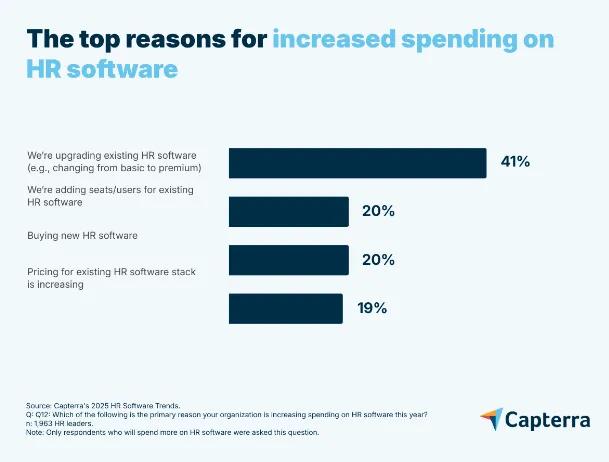
HR professionals who are increasing their HR software budgets cite upgrading existing systems for premium features, such as AI, as the primary reason. AI features may appear cost‑effective initially, but can lead to additional expenses for licensing, implementation, integrations, and training.
HR professionals who are increasing their HR software budgets cite upgrading existing systems for premium features, such as AI, as the primary reason. AI features may appear cost‑effective initially, but can lead to additional expenses for licensing, implementation, integrations, and training.
Content
Best practices:
Best practices:
Content
Model total cost of ownership over one to three years.
Model total cost of ownership over one to three years.
Content
Review renewal terms, SLAs, data ownership, and exit clauses.
Review renewal terms, SLAs, data ownership, and exit clauses.
Content
Involve HR, IT, legal, and finance early.
Involve HR, IT, legal, and finance early.
Content
Key vendor questions:
Key vendor questions:
Content
Can pricing scale with team size or usage?
Can pricing scale with team size or usage?
Content
Are future increases capped?
Are future increases capped?
Content
What data export options exist?
What data export options exist?
Content
If you would like a free personalized consultation with a specialized HR software advisor to find the best HR software with AI features for your business, you can connect with a Capterra Software Advisor here.
If you would like a free personalized consultation with a specialized HR software advisor to find the best HR software with AI features for your business, you can connect with a Capterra Software Advisor here.